Arizona Weekend Getaways for RVers: 10 Base Camps Worth Two Nights
A 35-foot fifth wheel is sitting in a Mesa driveway with a free weekend in front of it, and the list of the best weekend getaways in Arizona open on the phone ends every entry the same way: a resort, a boutique hotel, a vacation rental with a hot tub. Not one of them has a place to park it. That's the gap this list fills. Every Arizona weekend getaway below is a named campground that takes an RV, open all year, with the one road or length rule that decides whether yours goes.
Arizona is a state where two hours of driving changes the elevation by a mile and the weekend by a season. That's why weekend trips in Arizona work better than almost anywhere: the same Friday afternoon can end at a lake with the London Bridge over it or a snowbank at 7,000 feet. From Phoenix or Tucson, the ten base camps here are Sedona from Dead Horse Ranch, Prescott and the Granite Dells, the South Rim from Mather Campground, Flagstaff, Page and Lake Powell, Lake Havasu State Park, Tucson from Catalina State Park, Kartchner Caverns, Patagonia Lake, and Organ Pipe. Most of the famous places to visit in Arizona are on it. So are two you've never heard of.
If you'd rather see the whole state in one long swing, our full Arizona winter route from Phoenix to Quartzsite is built for exactly that. This article is for the other trip: two nights, one campground, home by Sunday dinner.
How These Ten Were Picked (and Why Every One Takes an RV)
Three rules, and they're strict. Every base camp on this list is open year-round. Every entry ends with the RV answer: the pull-through length, the hookups or lack of them, the road you don't take. And six of the ten sit low and warm, under 3,000 feet, because this is a list for the months when the rest of the country is scraping windshields. The two cold ones are on it on purpose. One for the snow, one for a rim with nobody on it.
Length is the thing that trips people. A campground's limit and a scenic road's limit are different numbers, and the road's usually bites first. Our guide to RV size limits at Yellowstone explains how those rules get written and why they count your trailer. The same logic runs through every entry here.
Dogs come too. The Arizona state parks on this list take a leashed dog on the trail and in the campground. The national park units have their own rules, and each entry says what they are. For the federal side more broadly, our guide to dogs in national parks covers the pattern.
Phoenix and Tucson both work as a starting point. Half the list is closer to one, half to the other, and the section near the bottom sorts them.
1. Sedona and the Verde Valley, from Dead Horse Ranch State Park
A copper mine on a hillside built this valley. Jerome dug the ore, Clarkdale smelted it, and a railroad hauled it out through a canyon no road has ever reached. The mine is gone. The train still runs, four hours into that roadless canyon and back, past cliff ruins and bald eagles.
The red rock is twenty minutes up the road. Sedona at first light, when the cliffs go orange before the parking lots fill, is what a Sedona weekend getaway is for. Sunrise there, the train from Clarkdale midday, Jerome in the afternoon, where the streets tilt so hard the old jail slid downhill. Then back to a base camp on the Verde River with lagoons, cottonwoods and a heron or two, where the crowds never make it.
Dead Horse Ranch State Park in Cottonwood is the RV answer, and it's a generous one: pull-through sites that take truck-and-trailer combinations up to 65 feet, most with water and 30/50 amp, open all year. If you'd rather sleep in town, Rancho Sedona on Oak Creek takes RVs to 45 feet and is walkable to uptown, but it fills on weekends. Plug in through a surge protector at either; a long feeder run and a full park of heat pumps will sag the voltage. Sedona itself, trailheads and all, fills a Sedona weekend on its own. This entry is the version you can do from a lawn chair by the river.
2. Prescott and the Granite Dells
Prescott was Arizona's territorial capital before Phoenix was a town, and the courthouse square still looks like it knows that. The saloon row across from it, Whiskey Row, burned to the ground in 1900 and was rebuilt in brick while the bars kept serving from the street. Just north of downtown, the Granite Dells are boulders more than a billion years old, weathered into a maze of domes and slots that a reservoir now fills halfway up.
The weekend is the water. Kayak into the Dells from Watson Lake in the morning, when the granite is pink and the lake is glass, and you'll paddle through channels barely wider than the boat. Walk the lakeshore trail after. Have dinner on Whiskey Row and listen to somebody play badly in a bar that's been open since the fire.
Point of Rocks RV Campground is the base camp, a full-hookup private park inside the Dells with its own trail from the sites down to Watson Lake Park, open all year. Prescott sits a mile up, though. Winter nights freeze hard and the days don't, so the RV that's comfortable here in January has a heated water hose or a full fresh tank and the hose put away.
3. The Grand Canyon South Rim, from Mather Campground
The river cut it, the plateau rose, and the rim you stand on is a mile of stacked time you can read downward like a bookshelf. In summer, the rim is a crowd. In winter you walk the Rim Trail at sunset with a coat on and six other people, the canyon steams below you at sunrise, and there's snow on red rock.
Then there's the road. Hermit Road runs seven miles west along the rim to Mary Colter's 1914 stone shelter at Hermits Rest, and for nine months of the year it's shuttle-only. During December, January and February, the shuttle stops running and the National Park Service opens Hermit Road to private vehicles under 22 feet. Those three months. Not "winter," because a March visitor gets the bus.
Mather Campground in the village is the year-round RV answer: 30 feet maximum, no hookups, a free dump and fill station at Camper Services, ponderosas and elk between the sites. It runs a reduced winter footprint. Trailer Village, the park's only full-hookup campground with paved pull-throughs to 50 feet, has been closed since the August 2026 flood that destroyed most of the South Rim's water pipeline; the park plans a phased reopening of overnight lodging after Thanksgiving 2026 and hasn't set Trailer Village's date. Until it's taking reservations, the hookup base is Williams, an hour south. The Grand Canyon in winter is a trip on its own, and our guide to national parks with RV hookups covers where else in the system you can plug in. At 7,000 feet, pack for the teens. Under 22 feet, pack for Hermit Road.
4. A Flagstaff Snow Weekend
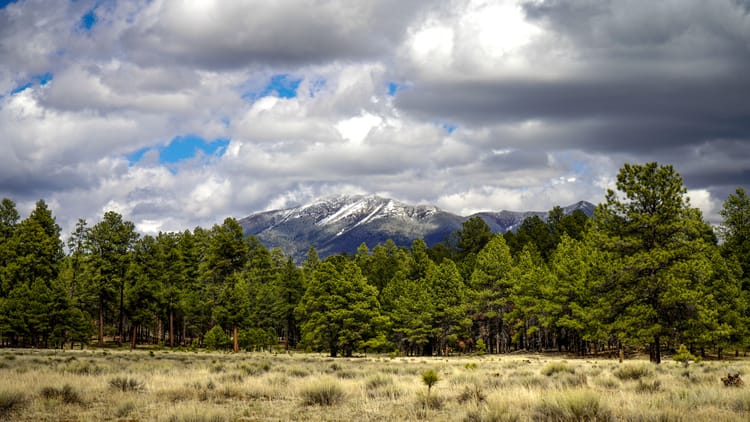
This is the one weekend on the list that exists because it's cold. Flagstaff is a railroad town at 7,000 feet inside the largest ponderosa pine forest on the continent, and the private observatory on the hill above it is where Pluto was found in 1930. About 90 inches of snow falls in an average winter, most of it between December and February.
So go for the snow. Arizona Snowbowl on the San Francisco Peaks is a real ski hill with a real lift line. Lowell Observatory runs public telescope nights, and the sky over Flagstaff is protected by the first dark-sky ordinance in the country. In the afternoon, Walnut Canyon National Monument is ten minutes east, with 800-year-old cliff dwellings tucked under a limestone ledge. Downtown still looks like the railroad built it, because it did.
Flagstaff's main RV parks stay open all year with full hookups. Flagstaff RV Park and Village Camp both do; skip the seasonal ones that shut for the winter. This is a weekend for an RV that's already had its winter RV camping prep done, with the tanks, the hose and the furnace sorted before you leave the valley. Ninety inches of snow doesn't care how nice your floor plan is.
Subscribe to our weekly newsletter.
EVERYTHING YOU NEED FOR THE PERFECT ARIZONA RV WEEKEND. FREE, EVERY WEDNESDAY.
5. Page, Lake Powell and Horseshoe Bend
Page was built in 1957 to house the people building Glen Canyon Dam, on a mesa above a canyon the dam then flooded. Lake Powell is now dropping back out of that canyon, and every year the water gives back more of what it covered. Five miles downstream, the Colorado River does a 270-degree turn a thousand feet below the rim. That's Horseshoe Bend, and you've seen the photo.
Take the photo yourself at dawn, before the tour buses. The walk from the lot is a mile and a half round trip on a graded, accessible trail, and it takes a leashed dog. Then spend midday in a slot canyon. Antelope Canyon is on the Navajo Nation, and a Navajo guide is mandatory at every entrance to it. Book the guide before you book the campsite. End the day on the hill above Wahweap Bay, looking at the lake, which is where you're sleeping.
Wahweap RV and Campground sits on that slope inside Glen Canyon National Recreation Area, open year-round, with full hookups on the hillside loops. Bring leveling blocks; the pads on a hill are pads on a hill. Horseshoe Bend's city-run lot has reserved oversize spaces for RVs. This is the long weekend on the list, four-plus hours from Phoenix, and for anyone continuing north, Utah's Mighty 5 by RV starts an hour up the road.
6. Lake Havasu State Park and the London Bridge
In 1968 a chainsaw magnate named Robert McCulloch bought the 1831 London Bridge, which was sinking into the Thames, had it cut into numbered granite blocks, shipped them through the Panama Canal to the Arizona desert, and rebuilt it. Then he dug a channel under it so it would have something to cross. That's the whole story, and it's true, and you can walk across it after breakfast.
Havasu is the warmest corner of the state, and in January that means water you can actually be on. Kayak the channel under the bridge, take a boat up the Colorado into Topock Gorge where the cliffs close in, or do nothing at all on a beach in a month when nobody else in the country can.
Lake Havasu State Park is in town, on the water, open year-round, and every site has 50 amp and water with a dump station on the way out. If your RV is 30 amp, a 50-to-30 amp adapter turns every site in the park into one you can use. Summer weekends carry a minimum stay here.
7. Tucson and Saguaro National Park, from Catalina State Park
The saguaro grows wild in one desert on Earth, and this is it. A saguaro takes seventy-odd years to grow its first arm, and the forest around Tucson was set aside for it in 1933. On the west side of town, the Arizona-Sonora Desert Museum is a zoo, a botanical garden and a natural-history museum that refuses to pick one.
A cactus forest at sunset is the Saturday. Drive the loop in the park's east unit as the light goes sideways, then head west Sunday morning for the museum's raptor flights, hawks and owls loose over the crowd, which only run in the cool months.
Saguaro National Park has no vehicle camping of any kind, RV included, so you sleep next door. Catalina State Park on the north side of Tucson has no RV length limit at all, more than a hundred electric-and-water sites, and is open all year; it's one of the best weekend getaways from Tucson because the trails run out the back of the campground. Gilbert Ray, the Pima County campground on the west side beside the Desert Museum, is the closer base for the museum, but it caps total length, vehicle and trailer together, at 40 feet. And any RV going to the museum comes in from the south by way of I-19, Ajo Way and Kinney Road. The museum itself says to avoid Gates Pass Road in any kind of RV. If you'd rather camp for free, desert boondocking in Arizona has options within an hour of here.
8. Kartchner Caverns, Tombstone and Bisbee
In 1974 two cavers found a hole in a hillside east of Tucson, crawled in, and found a living cave: wet, still growing, with formations that had never seen a light. They kept it secret for fourteen years until the state could buy the land and protect it. Forty miles south, Tombstone is the 1881 Gunfight at the O.K. Corral town and Bisbee is the copper town that turned into an artists' town when the mine shut. The same century, told two ways.
The cave is the Saturday morning: guided-only, humid enough to fog a lens, still dripping. The afternoon is Tombstone if you want the reenactment and Bisbee if you want the real thing, a town built up a canyon wall with stairs instead of streets and a mine tour that puts you in a rail car down the shaft.
Kartchner Caverns State Park's campground has electric and water at every site, pull-throughs to 60 feet and a dump station, and it's open year-round. The cave tour you get depends on the season, and tours book up to a year ahead, so reserve the tour when you book the site, not after. For an RV under 29 feet including racks, there's a wilder option an hour east: Bonita Canyon Campground in Chiricahua National Monument, year-round, no hookups, leashed pets fine, inside a forest of rock spires. Over 29 feet, the monument's scenic drive stops at the Faraway Ranch lot, and so do you.
9. Patagonia Lake State Park and the Sonoita Wine Country
A rancher dammed a creek in the grasslands south of Tucson and made a lake that turned into one of the best birding spots in the country, with vermilion flycatchers and elegant trogons on the list. The valley above it, around Sonoita and Elgin, sits at an elevation and on a soil that turned out to suit wine grapes. Nobody planned any of this.
The weekend runs itself. Binoculars at the lake at dawn, when the mist is on the water and the birds are loud, then a tasting room in the afternoon in a valley of grass and oak that looks more like somewhere in California than anything you expected from Arizona. This is the quietest entry on the list, and the one to pick for a romantic weekend getaway in Arizona if that's the brief. Two nights, one lake, one valley.
Patagonia Lake State Park's sites have 30 and 50 amp with water, and most take any size RV. A dozen boat-in sites exist for the reader with a kayak on the roof, and the marina rents boats for everybody else. Bring a pair of binoculars that can actually reach across the lake; the trogon does not come to you.
10. Organ Pipe Cactus National Monument
The organ pipe cactus grows wild on the US side of the border in this one place, and in 1937 the country set the monument aside for it. It's the only spot in the country where that whole stretch of Sonoran Desert, the cactus, the ocotillo, the mountains behind them, is protected in one piece. It's also two hours from anywhere, which is the reason to go.
Camp for the sky. Twin Peaks Campground has a loop where generators are never allowed, and the dark out here has a border town's worth of nothing in it. Drive the Ajo Mountain loop in the morning, 21 miles of graded dirt through the densest organ pipe stands in the monument, then take the solar-heated shower and sit outside. That's the whole activity, and it's enough.
Twin Peaks has no hookups but a dump-and-fill station and potable water, sites to 40 feet with a handful larger, reservable six months out on Recreation.gov, open all year. Every scenic drive in the monument bans trailers, buses and RVs over 25 feet, so plan the loop accordingly. Graded dirt is hard on tires; a tire-pressure monitor tells you about the slow leak before the desert does. Two nights without hookups is easy in winter if you know how long you can boondock on your tanks.
Weekend Trips from Phoenix, and the Ones That Are Closer to Tucson
Weekend trips from Phoenix run north, mostly, and they run uphill. Sedona and Dead Horse Ranch are about two hours. Prescott is the same, on a different road. The South Rim and Flagstaff are three to four hours and a mile higher than where you started. Lake Havasu is three hours west and downhill the whole way, into the warmth. Page is the long weekend, four-plus hours, and it's worth taking a Friday off for. Those are the six weekend getaways from Phoenix on this list, roughly in order of drive time.
Weekend getaways from Tucson are all inside two hours, and half of them are inside one. Catalina State Park is in town. Kartchner Caverns is an hour east on the interstate, Patagonia Lake an hour south through the grasslands, and Organ Pipe two hours west on a road with a whole lot of nothing on it. For the drives themselves, the routes out of Phoenix, with the stops along the way, are their own list: the drives out of Phoenix cover every road on this page.
The Short Version
- Ten base camps, all open year-round: Dead Horse Ranch, Point of Rocks, Mather, Flagstaff's in-town parks, Wahweap, Lake Havasu State Park, Catalina, Kartchner, Patagonia Lake and Twin Peaks.
- Hermit Road at the Grand Canyon opens to private vehicles under 22 feet in December, January and February only, with no shuttle running. Trailer Village is closed after the August 2026 flood, with a phased reopening after Thanksgiving.
- There's no RV camping inside Saguaro National Park. Catalina State Park next door has no length limit; Gilbert Ray caps total length at 40 feet.
- Reserve the cave at Kartchner and the guide at Antelope Canyon before you reserve the campsite.
- Organ Pipe's scenic drives ban RVs over 25 feet; Bonita Canyon at Chiricahua caps at 29 feet including racks.
- For a weekend trip to Arizona that turns into a week, the full winter route strings most of these together in order.
Ten Arizona Weekends, One Campground Each
Ten weekends, ten campgrounds, one rule apiece. A river at Sedona and 65-foot pull-throughs. A billion-year-old maze at Prescott. Twenty-two feet on Hermit Road in the three months it's yours. Snow at Flagstaff, a slot canyon at Page, a bridge from London at Havasu. No camping in Saguaro and no length limit next door. A cave you reserve before the site, a lake full of birds, and a cactus that grows in one place. Pick the one that matches your RV's length, its tolerance for cold, and how far you want to drive on a Friday afternoon.
When one weekend isn't enough, the whole Arizona winter route strings most of these together in sequence from Phoenix to Quartzsite, and the West's best national parks for RV camping keeps going from there. The road trips out of Phoenix are a separate list for the reader who cares more about the road than the campground. Death Valley in winter is one state over, same season, for the reader who has done all ten of these Arizona getaways and wants somewhere lower still.
FAQs
What is the best weekend getaway in Arizona?
It depends on the month. In the shoulder seasons, Sedona from Dead Horse Ranch State Park is the strongest pick: red rock at sunrise, the Verde Canyon train at midday, and a riverside campground with 65-foot pull-throughs. In December, January and February, the Grand Canyon South Rim from Mather Campground takes it, because those are the only three months Hermit Road is open to private vehicles under 22 feet and the rim is nearly empty. For pure warmth, Lake Havasu and Organ Pipe are the lowest entries on the list, and the best weekend getaways in Arizona for anyone who wants January to feel like April.
Can you camp in Saguaro National Park in an RV?
No. The National Park Service states that Saguaro has no accommodations for any vehicle camping, RVs included; the only overnight option inside the park is backcountry camping on foot. The two RV base camps are next door. Catalina State Park on the north side of Tucson has no RV length limit, electric and water at more than a hundred sites, and trails into the Santa Catalina Mountains from the campground. Gilbert Ray Campground, run by Pima County, sits beside the park's west unit and a few minutes from the Desert Museum, with a 40-foot total length limit covering vehicle and trailer together.
Is the Grand Canyon worth visiting in winter in an RV?
Yes, with two rules. Mather Campground in Grand Canyon Village is open year-round to RVs 30 feet and under, with no hookups and a free dump and fill station; Trailer Village, the park's only full-hookup campground, has been closed since the August 2026 flood with a phased reopening planned after Thanksgiving 2026, so until it reopens the nearest full hookups are in Williams, an hour south. And during December, January and February, Hermit Road is open to private vehicles under 22 feet with the shuttle out of service, which is the only time of year you can drive the rim's most famous seven miles yourself. The South Rim is at 7,000 feet, so plan for snow and nights in the teens.
How far is Sedona from Phoenix for a weekend trip?
About two hours up I-17, which makes it the easiest of the weekend trips from Phoenix on this list. Dead Horse Ranch State Park in Cottonwood is twenty minutes short of Sedona on the Verde River, with pull-throughs to 65 feet and year-round hookups, and it's where the RV sleeps while you do sunrise in Sedona, the Verde Canyon Railroad from Clarkdale and an afternoon in Jerome. Rancho Sedona, in town on Oak Creek, is the in-Sedona alternative for RVs to 45 feet.
Do you need a guide for Antelope Canyon?
Yes, always. Antelope Canyon is inside Lake Powell Navajo Tribal Park, and Navajo Nation Parks and Recreation requires an authorized Navajo guide for every location in the canyon, upper and lower, no exceptions. Tours book out, especially for the midday light-shaft hours, so reserve the guide before you reserve the campsite at Wahweap. Horseshoe Bend, ten minutes away, is the opposite: a self-guided mile-and-a-half round trip from a city-run lot with reserved RV parking, and it takes a leashed dog.
Where can you RV camp near Tucson with a dog?
Catalina State Park is the answer. Arizona State Parks allows leashed dogs on trails and in campgrounds there, so the dog walks the canyon trails out the back of the campground with you, and the park has no RV length limit. That makes it the best of the weekend getaways from Tucson for anyone traveling with a dog. Saguaro National Park allows leashed dogs only on its roads and a few short paved trails, per NPS, so the cactus-forest drive through the east unit is the part of that weekend the dog rides along for.
What is the warmest weekend getaway in Arizona in winter?
Lake Havasu, Organ Pipe and the Tucson base camps sit lowest, mostly under 2,500 feet, and they're the entries where a January weekend can mean short sleeves at noon and a jacket at dinner. Lake Havasu State Park is the warmest of the three and the only one where you'll actually want to be on the water. The list includes two cold weekends on purpose: Flagstaff, at 7,000 feet, for a snow weekend, and the Grand Canyon South Rim, at the same elevation, for a nearly empty rim and Hermit Road.
Categories
Related Posts
Subscribe to the Swervia Newsletter
The best RV stories, tips, and destinations—expertly curated and always free.