How Long Can You Boondock? A Real Water, Power, and Waste Tank Breakdown
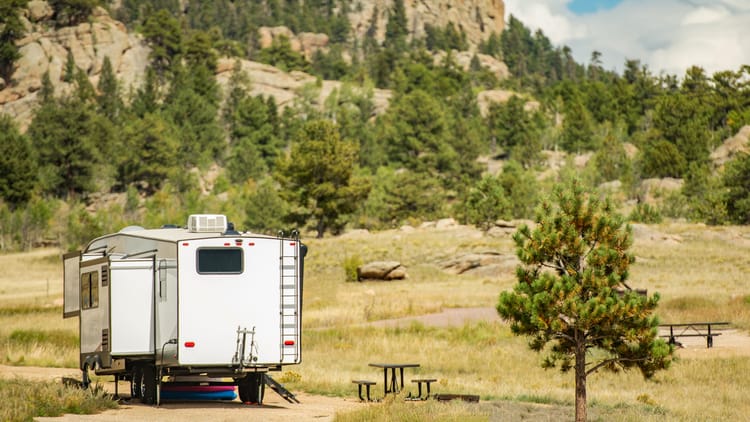
The average half-ton-towable travel trailer rolls out of the factory with about 40 gallons of fresh water, 30 gallons of grey, 30 gallons of black, and one or two 12-volt house batteries that weren't really designed to run anything for very long. Park two adults inside, hook up to nothing, and run the numbers honestly: that rig is a barely three-day machine.
The boondockers stretching the same setup to seven or ten days are not lucky and they are not doing anything mystical. They are running the math on four resources at once — fresh water, grey water, black water, and battery capacity — and adjusting behavior the moment one of them threatens to tap out first. The skill is not toughness. The skill is tracking.
This is the breakdown. Tank capacities translated into actual days, where most rigs run out first, which conservation moves double your stay versus only feeling like they should, and the propane reality almost nobody mentions until the furnace cuts out at 4 a.m.
The Four Resources You're Actually Budgeting
Boondocking without hookups gets framed as one challenge, but it's really four overlapping ones. The trip ends when the first of these four hits zero, not when the slowest one does. Knowing which resource is your weakest link before you leave is the entire game.
The four:
Fresh water in. What's in the tank when you arrive, plus anything you can refill from a jerry can or nearby water source. This is what you drink, cook with, wash with, and flush with.
Grey water out. Drain capacity for showers, sinks, and dishes. Many rigs have less grey than fresh, which is why showers are usually the chokepoint, not drinking water. (More on that surprise in a minute.)
Black water out. Toilet capacity. Different math entirely — it's measured in flushes per person, not gallons per day.
Amp-hours. What your battery bank can deliver between sunrise charges. Refrigerator, lights, water pump, furnace fan, phone chargers, vent fans, the propane detector that draws current 24/7 and that nobody thinks about. This is where most boondocking trips actually end.
A fifth resource lives at the edge of all of this: propane. It does not usually limit a 3-day trip, but it absolutely limits a 10-day winter one. We'll get there.
If you've never actually mapped your RV's three tanks — where they are, what they hold, which valve drains which — that's the prerequisite to any of this making sense in your own rig.
How Long Fresh Water Actually Lasts
The EPA puts average residential indoor water use at about 70 percent of 300 gallons a day per family — and the USGS pegs individual indoor use at around 80 to 100 gallons per person per day. In an RV with no hookups, you do not have that. You do not have 10 percent of that. The mental shift required to boondock is the difference between "use water freely" and "every cup is a decision."
Here is what fresh-water capacity translates to in real days, assuming two adults and zero conservation effort beyond not being wasteful:
Small travel trailers and truck campers (20–40 gallon fresh tanks)
- Drinking and cooking: 1 gallon per person per day = 2 gallons
- Dishwashing (sink running normally): 2 gallons
- One brief shower each: 6 gallons
- Hand washing, teeth, miscellaneous: 1 gallon
- Daily total: ~11 gallons
- A 30-gallon tank lasts about 2.5 to 3 days
Mid-size trailers and Class C motorhomes (40–60 gallon tanks)
Same math, slightly larger tank. 3.5 to 5 days before refill.
Larger fifth wheels, Class A motorhomes (60–100+ gallon tanks)
5 to 9 days at the same usage rate — assuming the grey tank doesn't fill first, which it usually does.
This is your uncompressed baseline. With conservation tactics — navy showers, two-basin dishwashing, a foot pedal on the kitchen sink — those days roughly double, which is where the seven-to-ten-day boondocker stories come from. They are not running more water. They are running half.
A factor people forget: the quality of incoming refill water matters. If you do go top off at a forest service spigot, an in-line water filter that screws onto your fill hose keeps sediment and questionable taste out of your tank. The version that costs about twenty bucks lasts a full season. (For deeper filtration on questionable sources, portable water filter systems are a separate conversation — there are systems designed specifically for backcountry refills.)
The Grey Tank Fills Before the Other Tanks
If amp-hours end most trips (more on that below), the grey tank ends the rest — and it's the most-violated assumption in boondocking math. Among the three tanks, the grey tank — not the fresh tank, not the black tank — usually hits capacity first.
Why: the grey tank is typically the same size as the black tank (around 30 gallons in mid-size rigs), but it absorbs everything — every shower, every sink rinse, every dishwashing pass. The black tank only gets what gets flushed.
So with no conservation, here is what a 30-gallon grey tank actually absorbs over three days for two adults:
- 6 brief showers across three days (about 3 gallons each): ~18 gallons
- Dishwashing for 3 days (about 2 gallons per day): ~6 gallons
- Hand washing and teeth (about 1 gallon per day): ~3 gallons
That math gets you to about 27 gallons across three days — and you hit the standpipe before you hit the actual top of the tank. Day three, the shower drains slowly, then not at all. That's the signal the grey tank reached the top of the standpipe — usually 24 hours before you actually planned to leave.
There are three responses, in increasing order of commitment:
Use less. Navy showers (water on, water off, water on for rinse) cut shower water by 60 to 70 percent. Two-basin dishwashing (one with soap, one with rinse) cuts kitchen water roughly in half. Brushing teeth with a cup of water instead of a running faucet feels silly until you realize it saves a gallon a day.
Use a portable tank. A portable waste tote that hitches behind your tow vehicle holds about 36 gallons — basically a full grey tank's worth. Drain into it, drive to the nearest dump station, empty it, drive back. This is how veteran boondockers extend stays past the grey-tank limit without breaking camp.
Dispose of cooking and rinse water legally outside the rig. Cooking water — the water that boiled the pasta, rinsed the spinach — can legally and ethically go on the ground at most dispersed campsites if it's free of food particles and soap. Soap water cannot. The Bureau of Land Management's dispersed-camping guidance and the Forest Service's visitor info both lean on this distinction — and on the 200-feet-from-water rule for anything that does go to the ground.
The Black Tank Math (Yes, Including the Toilet Paper)
Black tank math is different from grey because the inputs are categorical, not continuous. You aren't pouring gallons in — you're flushing a toilet a known number of times per day, with a known amount of water per flush.
A modern RV toilet uses roughly half a gallon per flush in pedal-down rinse mode. Two adults averaging six flushes a day collectively (some quick, some not) puts you at about 3 gallons of black tank intake per day.
A 30-gallon black tank, by that math, lasts about 9 to 10 days before fill. That's the theoretical number. In practice, three things shrink it:
Toilet paper bulk. RV-rated toilet paper dissolves quickly, but the volume still occupies tank space. Heavier paper users get less than 9 days.
The 3/4 rule. Black tanks should be dumped when they hit roughly three-quarters full, not 100 percent. Past that point, solids stack against the sensor and the gate valve, and the next dump becomes a problem. So practical capacity is more like 22 gallons, not 30.
Flush water. A lot of people add extra flush water after each use, which is good for tank health and bad for tank capacity. There is a real trade-off there.
So in real days, two adults on a typical 30-gallon black tank get roughly 7 days before a dump becomes necessary — which usually overlaps neatly with when fresh water needs a refill anyway. The grey tank, again, fills first.
Track four resources at the same time and your boondocking days roughly double. Subscribe to our weekly newsletter.
FOR RV PEOPLE WHO LIKE TO KNOW THINGS — WEDNESDAYS. ONE EMAIL. FREE.
Power Is Where Most Trips Actually End
The most common boondocking-trip-ender is not water. It's amp-hours.
Every device in the rig draws current from the house battery. Some draws are obvious (the refrigerator, the lights). Some are invisible until you start measuring (the propane detector pulling about 1 amp continuously, the CO detector doing the same, the LP gas system control board, the radio in standby). Add those small draws together over 24 hours and you've spent 15 to 30 amp-hours on things you didn't even use. RV battery drain catches almost every new boondocker the first time out.
Here is the baseline math:
A single 12-volt lead-acid house battery holds about 100 amp-hours nominal, but you can only use roughly half before damaging the battery. So usable capacity: about 50 amp-hours.
A 100-amp-hour lithium-iron-phosphate (LiFePO4) house battery — like a 100-amp-hour lithium-iron-phosphate battery built for RV banks — gives you about 95 amp-hours usable. That is roughly twice the usable capacity of an equivalent lead-acid battery in the same physical footprint, which is why almost every long-term boondocker has switched. Two of them in parallel doubles the budget again.
Daily draws, two-adult rig:
- 12V compressor refrigerator: ~30 Ah/day
- LEDs and water pump intermittent use: ~10 Ah/day
- Furnace fan in cold weather: ~20 Ah/day (fan only — the heat is propane)
- Vent fan in hot weather: ~15 Ah/day
- Phone, tablet, laptop charging: ~10 Ah/day
- Parasitic draws (detectors, control boards): ~15 Ah/day
- Total: ~100 Ah/day in summer, ~110 Ah/day in winter
So a single lead-acid battery (50 Ah usable) lasts about half a day. A single lithium (95 Ah usable) lasts about a day. A 200-amp-hour lithium bank lasts about two days. Without solar to refill that bank during daylight, you are dead in the water by the morning of the third day. That's the whole story.
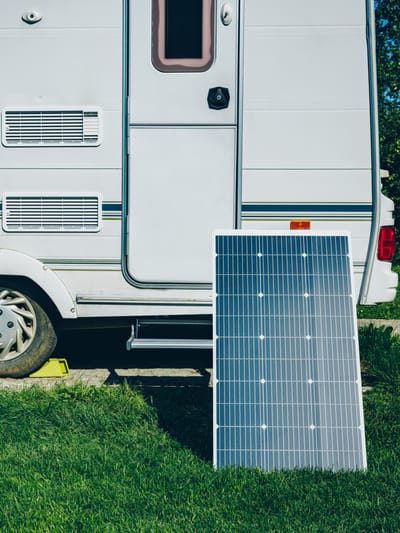
Add solar and the math flips. 200 watts of panels in good sun puts about 70 to 90 amp-hours back into the bank per day — most of what you used. 400 watts gets you net positive, which is why most veteran boondockers run that or more. A full RV solar setup is the upgrade that converts a 2-day rig into an indefinite one.
For people not ready to wire panels into the rig: a portable solar generator that pairs about 1,000 watt-hours of storage with 400 watts of folding panels is the bolt-on version. Drag it out in the morning, plug your essentials directly into it, and the house battery only handles overnight loads. Lower commitment, similar functional result.
The other piece of this nobody buys until trip three: a shunt-style battery monitor that tracks amp-hours in and out. The percentage gauge most rigs ship with is functionally lying. A shunt monitor tells you exactly what came in from solar today, exactly what went out to the rig, and what's left. The first week of using one is a humbling education in how much your refrigerator actually draws.
A side note for the future-thinkers: all-electric RV trailers are a developing category that reshapes this math entirely — bigger batteries, induction cooking, no propane required. The trade-offs are different, but the boondocking ceiling moves up.
Propane: The Resource Nobody Tracks Until It Runs Out
Propane runs the furnace, the water heater, the stove, the oven, and the refrigerator (when not on electric). Two 20-pound tanks on a travel trailer hold about 9 gallons of propane between them. That is a lot more capacity than the water or battery side, which is why most people forget about it — until they wake up in November and the furnace has been cycling all night on the second tank and there is no third tank.
Rough daily burn rates:
- Cooking only: ~0.5 gallons/day
- Water heater on demand for one or two showers: ~0.3 gallons/day
- Refrigerator on propane: ~1.5 gallons/day
- Furnace running overnight in 30°F weather: ~1.5 to 2 gallons/day
In summer with the fridge on electric, two adults use about a gallon a day. Two full 20-pound tanks last roughly 8 to 9 days. In winter with heat running, that drops to 4 days, sometimes 3.
A magnetic propane-tank level sensor is the cheapest peace of mind in boondocking — something like a magnetic propane-tank level sensor that reads through the steel sticks to the underside of the tank and reports the actual level to your phone via Bluetooth. No more guessing whether tank two is half or empty. The first time the furnace runs harder than expected on a cold night, the tool pays for itself.
The Conservation Multipliers That Actually Double Your Stay
Of all the tactics that get talked about, four genuinely move the needle and are worth committing to before a long trip. The rest is rounding error.
Navy showers. Water on for 20 seconds to get wet, water off while soaping, water on for 30 to 45 seconds to rinse. Total water used: about 1.5 gallons instead of 5. This single change doubles grey tank life on most rigs.
Two-basin dishwashing. One basin of soapy water, one of clean rinse. Wash everything in the soap basin, dip-rinse in the second. Roughly half the water of running-faucet washing, and the rinse basin water at the end is clean enough to use for plant watering or pre-rinsing the next round.
The "if it's yellow, let it mellow" rule. It saves an enormous amount of black tank space over a 7-day trip. Worth doing on solo flushes, less appealing during dinner-with-friends boondock weekends. Reader judgment.
Cooking outside. A propane camp stove and a fire ring or grill take the cooking load off the rig's water tank (the dishes still happen inside, but the rinse water from outdoor cooking can be disposed of legally on the ground if soap-free). Side benefit: the rig stays cool in summer.
What does not meaningfully extend your stay: turning off the water pump when you're not using it (saves maybe 1 Ah/day), unplugging the inverter (helps but minor), running the refrigerator on propane only (this uses propane faster than it saves amp-hours unless your solar is undersized). Be skeptical of any tactic that doesn't have a number attached to it.
Knowing When to Pack Up
The most useful skill in extended boondocking is reading the rig like a dashboard. Five signals, in order of urgency:
Grey water draining slowly. Tank is 90%+. You have one or two showers left. Either dump (or tote) immediately, or stop showering.
Pump cycling on its own when no tap is open. Either a slow leak (rare) or the fresh tank is empty and the pump is cavitating. Stop the pump immediately to prevent damage.
Black tank odor in the bathroom. Sensors lie, smell doesn't. Tank is at or above three-quarters full.
Battery voltage dropping below 12.2V before sunrise. You burned more than solar refilled. Two consecutive nights of this and you're heading toward a dead bank.
Propane regulator frosting in the morning. Tank is low and the regulator is working harder than designed. Time to switch or refill.
If two of these signal at once, the trip is over. Pack up early. The veteran boondockers leave with capacity to spare, not because they didn't enjoy themselves — but because the alternative is dumping a sloshing grey tote in a Wal-Mart parking lot at midnight, and they have already lived that life and don't want to live it again. Find free RV campsites becomes a very different exercise when you've actually tracked these signals for a few trips.
FAQs
How long can you boondock in an RV without running out of water or power?
A typical travel trailer with no conservation effort and no solar lasts about 2 to 3 days for two adults — limited usually by battery capacity or grey tank fill. With navy showers, two-basin dishwashing, and a 200-amp-hour lithium battery bank paired with 200+ watts of solar, the same rig stretches to 7 to 10 days comfortably. Beyond that requires a portable water tote, secondary propane, and either bigger fresh tanks or a refill plan.
What runs out first when boondocking, water or power?
For most rigs without solar, power runs out first — usually on the second night, because a single house battery only delivers 50 to 95 amp-hours and a typical rig draws 100 amp-hours per day. With solar installed, grey water becomes the next chokepoint, because grey tank capacity is similar to fresh tank capacity but receives all the shower and dishwashing volume.
How many gallons of fresh water do two people need per day in an RV?
Without conservation, about 10 to 12 gallons per day for two adults: 2 for drinking and cooking, 6 for one short shower each, 2 for dishwashing, 1 for hand washing and teeth. With navy showers and two-basin dishwashing, that drops to about 5 to 6 gallons per day — which is the difference between a 3-day stay and a 6-day stay on a 30-gallon tank.
Can you dump grey water on the ground while boondocking?
It depends entirely on what's in the water. Cooking water with no soap and no food particles can legally be disposed of on the ground at most dispersed sites if you're at least 200 feet from any water source. Soap-containing water cannot — that's a Leave No Trace violation and in some areas a federal one. The safer practice for any extended stay is a portable waste tote that you empty at a dump station.
How long does an RV battery last when boondocking?
A single 12-volt lead-acid house battery lasts about half a day under normal use (50 amp-hours usable, against a 100-amp-hour-per-day average draw). A single 100-amp-hour lithium battery lasts about a day. A 200-amp-hour lithium bank lasts about two days. With 400 watts of solar in good sun, any of those configurations can sustain indefinitely as long as the panels can refill the bank during daylight hours.
What's the longest you can boondock on BLM land?
The standard rule on most BLM-managed dispersed camping land is 14 consecutive days within a 28-day period, after which you must relocate at least 25 miles. Some districts have shorter limits (10 days) and a few high-use areas have stricter restrictions. The BLM publishes specific rules per field office — check the local one before assuming the 14-day rule applies.
Do you need solar to boondock for more than a few days?
Technically no, but practically yes. Without solar, every extended boondocking trip requires either running a generator daily (noisy and propane-hungry) or returning to a hookup site every 1 to 2 days to recharge the battery bank. Solar makes the rig energy-independent during daylight, which is the unlock that turns boondocking from a weekend novelty into a viable extended lifestyle.




Categories
Related Posts
Subscribe to the Swervia Newsletter
The best RV stories, tips, and destinations—expertly curated and always free.