The Best National Parks in Winter and Fall for RVers
Acadia's campgrounds shut for the season in the second and third weeks of October. The Maine coast, by most foliage maps, peaks in the third week of October. Plan from the map and you arrive to the color right on schedule and a closure sign at the campground gate, with the leaves doing their part and nowhere in the park to sleep.
A national park list written for a car and one written for a vehicle you also sleep in are two different lists. In the parks, fall and winter don't mean fewer people so much as fewer open things. The lodge closes, the shuttle stops, the campground loops go dark one at a time. Plan around what stays open and you get the national parks in winter the way the rangers get them: empty, cold-bright, and with a place to plug in.
For RVers, the parks that keep a campground and a road open all winter are Death Valley, Joshua Tree, Big Bend, the Everglades, the Grand Canyon's South Rim and, for the snow, Bryce Canyon and Zion. The fall list is the Smokies, Shenandoah, Grand Teton, Acadia and Zion, with campground seasons that end sooner than the foliage does. Yellowstone isn't on either list: its interior roads close to wheeled vehicles from early November to late April, and the geysers go behind a snowcoach ticket.
A warm winter park is a booked winter park. Big Bend over the holidays and the Everglades in February have waiting lists, not vacancies. Every one of them has a quiet stretch: Big Bend before the week of Christmas, the Everglades in early November before the electric sites fill, Joshua Tree in December with the crowds still a month away.
Why National Parks in Winter and Fall Work Better From an RV
A park's gate is open 365 days a year. Its campgrounds mostly aren't, and the loops that stay open through the cold tend to be the ones with electric at the post or a dump station near it. That's not generosity. It's plumbing. A campground built to run in January has to be built for freezing, and the ones that were are the ones you want anyway. Our guide to RVing in national parks covers the reservation patterns that apply everywhere; the parks below are the ones still worth reserving once the calendar turns.
Roads close before parks do. Yellowstone's interior shuts to wheeled vehicles for the winter while the park stays technically open. The Smokies' summit road closes for the season while two of its campgrounds never do. Grand Teton's full-hookup RV park goes dark in the first half of October, weeks before the last campground follows it. So "is the park open" is the wrong question. Ask which roads and which loops are open, because that's the difference between a trip and a drive to a locked gate.
Cold is an RV problem the warm parks solve for you. Below freezing, the furnace runs all night, propane goes faster than you budgeted, and an exposed water line becomes the thing you think about at two in the morning. The desert parks and the Everglades take that off the table for most of the winter. The snow parks don't, and the fix is preparation you do before you leave: our winter RV camping prep guide covers the heated hose, the tank heaters and the skirting. Bring a wireless propane tank sensor either way, because guessing at a gauge in the dark on a January night is how people end up with a cold furnace and a colder dog. Warm national parks in winter aren't a compromise. They're the season those parks were built for.
The Best National Parks to Visit in Fall From an RV
Fall in the parks is a foliage story for everyone else and a closing-dates story for you. The best national parks in October for an RVer are the ones whose campgrounds are still taking reservations in October, which is a shorter list than the calendar pictures suggest. Our guide to when fall colors peak has the timing by region.
Great Smoky Mountains in October
The most-visited national park in the country is also the one where fall lasts longest, which makes the Smoky Mountains in October the longest show of any park in the fall. Color starts on the high ridges and rolls downhill for weeks, so a trip that misses peak on the summit catches it in the coves a week later. The high point is Kuwohi, formerly Clingmans Dome, its Cherokee name restored in 2024, and the tower up there is the one place you can watch the whole thing happen at once.
Two campgrounds never close. Cades Cove and Smokemont stay open year-round, reservations required, which makes the Smokies the only headline fall park that carries straight through into winter without you moving the RV. Cades Cove is the one with the eleven-mile loop road through old farmsteads and, most mornings, a bear or a herd of elk holding up traffic. The NPS frontcountry camping page is where the loop-by-loop detail lives.
Two catches. The road up to Kuwohi is seasonal and closes for the winter, so if the tower is the reason you came, come before it does. And the Smokies are one of the stricter parks for dogs in national parks: two trails allow them, the rest don't, so a dog that hikes with you everywhere else is going to sit this park out on the leash at camp. Book the campground first and plan the drives around it.
Shenandoah National Park in Fall
Shenandoah is a road with a park attached. Skyline Drive runs a hundred and five miles along the crest of the Blue Ridge, with an overlook every few miles, and an RV on it is a rolling overlook with a kitchen. The color comes late here compared with New England and stays longer, and from the crest you see it on two sides at once: the Shenandoah Valley to the west, the Piedmont falling away east.
Pull off at Big Meadows, walk the meadow at dusk while the deer come out, and the campground is right there. The catch is that it's a fall park with a hard end and not a winter park in any sense. Every campground closes for the winter and Big Meadows is reservation-only, so a Shenandoah National Park fall trip is a September-through-October trip and you book it, you don't wing it. The NPS campground page has the per-campground detail. Go for a long weekend of driving, not a week of sitting.
Grand Teton in Fall, Before the RV Park Shuts
The Tetons have no foothills. The range comes straight up out of the valley floor on a fault, so the peaks look closer than they are and the aspens turn gold right at their feet. In September the elk are in rut and you hear them bugling across the flats at dawn. Grand Teton in fall is the best-looking week of the mountain year, and it is a short week.
The campgrounds close in the first half of October, and the full-hookup RV park at Colter Bay closes early in that window. So the Teton fall trip is a September trip that can run into the first days of October if you're lucky with weather. Length limits are generous at Gros Ventre, Colter Bay and Headwaters (45 feet) and tight at Signal Mountain and Lizard Creek (30 feet), per the NPS camping page. If the Tetons are one half of a bigger loop, our Yellowstone and Grand Teton RV road trip is the warm-season version of the same drive. Book September and treat October as a bonus.
Subscribe to our weekly newsletter.
ALL YOU NEED TO PLAN A NATIONAL PARK RV TRIP THIS WINTER. FREE, EVERY WEDNESDAY.
Acadia in September, and Why Not October
Acadia is the only national park in New England, and it's the one where granite meets the Atlantic. Cadillac Mountain catches the first sunrise in the country for part of the year, and the Park Loop Road threads pink cliffs, cobble beaches and spruce woods in a single morning's drive. In fall the summer crowd is gone and the light goes low and gold across the water.
The foliage calendars say October. The campgrounds say September. Blackwoods, Seawall and Schoodic Woods all close in the second and third weeks of October, which is exactly when the foliage pages tell you to arrive. Plan Acadia for September into the first days of October and you get the coast in fall light with a campsite to come back to. Schoodic Woods, across the bay on the quieter peninsula, has RV sites with electric and water, which makes it the one to book if you want a hookup. And the Cadillac Summit Road needs a vehicle reservation now, so the sunrise is something you book, not something you show up for. The NPS camping page has the reservation links. Go in September. The trees will be a little green. You'll have a place to sleep.
Zion in October and November, on the Right Side of the Tunnel
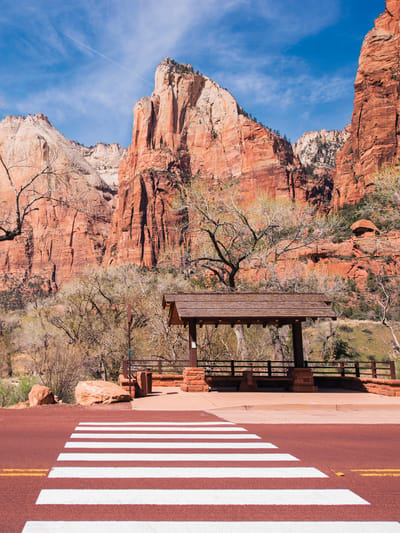
Zion is a slot in Navajo sandstone with a river running through the floor of it, and the walls go up two thousand feet on either side of the road. Late October and November are when the cottonwoods along the Virgin River turn gold against the red rock, the shuttle crowds thin, and the canyon floor gets the light back.
Watchman Campground is open year-round with electric sites for RVs up to 40 feet, so Zion is a fall park that quietly doubles as a winter one. Book it and Zion in fall works from the campsite outward. The asterisk is the size of a Class A. The Zion-Mount Carmel Highway, the road that climbs out of the canyon to the east side and on toward Bryce, has hard size limits: a single vehicle can't be longer than 35 feet 9 inches, wider than 7 feet 10 inches or taller than 11 feet 4 inches, a truck-and-trailer combination can't exceed 50 feet, and the measurements include mirrors, roof air conditioners and racks. The NPS page says oversize vehicles "will not be permitted" on that stretch and will be given instructions for turning around at the entrance. Don't plan around an escort through the tunnel. Measure before you go. If you're over, you can still camp at Watchman; you just leave the park the way you came in and reach Bryce the long way around through Cedar City. Our guide to RV height clearance in national park tunnels has the same problem across other parks, and Utah's Mighty 5 by RV is the full loop.
The Best National Parks in Winter for an RV
The winter list is warm parks plus two snow parks, and "warm" means "booked." A Big Bend site over the holidays or an electric site at the Everglades in February gets reserved months out, so the reservation habit matters more in winter than in any other season. For the full list of parks with electric and sewer at the post, our guide to national parks with RV hookups has them all. These are the ones that are worth a winter.
Death Valley in Winter
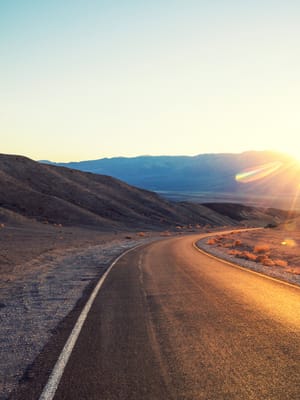
The lowest, hottest, driest park in the country is a shirt-sleeve park from November into March, with cold nights and the kind of clear that makes the salt flats look close enough to walk to. Furnace Creek Campground is open all year and takes reservations for the cool season, with a short row of full-hookup sites that go first. The best viewpoint roads, Dantes View and Artists Drive, ban vehicles over 25 feet, and Titus Canyon Road is closed to all vehicles through September 2027, so the classic drives need a car or a small RV. For the plan, day by day, our Death Valley winter itinerary is built around exactly those limits.
Joshua Tree National Park in Winter
Two deserts meet inside Joshua Tree, the high Mojave and the low Colorado, and the trees that give the park its name are yuccas with ambitions. Winter is the season the park is built for: rock-scrambling weather by day, cold clear nights, and the Milky Way over Hidden Valley by nine. The boulder piles at Jumbo Rocks are the campsite and the playground at once.
Plan Joshua Tree around water. Most campgrounds in the park have no water at all, and the only water fill and dump stations are at Black Rock and Cottonwood, at opposite ends of the park. So you arrive full, you camp dry in the middle, and you route the trip so you pass one of those two on the way out. The NPS campground page lists which loops take reservations in the busy season, which runs from fall through spring and books months ahead. White Tank and Hidden Valley cap combined length at 25 feet; Belle takes up to 35. A pair of leveling blocks gets used every night in a park where every site is a gravel pad between boulders, and a battery monitor tells you what a cold night without hookups actually cost you before the furnace finds out. If dry camping in the desert is new to you, our desert boondocking guide covers the water math. Plan the days around Black Rock and Cottonwood and the rest of Joshua Tree takes care of itself.
Big Bend National Park in Winter
Big Bend is the Rio Grande bending around the Chisos Mountains, a mountain island in the Chihuahuan Desert, with the border running down the middle of the river. Winter is the one season the desert floor is walkable all day, from the Santa Elena Canyon walls to the hot springs on the riverbank. After dark the sky takes over. The park's own night-sky page puts it plainly: the dark night sky has always been part of Big Bend. Bring a pair of astronomy binoculars and you'll see why people drive twelve hours for it.
The RV decision is which of two campgrounds you're built for. Rio Grande Village RV Park, run by the park's concessioner, is the only full-hookup campground in Big Bend, and it caps out at 38 feet. Chisos Basin, up in the mountains, is the prettier campsite and the harder road: the NPS page doesn't recommend it for trailers over 20 feet or RVs over 24 feet, because the climb is steep and the switchbacks are sharp. Both require reservations, and the holidays are the peak. The approach roads are long and empty, so a tire-pressure monitor is worth more here than almost anywhere. Reserve Rio Grande Village early and day-trip the Basin.
The Everglades in the Dry Season
The Everglades isn't a swamp. It's a river of grass fifty miles wide and a few inches deep, sliding toward the Gulf, and it's the only place on Earth where alligators and crocodiles share the same water. The park has two seasons, wet and dry, and the dry season, roughly November into April, is the only time the mosquitoes stand down and the wading birds crowd into whatever water is left. The dry season is the reason to go.
Flamingo Campground, at the end of the road on Florida Bay, is open year-round, and the RV loop has electric-only sites: power at the post, no water or sewer at the site, so you fill and dump at the campground stations. The concessioner's page lists the loops, and the NPS announcement is the record of when the power went in. The electric sites are booked solid all winter. Reserve them months out or plan on a site without power and a quiet generator hour.
Grand Canyon in December, With Hookups
Snow on the rim, the canyon steaming at sunrise, and the shuttle crowds gone: Grand Canyon in December is the park at its most private, and the South Rim stays open for it.
Two campgrounds sit a few hundred yards apart in the village and answer two different questions. Mather Campground is open year-round for RVs up to 30 feet with no hookups. Trailer Village next door is open year-round with full hookups and pull-through sites to 50 feet, per the NPS Trailer Village page. The North Rim and Desert View close for the season, so the South Rim is the winter Grand Canyon. It gets cold up there at seven thousand feet, so pack a heated blanket for the first night before the furnace catches up. Book Trailer Village if you want to leave the water on.
Bryce Canyon in Winter, Hoodoos in Snow
Bryce is the highest of the Utah parks, up around eight thousand feet, so it's the one that actually gets a winter. The amphitheater full of hoodoos with snow on every ledge, lit orange at sunrise, is the reason to come in January. Walk the rim from Sunrise Point to Sunset Point in the cold and you'll have it mostly to yourself.
North Campground's first loop stays open year-round; Sunset Campground closes for the winter. The 23-foot vehicle restriction around the amphitheater applies during shuttle season only, so in winter you drive to the viewpoints yourself. The NPS campground page has the loop detail and the reservation link. Pack for real cold and come for the sunrise.
Winter Parks That Don't Work From an RV
The test is the same every time: the park is open, and the campground or the road isn't.
Yellowstone is a magnificent winter park. It's also closed to the vehicle you drove there in. The NPS road page states it in one line: most park roads are closed to regular vehicles from early November to late April. The one road that stays open to wheels runs from the North Entrance at Gardiner through Mammoth to Cooke City, and the one campground that stays open, Mammoth, caps RVs at 30 feet in winter. Go if you want to, base the RV in Gardiner or at Mammoth, and see the geysers by snowcoach. Just don't plan a January loop of the figure-eight roads, because they aren't there.
Lassen Volcanic is the same story at a smaller scale. The park highway, the one road through the middle, closes for the season in mid- to late November, and the NPS winter page lists exactly one place for front-country vehicle camping once it does: the Southwest parking area. That's a plowed lot at the bottom of a closed road, with the snowshoe routes leaving from its edge. Not a campground, and not a winter base for a trailer. Base the RV in the valley below, drive up for the snow, and come back for Manzanita Lake when the road reopens.
Mount Rainier is the one that surprises people, because its winter recreation page reads like an invitation: snowshoeing, skiing, camping in the snow at Paradise. Read one line further. "No vehicle camping is available anywhere in the park during the winter season." Cougar Rock, Ohanapecosh and White River all run late May to late September, per the NPS campground page, and the winter camping that is allowed is on snow, with a wilderness permit, on foot. Park the RV outside the park and drive in for the day.
Saguaro comes up every winter because Tucson is warm in January, and it is. But the NPS camping page says it in its own words: "no accommodations for any vehicle camping (including RV)" in either district, and the only camping is backcountry. Saguaro is a day park from a Tucson campground, and a good one. It isn't a place to park.
Which National Parks to Visit in November, December, January and February
November. The Smokies hold their last color in the low coves and hand you the first empty weekends, with Cades Cove and Smokemont still open. Death Valley's seasonal campgrounds reopen for the cool season. The Everglades' dry season begins, before the electric sites fill. Zion's cottonwoods are at their best. The best national parks in November are those four, and the Smokies are the one you can drive to from most of the country in a day.
December. The national parks to visit in December start with Grand Canyon in December, if you want snow with a hookup. Big Bend before the holiday rush, which starts the week of Christmas. Joshua Tree, with the crowds still a month away. The best national parks in December split by what you want: snow at the Grand Canyon or Bryce, warm sun at Big Bend, Death Valley and Joshua Tree.
January. Death Valley in its best month, Big Bend, and the Everglades at their fullest, which is also the reservation warning. If you don't have a January site by early fall, you're on a waitlist. National parks to visit in January are the warm ones, and everybody knows it.
February. The best national parks to visit in February are the Everglades and Big Bend at their peak, Death Valley in its last mild month before the heat builds, and Bryce if you came for snow and a quiet rim. It's the month the crowds and the weather agree.
Fewer open things, not fewer people. Now you know which things stay open, which loops take a hookup and which roads turn an RV around. The rest is booking early. The seasonal reservation windows change every year, and they land in our newsletter the week they open, so subscribe if you'd rather not check nine park pages yourself. For the timing to go with these places, when fall colors peak has it by region.
The Short Version
- Acadia is a September park for RVers. The campgrounds close in the second and third weeks of October.
- Grand Teton's campgrounds, including the full-hookup RV park, close in the first half of October. Book September.
- The Smokies never fully close. Cades Cove and Smokemont run year-round, so fall carries into winter.
- Zion's Watchman Campground is open year-round with electric to 40 feet, but the Zion-Mount Carmel Highway turns oversize RVs around. Measure first.
- Joshua Tree runs on water: fill and dump at Black Rock or Cottonwood, camp dry in between.
- The Grand Canyon's South Rim has full hookups all winter at Trailer Village; the North Rim is closed.
- Yellowstone, Lassen and Mount Rainier aren't on this list. Yellowstone's interior roads close to wheeled vehicles from early November to late April, Lassen's park highway closes in November, and Rainier has no vehicle camping anywhere in winter.
- Warm means booked. Reserve Big Bend, the Everglades and Death Valley months ahead for January and February.
FAQs
What national parks are best to visit in winter?
For RVers, the best national parks in winter are the ones that keep a campground with power and a paved road open: Death Valley, Joshua Tree, Big Bend, the Everglades and the Grand Canyon's South Rim for warm or mild weather, plus Bryce Canyon and Zion for snow with a year-round campground. Each of them has at least one loop that runs all year and a road you can drive in a standard RV. The warm ones book out months ahead, so reserve before you plan the rest of the trip.
What national parks are open in winter?
Nearly every national park is open in winter, but "open" refers to the gate, not the roads or the campgrounds. Yellowstone is the clearest example: the park is open, and most of its interior roads are closed to regular vehicles from early November to late April, with one campground running at a 30-foot limit. The useful question is which campground loops and which roads are open, and for RVers that produces a much shorter list: the Smokies, Zion, Bryce, Death Valley, Joshua Tree, Big Bend, the Everglades and the Grand Canyon's South Rim.
Which national park is best to visit in December?
It depends on whether you want snow. For snow with a hookup, the Grand Canyon's South Rim: Trailer Village has full hookups all winter and the rim gets real snowfall at seven thousand feet. For warm days, Death Valley is at its best in December, with mild afternoons, cold nights and a year-round campground at Furnace Creek. Big Bend is the third choice and the quietest before the holiday week.
Which national parks have campgrounds with hookups in winter?
Trailer Village at the Grand Canyon's South Rim and Rio Grande Village RV Park at Big Bend have full hookups year-round, with length limits of 50 feet at Trailer Village and 38 feet at Rio Grande Village. Watchman Campground at Zion has electric sites for RVs to 40 feet. Flamingo in the Everglades has electric-only sites with no water or sewer at the post. Furnace Creek at Death Valley has a short row of full-hookup sites. Our guide to national parks with RV hookups has the full list across every season.
Is fall a good time to RV in the national parks?
Yes, and it's better than summer in most of them, with one condition: the campgrounds close weeks before the foliage does. Acadia's campgrounds shut in the second and third weeks of October, right at peak, so it's a September trip. Grand Teton's close in the first half of October. The Smokies and Zion are the two fall parks with campgrounds that never close, which makes them the safest bets for a trip planned around color.
Can you take an RV through the Zion tunnel?
Only if it fits the hard limits on the Zion-Mount Carmel Highway: a single vehicle no longer than 35 feet 9 inches, no wider than 7 feet 10 inches and no taller than 11 feet 4 inches, or a combined truck-and-trailer no longer than 50 feet, with measurements that include mirrors and roof air conditioners. Anything over those limits is not permitted on the road between Canyon Junction and the East Entrance and is turned around at the entrance station. You can still camp at Watchman; you just reach the east side and Bryce by the longer route through Cedar City.
Where are the warmest national parks in winter?
The Everglades is the warmest, with dry-season days in the seventies and the mosquitoes gone. Big Bend has mild desert days and cold nights along the Rio Grande. Death Valley runs shirt-sleeve mild by day from November into March. Joshua Tree is cooler than the other three because of its elevation, with nights that drop near freezing. All four have year-round campgrounds that take RVs.
Categories
Related Posts
Subscribe to the Swervia Newsletter
The best RV stories, tips, and destinations—expertly curated and always free.