National Forest Camping: Rules, Limits, and How It's Different from BLM
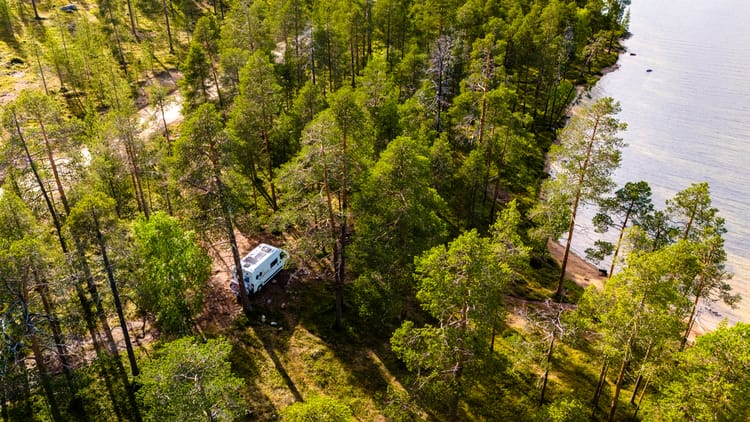
The U.S. Forest Service manages 193 million acres of land across 154 national forests and 20 national grasslands — an expanse larger than Texas — and almost all of it allows some form of camping. For RVers, that means a parallel universe of free overnighting that sits right next to BLM land in the public-lands hierarchy, with rules that look similar at a glance and behave very differently in practice.
National forest camping is the everyday shorthand for staying overnight on land managed by the Forest Service, whether that's a developed campground with a number plate hammered into a tree, or a dispersed pull-off on a forest road three miles past the last cell bar. The category is huge, the rules vary by ranger district, and the experience trends greener, cooler, and more tree-shaded than what BLM dispersed camping typically delivers.
Here is what national forest camping actually is, how it differs from BLM, and the specific limits, maps, and seasonal restrictions that decide whether a forest road is a usable site or a $200 ticket waiting to happen.
What Is National Forest Camping
The U.S. Forest Service is an agency of the U.S. Department of Agriculture, established in 1905 to manage federally designated national forests and grasslands for multiple uses — timber, watersheds, wildlife habitat, grazing, and recreation. Camping is one of those recreational uses, and the agency takes a relatively permissive stance on it. On most national forest land outside of developed sites, dispersed camping is allowed by default as long as a few standard rules are followed.
National forest camping splits into two distinct activities. Developed campgrounds are the ones with numbered sites, picnic tables, vault toilets, fire rings, and sometimes a host trailer at the entrance. These are typically reservable through recreation.gov, cost $15 to $30 per night, and fill up months in advance for popular forests like Olympic, White Mountain, and the Sierra Nevada cluster around Yosemite. Dispersed camping is everything else — undeveloped, unmarked, free, and far more common.
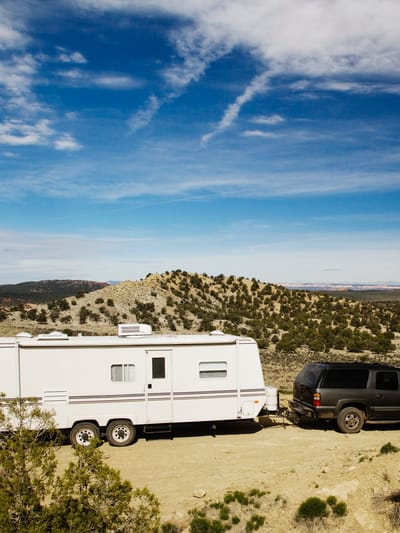
The dispersed side is what most RVers and boondockers mean when they talk about national forest camping. It's the version where the experience starts at a forest road number, ends at whatever pull-off looks level and already-used, and includes no services of any kind. Our complete guide to boondocking without hookups covers the broader systems side — water, power, waste — that every dispersed forest stay depends on.
How National Forest Camping Differs from BLM Camping
The two agencies look interchangeable on the surface — federal land, dispersed camping, 14-day stays, no services — and the differences are the kind that get a trip in trouble if you assume one set of rules applies on the other.
Geography and scenery diverge first. BLM land concentrates in 12 western states and skews high-desert: sage, rock, scrub, vast open ground, almost no canopy. National forests run across 40-plus states and skew forested and elevated: alpine meadows, pine and fir stands, rivers, lakes, and significantly more shade. For RVers who hate cooking inside a 110-degree rig, that distinction is not academic.
Access rules diverge next. On most BLM dispersed land, you can drive cross-country on existing two-tracks and camp essentially anywhere you find a flat spot, within reason. On most national forest land, motorized vehicle travel is restricted to designated roads only. Off-road or cross-country driving is prohibited in most forests, and the specific roads you can use are not a guess — they're published on a document called the Motor Vehicle Use Map (more on that below). Set up a camp 100 feet off an undesignated road in a national forest and the ranger conversation will go differently than the same setup on BLM ground.
Fire policy diverges sharply, especially in summer. National forests cycle through stage-based fire restrictions almost every summer, and those restrictions are often stricter than the BLM equivalent in the same county. A dispersed BLM site in Arizona may allow charcoal during a stage when the national forest 20 miles uphill bans every form of open flame, including propane stoves with exposed pilots. That gap catches travelers every year.
Density and competition are different too. Popular national forest dispersed areas near big national parks (Mount Hood, Bridger-Teton outside Jackson, the forests ringing Yellowstone) are visibly busier than equivalent BLM areas in the same regions. Some districts now operate permit lotteries or designated-dispersed-only systems to manage the load. BLM has versions of this — Sedona's red rock districts, the LTVAs in Southern California — but it's more concentrated in the national forest system overall.
The 14-Day Rule in National Forests
Like BLM, the Forest Service runs on a 14-day stay limit for dispersed camping on most national forest land. The standard interpretation: you can camp at any single location for up to 14 consecutive days within a 30-day period, after which you must move to a meaningfully different area before camping again.
The "meaningfully different" part is where this rule trips people up. Some forests interpret it as five miles, some require a different ranger district, and a few popular areas (much of Bridger-Teton near Jackson, parts of Coconino near Sedona, the Salt Lake City Wasatch cluster) have shortened the stay limit to 5, 7, or 10 days within designated zones. The supplementary rules are typically posted at trailheads and forest service offices, and they override the 14-day baseline whenever they exist.
A handful of structural differences from BLM are worth knowing. National forests are organized into ranger districts rather than the BLM's field offices, and stay limits, road closures, and supplementary rules are set at the district level — not the forest level. Two adjacent districts of the same national forest can have meaningfully different rules. Always check the district whose ground you're actually camping on, not just the forest as a whole.
Motor Vehicle Use Maps: The Document That Decides Everything
The Motor Vehicle Use Map (MVUM) is the most important piece of paper in national forest camping, and most first-timers have never heard of it. Every national forest publishes an MVUM that shows exactly which roads are open to motorized travel, which classes of vehicle they're open to (passenger cars vs. high-clearance vs. ATV-only), and what kind of dispersed camping is allowed along each one. Camping on a road not shown on the MVUM, or driving off the road shown on the MVUM into a side spot the map doesn't authorize, is technically illegal in most forests.
MVUMs are available as free PDFs from the [Forest Service's main website](https://www.fs.usda.gov) under the individual forest's page. They're also integrated into the major offline mapping apps — the Forest Service's own Avenza Maps partnership lets you download the MVUM and use GPS-tracked location on it without cell service, which is the actual reality of using these maps in the field.
A useful shorthand: green-bordered roads on most MVUMs allow dispersed camping within a designated distance from the road (usually 150 to 300 feet, varies by forest). Roads not so marked don't, even when there's an obvious pull-off and an established fire ring sitting on them. That fire ring may exist because the road used to be open and was reclassified, not because the spot is legal today.
Designated Dispersed Areas vs. Open Dispersed
A growing share of popular national forests have shifted to designated dispersed camping in busy zones, where only specific marked spots are usable and the rest of the road is off-limits to overnighting. This pattern shows up most often in forests near major national parks and recreation hubs — the Bridger-Teton outside Grand Teton, the Coconino outside Sedona, the Inyo east of the Sierra Nevada, and the Gifford Pinchot near Mount St. Helens.
In these designated zones, sites are usually numbered with a stake or sign, sometimes reservable online, and capped at a defined group size and vehicle count. Outside the designated zone, dispersed camping reverts to standard rules. Treating the entire forest as open-dispersed when half of it is designated-only is the rookie mistake that ends in a citation.
The forest road that looks free may not be. Subscribe to our weekly newsletter.
EVERY WEDNESDAY. ONE EMAIL. FREE.
What National Forest Camping Costs
For dispersed camping in most national forests, the cost is nothing — no reservation, no nightly fee, no permit beyond a Northwest Forest Pass or similar regional pass that occasionally applies to specific trailhead access. That's the same baseline as BLM, and it's the reason a multi-month western road trip on public lands can be done on a fuel and food budget.
The exceptions that do cost money:
- Developed national forest campgrounds run $15 to $30 per night, reservable through recreation.gov. Most have vault toilets, a fire ring, a picnic table, and a leveled gravel or paved pad. Hookups are rare; a small number of premium developed sites in heavily used forests (Pinecrest in the Stanislaus, some of the Olympic loop) offer electric.
- Designated dispersed sites in busy zones sometimes charge a nominal $5 to $10 nightly fee, even though the site itself is unimproved. The fee covers the administrative cost of running the designated system.
- Special-use permits and Northwest Forest Passes apply to specific trailhead access, day-use areas, and certain recreation sites within the broader forest. They don't typically apply to dispersed overnight camping, but they're worth checking on a forest-by-forest basis.
Fire Restrictions, Stage Bans, and Why They Matter More Here
Fire restriction stages are the single most important seasonal rule to track when camping in national forests, especially in the West from June through October. The Forest Service uses a tiered system that escalates with conditions: Stage 1 typically bans fires outside of approved fire rings in developed sites; Stage 2 bans all open fires and most charcoal use, restricting cooking to enclosed propane appliances; Stage 3 closes the forest to recreation entirely.
Stage 2 is the one that ends trips by surprise. A reader arriving at a remote dispersed site with a brand-new fire pit and a bundle of firewood may discover the forest moved to Stage 2 the day before, making every form of campfire — and most charcoal grills — a citation-worthy offense. Stage status is published on each forest's website and at every developed entrance, and it changes weekly during fire season.
The practical implication for cooking and warmth: a propane stove or enclosed propane fire pit with a safety-shutoff valve is usable in most Stage 2 conditions, where any open flame is not. A portable solar generator with around 1,000 watt-hours and an integrated solar panel handles the electric-griddle, induction-burner, and small-appliance side of dispersed cooking without any flame involved, which is what gets a lot of veteran boondockers through Stage 2 without changing trip plans.
Some forests issue free or low-cost campfire permits for dispersed use; California national forests have used a statewide California Campfire Permit system for years. A campfire permit does not override stage bans — it's a separate registration the agency uses to track fire activity, and it sometimes includes the legal authority to operate a propane stove during Stage 2.
What to Bring (Tree Cover Changes the Math)
National forest dispersed camping changes the gear calculation in a few specific ways relative to BLM. The biggest difference: tree canopy disrupts solar. A spot that looks beautifully shaded at noon may produce 30 percent of expected solar yield by evening, and a heavily forested dispersed area can leave even a well-sized solar setup short on a multi-day stay. Our complete RV solar setup guide on any budget walks through how to size for partial-shade conditions, where the rated wattage of the panels rarely matches the actual harvest.
Water is the second variable. National forests typically have more surface water than BLM areas — creeks, springs, alpine lakes — which makes refill possible without driving back to town if the filtration is right. A gravity-fed countertop water filter handles untreated stream water without a pump or electricity, and it sits on a counter and runs on gravity, which is the right level of equipment for most weeklong dispersed stays. Drinking directly from any surface water source without filtration is a giardia risk; the spring that looks pristine is almost certainly not.
Waste capacity matters the same way it does on BLM. Most RVs carry 30 to 50 gallons of grey and a similar amount of black, and a multi-day forest stay will fill those tanks faster than the fresh tank empties, especially with shower use. For longer stays, a portable 36-gallon waste-water tote tank lets you ferry tanks to a dump station without breaking camp; our primer on the three RV tanks and what they actually do is the starting point for anyone new to the plumbing side.
Leveling is a more frequent challenge in national forests than on BLM, because forest roads cut into hillsides and the pull-offs alongside them are rarely flat. A stackable set of RV leveling blocks does what an automatic leveling system can't on a steep side-tilt, and it's the kind of gear that turns a "this spot is unusable" pull-off into the kind of overnight that sets up in 20 minutes.
The roads themselves require respect. Forest service roads range from graded gravel maintained for passenger cars to washed-out double-track that requires high-clearance four-wheel-drive, and the MVUM doesn't always reflect current conditions. A solar-charging tire pressure monitoring system gives a live read on every tire while underway on rough roads, which is the kind of warning that prevents the slow leak that ends in a stranded rig 12 miles from cell service.
Communications fall off faster in tree cover than in open desert. Satellite messengers and satellite internet still work in most forest settings, but cellular drops sharply in deep canyons and dense canopy. Our breakdown of the best RV internet for remote work covers what actually works miles from a tower, including the Starlink setup that's become standard for off-grid remote work in forested settings.
Etiquette and Leave No Trace in National Forests
The unwritten rule of dispersed forest camping is use already-disturbed sites. Look for established fire rings, flattened ground, and visible vehicle tracks. Creating a new site in untouched vegetation is the most damaging thing a camper can do in a forest setting, and it's the behavior that gets dispersed areas closed to camping. The Leave No Trace Center for Outdoor Ethics publishes the seven-principle framework that the Forest Service itself references in its dispersed camping guidance, and it's the right baseline for any first trip.
A few specifics that matter more in forests than on BLM: pack out toilet paper (do not bury it in forest soil — it breaks down extremely slowly under canopy); maintain a 100-foot setback from any water source for camp, cooking, and waste; avoid hanging hammocks or strapping equipment directly to tree trunks without protective straps. The forest soil and tree-cover ecosystem is more fragile than desert hardpan, and the recovery time for damaged ground is measured in years.
Best Regions for National Forest RV Camping
The full national forest system is too large to rank, but a few regional clusters consistently deliver for RVers willing to do the MVUM homework.
The Northern Rockies — Bridger-Teton (Wyoming), Custer Gallatin (Montana), and the Idaho Panhandle forests — offer some of the best dispersed RV camping in the country, with high alpine meadows, fishing access, and proximity to Yellowstone and Grand Teton. Bridger-Teton in particular has shifted heavily to designated-dispersed in the Jackson zone, so MVUM checking is non-negotiable. Our primer on what to know before your first RV trip out west covers the regional logistics that apply across this cluster.
The Pacific Northwest — Olympic, Gifford Pinchot, Mount Hood, Willamette, and Deschutes — runs heavily forested with strong solar challenges and excellent water access. Some of the best free RV-friendly dispersed camping in the country sits in the Deschutes and Willamette areas, with reasonable road access for trailers up to 30 feet.
The Sierra and Southern California — Inyo, Sequoia, Sierra, San Bernardino, and Cleveland — runs the full elevation range and the full fire-restriction calendar. Inyo in particular is a year-round option for shoulder-season RVers willing to handle elevation. Fire stage tracking is critical here from May through November.
The Southern Appalachians — Pisgah, Nantahala, Cherokee, and Chattahoochee — tend toward developed-campground use rather than open dispersed, with limited free dispersed RV-friendly road access. The hardwood canopy makes solar particularly challenging, and the developed campground system is excellent in this region.
The Bottom Line on National Forest Camping
National forest camping is the larger, greener, more shaded cousin to BLM dispersed camping, with rules that look similar and behave differently in three specific ways: motorized travel is restricted to designated roads, fire restrictions cycle through stages that can shut down cooking by surprise, and the MVUM is the document that decides whether any given pull-off is legal.
For RVers who treat the MVUM as gospel, watch fire stages weekly, and accept that solar harvest in tree cover is a real engineering problem, the national forest system offers some of the best free overnighting in the United States. The trade-off — homework before the trip — is the price of getting access to 193 million acres of public land that the federal government essentially lets you sleep on for nothing.
FAQs
Can you camp anywhere in a national forest?
No. Dispersed camping is allowed on most national forest land, but motorized travel is restricted to roads designated on each forest's Motor Vehicle Use Map (MVUM). Camping along an undesignated road, or in an area marked off-limits to overnighting, is illegal in most forests even if the spot looks established. A handful of popular forests (Bridger-Teton near Jackson, Coconino near Sedona, parts of Inyo) restrict dispersed camping to designated sites only within high-use zones.
How long can you stay in a national forest campground?
The standard limit is 14 consecutive days within any 30-day period at a single location, after which you must move to a meaningfully different area. The specific definition of "meaningfully different" varies by ranger district — some require five miles, some a different district entirely. A handful of high-use areas have shortened the limit to 5, 7, or 10 days, with the supplementary rules posted at trailheads and forest service offices.
What's the difference between national forest and BLM camping?
The biggest differences: national forests are mostly forested and elevated, BLM is mostly high desert and open. National forests restrict driving to designated roads on the MVUM, while BLM allows broader cross-country travel in most areas. National forests cycle through staged fire restrictions that often ban open flame, while BLM restrictions are typically less aggressive in the same season. Both allow free dispersed camping for up to 14 days, with no hookups or services.
Do you need a permit to camp in a national forest?
For most dispersed camping in national forests, no permit is required. Exceptions include developed campgrounds (reservable through recreation.gov for $15 to $30 per night), some designated-dispersed sites in busy zones (sometimes $5 to $10 per night), and certain wilderness or alpine-zone overnight permits. A campfire permit may be required separately, especially in California, and is free or low-cost when so.
Can you have a campfire while dispersed camping in a national forest?
Sometimes — it depends on the current fire restriction stage. Most forests cycle through Stage 1 (fires in approved rings only), Stage 2 (all open fires banned, including most charcoal), and occasionally Stage 3 (forest closed). Stage status changes weekly during fire season and is posted on each forest's website. A propane stove with a safety-shutoff valve is usually permitted under Stage 2; any open flame is not.
Are national forest dispersed sites free?
Yes, in almost all cases. Standard dispersed camping on national forest land outside of developed sites and designated-dispersed zones carries no fee. Some designated-dispersed sites in heavily used forests now charge a nominal $5 to $10 per night, and developed campgrounds run $15 to $30 per night, but the baseline dispersed model is free.
Can a 30-foot RV fit in a national forest dispersed site?
In many forests, yes — particularly in the Deschutes, Willamette, Bridger-Teton, and some Inyo areas, where the major forest roads are graded and the dispersed pull-offs are sized for travel trailers up to 30 to 35 feet. Steeper alpine forests (much of Colorado, parts of the Sierra) have tighter access and shorter pull-offs that work better for rigs under 25 feet. The MVUM doesn't track rig size — that information comes from app-based intel (FreeRoam, iOverlander) and from calling the local ranger district before committing.

Categories
Related Posts
Subscribe to the Swervia Newsletter
The best RV stories, tips, and destinations—expertly curated and always free.