Utah's Mighty 5: How RVers Actually Road-Trip All Five National Parks
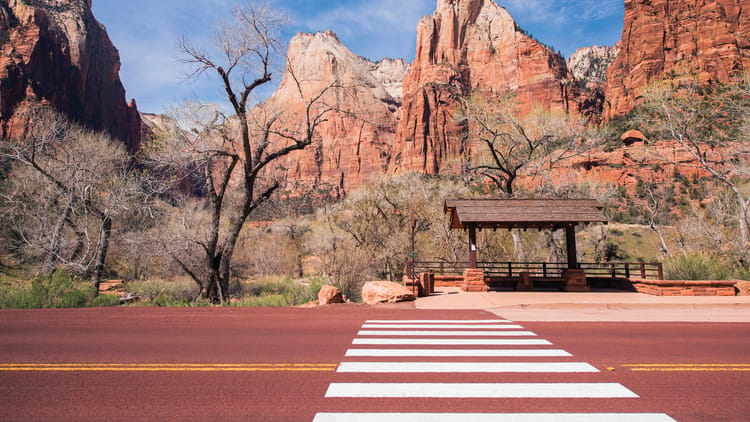
Five national parks in one trip, and you sleep in your own bed every night of it. Zion, Bryce Canyon, Capitol Reef, Canyonlands, and Arches run west to east across southern Utah, close enough that the drive between them is a morning rather than a travel day. You go to sleep under Zion's canyon walls. A few days later you're eating breakfast in an orchard that pioneers planted, with red cliffs standing over you.
None of it requires checking into anything. You move the RV four times in two weeks, and the rest is driving out to trailheads and coming back to your own kitchen.
Why Utah's Mighty 5 Works as One RV Trip
That shape makes this a line and not a loop. Zion anchors the southwest near Springdale. Bryce Canyon sits east of it and a good deal higher. Canyonlands and Arches share Moab at the far end. Drive all of it and you finish a long way from where you started, which matters if anyone's flying home.
Capitol Reef is the hinge: the midpoint and the least crowded of the five. Most people treat it as the park you pass through on the way to Moab, which is how it stays the quietest.
Zion and Bryce Canyon Are the Two Everyone Comes For
Zion is the one people picture. You drive up the floor of a canyon between sandstone cliffs of cream, pink, and red, and the scale takes most of a day to adjust to. Walk to the end of the Riverside Walk and the canyon keeps narrowing until the trail runs out and the river becomes the trail. That's The Narrows. Wading up a slot canyon with the walls closing overhead is what people fly across the country for. Angels Landing is the other famous one, and it needs a permit you apply for ahead of time.
Bryce is the opposite kind of place. Going straight from one to the other is half of why this trip works. At Zion you stand at the bottom looking up. At Bryce you stand on a rim looking down into an amphitheater packed with hoodoos, the largest concentration found anywhere on Earth. At sunrise the whole bowl lights up orange from the top down. People who claim not to be morning people get up for it.
Bryce keeps longer vehicles out of the rim lots during shuttle season. Sounds worse than it is. Park once at the shuttle station and ride in; the shuttle stops at every overlook you'd have driven to. A few roads out here turn on RV height clearance at national park tunnels, so it's worth knowing your numbers early.
Subscribe to our weekly newsletter.
ALL THE INFO YOU NEED TO PLAN YOUR PERFECT UTAH RV TRIP. FREE, EVERY WEDNESDAY.
Capitol Reef, Canyonlands, and Arches: The Quieter Three
Capitol Reef is built around the Waterpocket Fold, a wrinkle in the earth's crust that runs almost 100 miles. Settlers farmed the one green pocket in it and planted orchards, and those pioneer-era trees still stand under the Wingate cliffs beside the old barns. Fruit trees, in a red-rock desert. A strange, lovely thing to walk through after four days of sandstone. The paved Scenic Drive runs 7.9 miles, and its dirt spurs into Grand Wash and Capitol Gorge are usually fine for RVs up to 27 feet.
Canyonlands is one park that behaves like three. The Green and the Colorado meet in the middle of it and cut the land into three wedges, and no road inside the park crosses either river to join them. Pick wrong and you're on the wrong side of water with no bridge. Island in the Sky is the wedge between the two rivers, a mesa standing over 1,000 feet above the desert floor, about 40 minutes from Moab and paved the whole way. Walk to the edge at Grand View Point and the ground simply stops, a hundred miles of dirt road threading the bench far below. The Maze, across the water, wants high-clearance four-wheel drive and days of self-reliance. Same park, different vacation.
Arches holds over 2,000 stone arches, plus fins, pinnacles, and balanced rocks stacked in ways that look temporary and aren't. Delicate Arch is the one on the license plate, probably the most famous natural arch in the world. Devils Garden strings a run of them together, Double O included. It's also the crowded one. When the entrance line backs up to the highway or the trailhead lots fill, rangers hold new entries until it clears. Go early. Or go at dinnertime, when the tour vans have cleared out and the rock turns the color everyone came for.
Where an RV Actually Sleeps Between Parks
No chain of RV resorts runs between these parks, and the in-park campgrounds are small and booked months out on the timeline our guide to RVing in national parks walks through. So plan base camps instead of nightly moves: Springdale or the Zion campgrounds, Bryce Canyon City, Torrey for Capitol Reef, then Moab for the last two. Four moves, not eight, and four evenings where you're parked before dark instead of still driving.
Between those, southern Utah is generous with BLM land, and dispersed camping on it is free and legal in the right places. Our desert boondocking guide covers the heat and water math for Utah, Nevada, and Arizona, and if the terms are new, dispersed camping, boondocking, and stealth camping aren't the same thing.
If you reserve one thing, make it Moab. Arches and Canyonlands share a town, that town shares a season with every mountain biker in North America, and it fills.
How to Decide Which Direction to Drive It
There's no correct order, only a correct starting point: whichever end you're closest to. From Las Vegas or California, start at Zion and finish in Moab. From Denver or I-70, run it backwards.
Most people spend their extra day at Arches, because that's the postcard. But you can spend it at Capitol Reef instead. It's quiet, it's the middle of the drive, and it's the one park in the group where you can stand somewhere remarkable without a shuttle ticket or a parking strategy.
Measure your RV before you leave. The trip works or doesn't on a number most people have never checked.
FAQs
What are Utah's Mighty 5 national parks?
Zion, Bryce Canyon, Capitol Reef, Canyonlands, and Arches, all in southern Utah. Visit Utah coined the grouping and it stuck because the geography backs it up: the five chain into one road trip, west to east from Springdale to Moab.
Can you visit all 5 Utah national parks in one RV trip?
Yes, and it's one of the better multi-park RV trips in the country. Give it two weeks if you can, and plan four base camps rather than nightly moves: Zion, Bryce Canyon, Capitol Reef, then Moab for the last two.
Which of Utah's Mighty 5 is the most underrated?
Capitol Reef, and it isn't close. It sits in the geographic middle of the group, draws the smallest crowds of the five, and holds something none of the others do: a pioneer orchard still standing under the cliffs, with the Waterpocket Fold running almost 100 miles behind it. Most people treat it as the drive-through park between Bryce Canyon and Moab. Give it the extra day instead.



Categories
Related Posts
Subscribe to the Swervia Newsletter
The best RV stories, tips, and destinations—expertly curated and always free.