Can You Drive an RV Through Yellowstone? Size Limits, Roads & Parking for RVers
Yes, you can drive an RV through Yellowstone. The park caps recreation vehicles at 75 feet on its roads, and most of those roads handle a 40-foot RV without drama. Each campground then sets its own length limit, from 25 feet at Lewis Lake up to 95 feet at Fishing Bridge RV Park, the only in-park site with full hookups. So the real question is not whether you can drive Yellowstone in an RV. It is which parts of it your specific RV will physically fit. If you are still building the trip around those constraints, our Yellowstone RV trip itinerary lays out the four days these numbers have to accommodate.
That distinction is where most trip-planning goes sideways. People conflate three separate questions that have three separate answers: can your RV legally and safely drive the park roads, which campground will actually take your length, and what to do if your RV is too big for the good sites. This guide takes them one at a time, using the numbers the National Park Service publishes right now rather than the conflicting figures floating around older forum threads. Measure your trailer and your tow vehicle first, then add them together, then read on.
The Short Answer: Yes, but 75 Feet Is the Ceiling
The National Park Service states plainly that the maximum length for recreation vehicles is 75 feet on Yellowstone's roads. Almost no consumer RV comes close to that, so for driving purposes the ceiling is largely theoretical. A 40-foot Class A towing a car sits comfortably under it, and even a big fifth-wheel setup usually clears with room to spare.
The Park Service lists that 75 feet as a flat maximum for park roads, and in practice nearly every consumer RV combination sits comfortably below it, towed car included. Where measuring genuinely decides your trip is at the campground, and there the park is explicit: it wants your trailer and your tow vehicle added together. A setup that reads as a "32-foot trailer" on the spec sheet is a 52-foot reservation once the truck is counted. That distinction is the subject of the campground section below, and it is where most booking mistakes happen.
Driving Your RV Through the Park: Roads, Grades, and the Tight Spots
The 75-foot number tells you what is legal. It does not tell you what is comfortable, and Yellowstone's roads have opinions.
What the Roads Are Actually Like
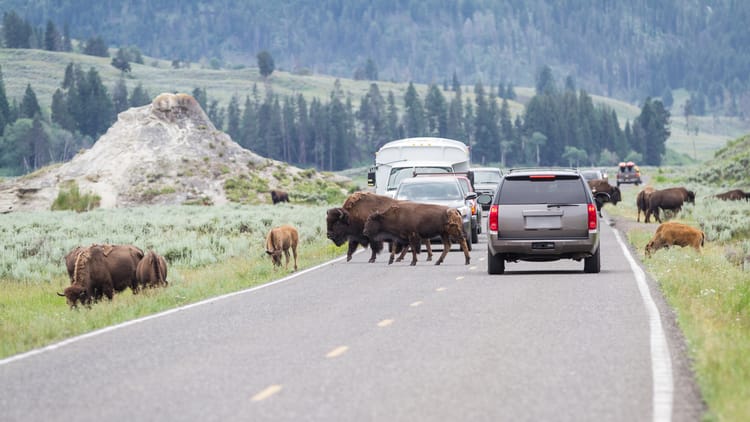
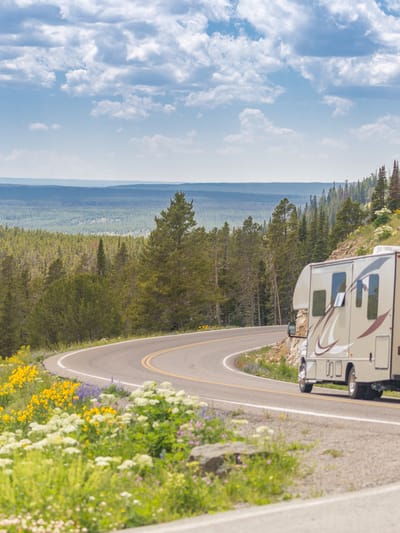
The park describes its own roads as winding over mountain passes with inclement weather, sharp curves, and steep grades. That is not marketing softness; it is a fair warning. You will climb and descend real mountain grades, take switchbacks that were laid out for 1930s sedans, and share narrow shoulders with a tour bus and a bison who both believe they have the right of way. None of it is beyond a competent RV driver, but a slow pace and good equipment make the difference.
Two upgrades matter more here than they do on flat interstate. A tire-pressure monitor turns a slow leak on a long descent into a dashboard warning instead of a roadside surprise, and heat plus grade is exactly when RV tires fail. A set of extended towing mirrors gives you a real view down both sides of a long RV on curves where guessing is not a plan. If you are towing a heavy trailer over the passes, a weight-distribution hitch with sway control keeps the whole RV planted when a crosswind or a passing semi tries to renegotiate your lane position.
Where Big RVs Get Pinched
The main figure-eight loop road is the easy part. The tighter driving lives on the interior spur roads, the short dead-end stretches out to specific overlooks and canyon rims, where the pavement narrows, the parking is limited, and turning a 40-footer around becomes a genuine problem.
Various RV guides quote hard length caps on a few of these spurs, but those numbers are not consistently posted on an official Park Service page and they change with construction and conditions. Treat them as a caution, not gospel: some interior spur roads and overlook lots are tighter than the main loop. Check the park's current conditions and road status before you commit a long RV to any dead-end road. When in doubt, park the big one and take the smaller vehicle out to the overlook.
Why Big-RV Owners Tow a Car
Drivers of 40-foot-plus motorhomes almost never sightsee in the motorhome. They tow a smaller vehicle, a "toad" in RV shorthand, set up camp once, and explore the park in the car all week. It is faster, cheaper on fuel, far less stressful in a crowded overlook lot, and it sidesteps the spur-road question entirely. If you own a big motorhome and a tow car, Yellowstone is a textbook case for using them exactly as designed.
Campground Length Limits, Decoded
Here is where the length question actually bites, and where the older lists online do the most damage. Aggregator blogs quote Yellowstone campground limits at 27, 35, 40, and 42 feet almost interchangeably, and they are frequently years out of date. The numbers below come straight from the current NPS campgrounds page.
How Yellowstone Measures Your RV
The number you give when you book is combined length. Yellowstone's campground table heads that column "RV + Vehicle max length," and the park's concessioner asks reservation callers for "the length of your truck in addition to the length of your trailer when fully open." So a 32-foot trailer behind a 20-foot truck is a 52-foot booking, not a 32-foot one. That is the arithmetic that surprises people.
There is one documented exception, and it is worth knowing because it is the difference between fitting and not. At Fishing Bridge RV Park, designated sites are built to hold the towing unit and the towed unit side by side rather than nose to tail. The concessioner's own example: a 35-foot site will take an 18-foot truck and a 35-foot trailer, unhooked, parked alongside each other. Measure with your slideouts out when you check that math. The catch is that not every site there works this way, because some Fishing Bridge sites are single-wide and will not accommodate side-by-side parking at all.
Outside Fishing Bridge, do not plan on unhooking your way under a limit. The park's other campgrounds publish a combined figure without any side-by-side provision, so assume the truck counts against your total. Before you rule a campground out, it is still worth pulling up your specific site on recreation.gov, where each listing shows driveway length, whether it is pull-through or back-in, and how many vehicles are allowed. And if you are close to a limit, call and ask rather than guessing, since the person who assigns sites knows which ones actually take what. If you are shopping for a first trailer partly around where it can go, it is worth understanding what lightweight travel trailers actually weigh and measure, because length and weight both decide your options.
The Campground-by-Campground Reality
Yellowstone runs a dozen campgrounds, and their RV limits span a huge range. From most to least accommodating:
Fishing Bridge RV Park takes RVs up to 95 feet and is the only in-park campground built for the longest RVs. It is hard-sided units only, and the rule is tighter than "no tents": tent campers are out, and so is any camper with a tent-style slideout, because it sits in prime bear country.
Bridge Bay and Madison each cap at 60 feet, which covers the large majority of consumer RVs, toad included.
Grant Village takes up to 50 feet.
Mammoth allows up to 45 feet from roughly May through mid-October, dropping to 30 feet in winter when it is the park's only cold-season campground.
Canyon caps at 40 feet, a common surprise for anyone assuming the park's biggest developed campground takes the biggest RVs.
Indian Creek tops out at 35 feet.
Slough Creek, Tower Fall, and Pebble Creek, the small northeast-corner campgrounds, run in the neighborhood of 30 feet, with a mix of shorter sites and a few longer pull-throughs.
Lewis Lake is the tightest at 25 feet, best treated as a van-and-small-trailer campground.
Because these figures do get updated, confirm your specific campground's current limit on the NPS Yellowstone campgrounds page before you book. And whichever site you land, backing a long RV into a length-limited slot with a tree on one corner is its own event; a wireless backup camera for tight sites and a good set of leveling blocks make the difference between a two-minute set-up and a marital incident. Our camp arrival checklist walks the rest of the routine.
Hookups: Fishing Bridge Is the Only Full-Hookup Option
If you want water, sewer, and electric all at your site inside the park, there is exactly one address: Fishing Bridge RV Park, the only campground offering full hookups, with 50-amp or 30-amp service depending on the site. Its 95-foot ceiling is combined length too, RV plus tow vehicle, and the concessioner notes that fitting the longest setups depends on a right-size site being available. Every other in-park campground is dry or, at best, has a dump station and potable water fill on the way in and out, but no electric or sewer at the pad. Plan your power and water around that reality. If you do score Fishing Bridge, a 50-amp surge protector is cheap insurance against the voltage swings that come with a big shared electrical system in the mountains.
4-DAY YELLOWSTONE RV ITINERARY
GET THE FREE 4-DAY YELLOWSTONE RV ITINERARY
What If Your RV Is Too Big for In-Park Campgrounds?
Plenty of RVs are. A 43-foot fifth wheel with a truck up front, or a 45-foot Class A towing a Jeep, blows past almost every in-park limit except Fishing Bridge, and Fishing Bridge books out months ahead. Being too big for the interior is not the end of the trip. It just changes where you sleep.
Gateway Full-Hookup Parks
The towns ringing Yellowstone exist in part to catch exactly this overflow. West Yellowstone, Montana, at the busy west entrance, has full-hookup private RV parks built for large motorhomes, including the well-known Yellowstone Grizzly RV Park a few blocks from the gate. Gardiner, Montana, guards the north entrance and the road to the Lamar Valley. Cody, Wyoming, sits east of the park along a scenic approach. All three offer the amenities the interior campgrounds lack, longer sites, full hookups, real showers, and reliable cell service, at the cost of a drive to the entrance each morning.
Base Camp Outside, Day-Trip In
This is the same toad logic, scaled up to the whole trip. Park the big RV at a gateway full-hookup site, leave it set up all week, and drive into the park in your tow vehicle or a smaller car each day. You trade a little morning windshield time for full hookups, no interior length worries, and a stress-free daily drive on Yellowstone's tighter roads. For a lot of large-RV owners it is genuinely the better trip, not the consolation prize. The same approach works across the region; our guide on what to know before your first RV trip out West covers the wider logistics.
Booking, Seasons, and the Rules That Trip People Up
A few operational details decide whether the plan actually holds together. In-park campground reservations currently run through recreation.gov and the park's concessioner, Yellowstone National Park Lodges, and the popular ones open a window months in advance and vanish fast, especially for summer. One change to know about if you are planning ahead: the concessioner has said that starting in 2027, reservations for the campgrounds it runs move to recreation.gov, though it keeps managing the campgrounds themselves.
Stay limits are set by the concessioner rather than posted as a park-wide NPS rule, and they are stricter than most people expect. From July 1 through Labor Day you get a maximum of 14 nights, and the count follows you: nonconsecutive nights across different Xanterra and NPS campgrounds all add up. Outside that window the cap is 30 nights, and there is a season-long ceiling of 44 total nights. The one documented exception is Fishing Bridge RV Park, which the concessioner states has no length-of-stay limit at all. Rental RVs cannot be dropped off or picked up inside the park, so if you are renting, you collect the RV in a gateway town. Generator hours are restricted in the campgrounds, which matters if you are dry camping and counting on a generator for power.
Yellowstone is also a summer-weighted park for RVers. Most campgrounds and most of the road system open late spring and close in fall, with Mammoth the main cold-season holdout. Before any shoulder-season trip, check the park's current conditions for road and campground status, because a spring snowstorm can reshuffle your itinerary overnight. Our free Yellowstone 4-Day RV Guide maps the four days around those constraints, with the base-camp options laid out gate by gate. If Yellowstone is one stop on a bigger loop, our roundup of the top national parks for RV camping in the West and the broader national-parks RV planning guide help you sequence the rest. And if your route in or out crosses the mountains, our list of highways that punish big RVs is worth a look before you commit to a pass.
FAQs
Can you drive an RV through Yellowstone?
Yes. Yellowstone allows recreation vehicles up to 75 feet long on its park roads, which covers essentially every consumer RV. The roads are mountainous, with steep grades and sharp curves, so a slow, careful pace is the norm, but there is no restriction that keeps a normal-length RV out of the park. The tighter driving is on short interior spur roads to overlooks, where many big-RV owners park the motorhome and drive a smaller vehicle instead.
What is the maximum RV length allowed in Yellowstone?
The National Park Service sets the maximum length for recreation vehicles at 75 feet on Yellowstone's roads. Almost no consumer RV reaches that, so the road limit rarely comes into play. The campground limits are the numbers that actually constrain trips: they range from 25 to 95 feet, and they are measured as combined length, meaning your trailer plus your tow vehicle added together, or your motorhome plus the car behind it.
What is the biggest RV Yellowstone campgrounds allow?
Fishing Bridge RV Park accepts RVs up to 95 feet and is the only in-park campground built for the largest motorhomes, as well as the only one with full hookups. After that, Bridge Bay and Madison cap at 60 feet, Grant Village at 50, Mammoth at 45 in summer, Canyon at 40, Indian Creek at 35, the small northeast campgrounds around 30, and Lewis Lake at 25. Those figures are combined length, your trailer plus your tow vehicle, so add both before you book. The one exception is Fishing Bridge, where designated sites hold the tow vehicle and trailer side by side unhooked, meaning a 35-foot site there takes a 35-foot trailer plus an 18-foot truck; some Fishing Bridge sites are single-wide and do not. Everywhere else, assume the truck counts against the total.
Which Yellowstone campground has full hookups?
Only Fishing Bridge RV Park has full hookups, meaning water, sewer, and electric service at the site, with 50-amp or 30-amp power depending on the site. Every other in-park campground is dry camping or offers only a dump station and potable-water fill, with no electric or sewer at the pad. Fishing Bridge is also hard-sided units only, which rules out tents, tent campers, and any camper with a tent-style slideout, because it sits in active bear country. It books out well in advance for summer, and its 95-foot maximum is combined length, RV plus tow vehicle.
Is Yellowstone hard to drive in a big RV?
It is manageable but demanding. The main loop road handles a 40-foot RV comfortably, but you will face mountain grades, sharp curves, narrow shoulders, crowded overlook lots, and wildlife that stops traffic without warning. Interior spur roads to some overlooks are tighter and harder to turn around in. Most owners of RVs longer than about 40 feet base-camp at a gateway full-hookup park and tour the interior in a smaller vehicle, which removes nearly all of the difficulty.
Related Posts
Subscribe to the Swervia Newsletter
The best RV stories, tips, and destinations—expertly curated and always free.