The Yellowstone + Grand Teton RV Road Trip: Route, Campgrounds & Timing
Search "Yellowstone and Grand Teton road trip" and you get a hundred versions of the same five-day plan, all written for someone in a rental sedan with a hotel booked in Jackson. Those plans are fine. They also fall apart the moment you are driving something 30 to 45 feet long that has to sleep somewhere every night.
An RV changes every decision on this trip. It changes which campgrounds you physically fit into, where the only hookups are, when the connector road is even open, and whether you move every day or plant the RV and day-trip from a base. This is the version of the Yellowstone and Grand Teton road trip written for the way RVers actually travel: two parks, one connecting parkway, and a set of logistics the generalist itineraries skip entirely.
There is nothing wrong with the "book a hotel in town and day-trip in" camp. It works beautifully for people who fly in and rent a car. But when your lodging has wheels, a holding tank, and a length limit, you plan differently, and that is what the rest of this guide is about.
The Short Answer: Is This Trip Doable in an RV
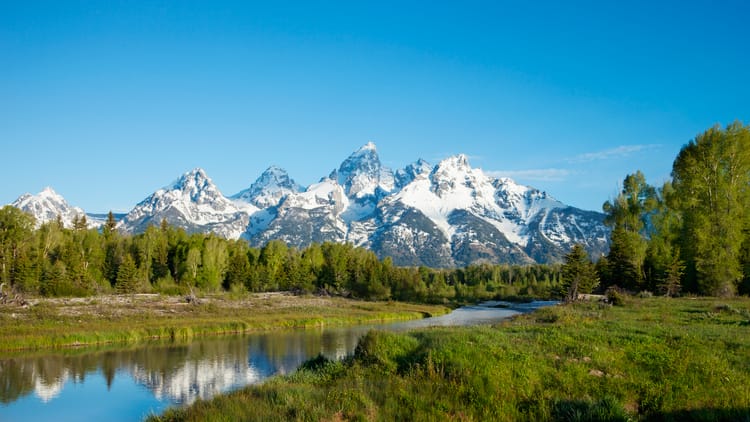
Yes, and it is more straightforward than the map makes it look. Grand Teton and Yellowstone share a border, joined by the John D. Rockefeller Jr. Memorial Parkway, a 24,000-acre corridor of US-89/191/287 running from Grand Teton's north boundary to Yellowstone's South Entrance. You never have to leave the protected corridor to get from one park to the other.
Plan on four to six days. You can technically blitz both in three, but you will spend most of that time behind the wheel and setting up camp in the dark, which is nobody's idea of a vacation. Four to six days lets you base-camp in each park, day-trip the loops, and still have a morning or two where the biggest decision is a second cup of coffee. If you only have a long weekend, pick one park and do it well rather than dividing three days across two enormous parks and a connecting drive.
The catch is timing and fit, not distance. The connector and the interior roads are seasonal, and not every campground takes a big RV. Get those two things right and the rest of the trip is genuinely relaxing. If Yellowstone is the half you care most about, our full Yellowstone RV trip itinerary goes day by day through that park on its own.
The Route: Grand Teton to Yellowstone (the Connector)
The Drive Itself
Here is the fact that surprises most first-timers: Grand Teton and Yellowstone are not a long haul apart. From the heart of Grand Teton near Colter Bay to Yellowstone's South Entrance is about 20 miles, and from the South Entrance up to the interior hubs like Grand Village or Fishing Bridge is another 20-plus miles of park road. Door to door, base camp to base camp, you are usually looking at a two-hour driving day, not a marathon.
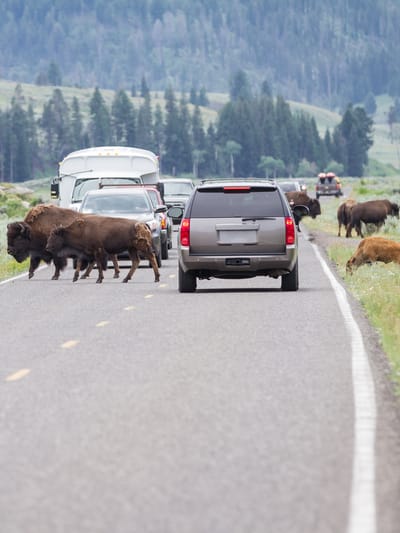
That two hours comes with an asterisk in an RV. Park roads are narrow, frequently under construction in early season, and prone to wildlife jams that can freeze traffic for 20 minutes while a bison decides the centerline is his. Plan the transfer day as a travel day, not a sightseeing day, and you will arrive with daylight to spare. The route runs through the Rockefeller Parkway, and the National Park Service keeps the corridor's current conditions on the Grand Teton parkway page, which is worth a look before you roll.
Which Direction to Drive It and Why
Most RVers do this trip south to north: start in Grand Teton, then move up into Yellowstone. There are two practical reasons. First, Grand Teton is smaller and easier to read as a warm-up, so you get your park-road legs under you before Yellowstone's bigger distances and denser crowds. Second, the base-camp logic works cleaner in that direction. You settle into a Teton campground for a couple of nights, break camp once, make the short hop north, and settle into a Yellowstone campground for the rest of the trip. Two setups, two teardowns, instead of the daily hitch-and-unhitch grind.
If you are entering the region from the north, from Bozeman or the Montana gateways, you will simply run it in reverse, Yellowstone first. The base-camp principle does not care which direction you drive it. It only cares that you stop moving the RV every single day.
One perishable note: the South Entrance and the parkway connection are seasonal. In shoulder months the connector can be the difference between a two-hour transfer and a several-hour detour around through other entrances. Always confirm current road status at nps.gov/yell and nps.gov/grte before you commit to a route.
When the Roads Are Actually Open (and the Best Time to Go)
This is where an RVer cares more than a car tourist, because a closed interior road does not just cost you a scenic overlook. It can strand your entire base-camp plan.
Yellowstone's roads open in phases in spring, weather permitting. In 2026, select entrances and roads opened to the public at 8 a.m. on April 17, with the remaining interior roads plowed and opened in stages through late May. Fall runs in reverse, with interior roads beginning to close in early November. Grand Teton's main season and campground openings fall in that same late-April-through-early-October window. Treat every one of those dates as a 2026-season data point, not an evergreen fact, and check the current-year schedule before you book anything.
The sweet spot for most RVers is late May through September. June and September are the shoulder favorites: thinner crowds, cooler grades for towing, and campgrounds that are open but not yet at July-Fourth-weekend chaos levels. July and August are gorgeous and completely booked, which brings us to the single most important planning move on this trip.
One heads-up worth filing away: Grand Teton's Moose-Wilson Road is closed to RVs and trailers entirely, anything over 280 inches or 23.3 feet, at any time of year. Take the toad or the tow vehicle, or skip it. It is a scenic connector, not a lifeline, and it is easy to route around.
4-DAY YELLOWSTONE RV ITINERARY
GET THE FREE 4-DAY YELLOWSTONE RV ITINERARY
Where to Park the RV: Campgrounds by Length and Hookups
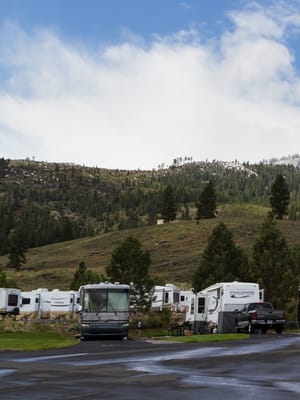
This is the section the sedan-and-hotel itineraries cannot write for you, because they never had to. In an RV, the campground is not a footnote. It is the entire spine of the trip. Here is what actually fits, and where the power is.
Grand Teton Campgrounds
Colter Bay RV Park is the full-hookup option in Grand Teton, with water, sewer, and electric at the site. Pull-through sites accommodate RVs up to about 45 feet, and back-in sites cap closer to 30 feet. The 2026 season runs roughly May 4 through October 9. If you want to arrive, plug in, and not think about your tanks for a few days, this is the Teton base camp.
Gros Ventre Campground is the big-RV workhorse on the Teton side, accommodating RVs up to 45 feet, with a 2026 season starting in late April and running into early October. It is a large campground with a mix of site types and is a strong pick if Colter Bay is full.
Signal Mountain and Lizard Creek are the scenic small-RV options, both limited to roughly 30 feet. They are lovely and lakeside, and they are also a hard no for anything longer. If you are driving 40-plus feet, do not build a plan around either one.
A full-hookup site means shore power, and shore power means you want protection between the pedestal and your RV. A 50-amp surge protector guards your electronics against the miswired or over-voltage pedestals that turn up even at well-run parks, and a water-pressure regulator keeps variable park hookup pressure from blowing a fitting inside the wall where you cannot see it. Both live permanently in the wet bay of most experienced RVers for exactly this reason.
Yellowstone Campgrounds
Here is the fact that reorganizes everyone's plan: Fishing Bridge RV Park is the only campground in all of Yellowstone with full hookups — water, sewer, and 30/50-amp electric. It takes hard-sided RVs only, no tents and no pop-ups, because it sits in prime grizzly country. It accommodates RVs up to about 95 feet, its 2026 season runs roughly May 8 through October 18, and it is reserved through the park's lodging operator (with the reservation system moving to Recreation.gov in 2027). If you want hookups inside Yellowstone, this is the one and only address.
Everything else in Yellowstone is a dry campground. Bridge Bay, Madison, Canyon, and the rest offer no hookups, which is fine for a night or two if your RV is set up for it and a real problem if it is not. Dry camping means running on your batteries and fresh-water tank, and if you plan to skip hookups for more than a night, a portable power station sized for an RV keeps the fridge, the fans, and the devices alive without idling a generator during quiet hours. Plan your water and tank capacity honestly before you commit to a string of dry nights.
The Length-Limit Cheat Sheet
Read this before you reserve anything. Colter Bay RV Park takes up to about 45 feet on pull-throughs, 30 on back-ins. Gros Ventre takes up to 45 feet. Signal Mountain and Lizard Creek cap around 30 feet. Fishing Bridge RV Park takes up to about 95 feet but hard-sided only. The pattern is simple: if you are under 30 feet you can stay almost anywhere, and if you are over 40 feet your options narrow fast, so book the campgrounds that fit you the moment reservations open. For the reservation and permit mechanics across the park system, our national parks RV planning guide walks through how the booking windows actually work.
Two more items earn their place in the bay before you get here. Leveling blocks matter because a lot of these sites are unlevel, and a level RV is the difference between a good night's sleep and slowly migrating to one corner of the mattress. A wireless backup camera pays for itself the first time you have to reverse a long RV into a tight back-in site with a line of cars watching.
A Sample 5-Day Base-Camp Itinerary for RVers
The whole idea here is two base camps, not five one-nighters. You are not touring the parks so much as living beside them for a few days each.
Days 1 and 2, Grand Teton side. Set up at Colter Bay or Gros Ventre and leave the RV there. Day-trip the Teton Park Road, the Jenny Lake area, and the overlooks. Use the toad or the tow vehicle for in-park driving so the big RV stays planted. This is your warm-up: shorter distances, easier roads, staggering scenery.
Day 3, the transfer. Break camp, make the short run north through the Rockefeller Parkway and into Yellowstone's South Entrance, and set up at Fishing Bridge (or a dry campground if you booked one). Treat the whole day as a travel day and you will not feel rushed.
Days 4 and 5, Yellowstone side. Day-trip the loops from your Yellowstone base. Old Faithful and the geyser basins one day, the Grand Canyon of the Yellowstone and Hayden Valley wildlife the next. You will not see all of Yellowstone in two days, and that is the correct expectation. You will see enough to know you are coming back.
Stretch this to six or seven days and you simply add breathing room, not new setups. That is the base-camp payoff: the RV moves once, and the rest of the time it just sits there being your kitchen and your bed.
Big-RV Realities Most Itineraries Skip
This is the section that earns the RV in the title. None of it is a reason to skip the trip. All of it is worth knowing before you are halfway up a grade wondering why the temperature gauge is climbing.
Mountain grades and cooling. The roads in and out of both parks climb and descend real elevation, and a heavy RV works hard on a sustained grade. Watch your engine and transmission temperatures, use lower gears on the descents so you are not riding the brakes, and give yourself extra following distance. A tire-pressure monitoring system is genuinely useful here, because heat plus long grades plus a loaded RV is exactly the recipe that finds a weak tire.
Fuel gaps. Gas stations inside the parks are limited and seasonal, and prices reflect the captive audience. Top off in the gateway towns before you enter, and do not let a big motorhome coast into a park on a quarter tank assuming there is a station around the next bend.
Wildlife jams. A bison herd or a bear sighting can stop traffic cold, and a long RV has nowhere to go while it waits. Build slack into every driving day and accept that "animal jam" is a legitimate and frequent cause of delay. It is also, frankly, part of why you came.
Cell dead zones and generator hours. Cell coverage inside both parks is spotty to nonexistent, so download maps and reservations offline before you lose signal. Our free Yellowstone 4-Day RV Guide is built for exactly that — the whole four days on paper, readable with no bars. If you are running a generator at a dry campground, respect the posted quiet hours — your neighbors can hear it, and campground goodwill is a real currency out here. First-timers heading into this kind of country will find more of the groundwork in our guide to what you need to know before your first RV trip out West.
When the campgrounds are full. July and August fill up, and sometimes the park campgrounds are simply booked. The public lands around the parks are the pressure valve. Dispersed camping on the surrounding national forest is a legitimate overflow option if you are self-contained — our breakdown of national forest camping rules and limits explains how it differs from BLM land, and our beginner's guide to BLM camping covers the free-camping fallback when everything inside the gates is taken. If Yellowstone and the Tetons leave you wanting more Western parks, our roundup of the top national parks for RV camping in the West is a good place to plan the next loop.
FAQs
How many days do you need for a Yellowstone and Grand Teton road trip?
Plan on four to six days to do both parks without living behind the wheel. Three days is possible but rushed, since you would be splitting limited time across two large parks plus the connecting drive. Four to six days lets you base-camp two nights in Grand Teton and three in Yellowstone, day-trip the major loops, and still have unhurried mornings. If you only have a long weekend, do one park well instead of both poorly.
How far is Grand Teton from Yellowstone?
The parks share a border, so the drive is short. From the Colter Bay area in Grand Teton to Yellowstone's South Entrance is about 20 miles, connected by the John D. Rockefeller Jr. Memorial Parkway. Add another 20-plus miles from the South Entrance to Yellowstone's interior hubs. Realistically, base camp to base camp is about a two-hour driving day in an RV once you factor in narrow roads and wildlife jams.
Where should RVers stay near Yellowstone and Grand Teton?
For full hookups, there are two names to know: Colter Bay RV Park in Grand Teton and Fishing Bridge RV Park in Yellowstone, the only full-hookup campground in the entire park. Gros Ventre in Grand Teton takes big RVs up to 45 feet but is a dry campground, while Signal Mountain and Lizard Creek cap around 30 feet. Everything else inside Yellowstone is dry camping, so book the hookup sites the day reservations open if you need power.
What is the best time to visit Grand Teton and Yellowstone?
Late May through September is the reliable window, with June and September as the shoulder-season favorites for thinner crowds and cooler towing conditions. Yellowstone's roads open in phases in spring — in 2026, select roads opened April 17, with the rest through late May — and interior roads begin closing in early November. Treat those as current-year dates and confirm the schedule at nps.gov/yell and nps.gov/grte before you finalize a trip.
Can a 40-foot RV do the Yellowstone and Grand Teton trip?
Yes, but your campground list gets shorter. A 40-foot RV fits Colter Bay RV Park pull-throughs (up to about 45 feet) and Gros Ventre (up to 45 feet) in Grand Teton, and Fishing Bridge RV Park (up to about 95 feet, hard-sided only) in Yellowstone. It will not fit Signal Mountain or Lizard Creek, which cap around 30 feet. Book the big-RV-friendly campgrounds early, watch your grades and temperatures on the mountain roads, and the trip is very doable.
Related Posts
Subscribe to the Swervia Newsletter
The best RV stories, tips, and destinations—expertly curated and always free.