Dog-Friendly Yellowstone: What RVers With Pets Need to Know
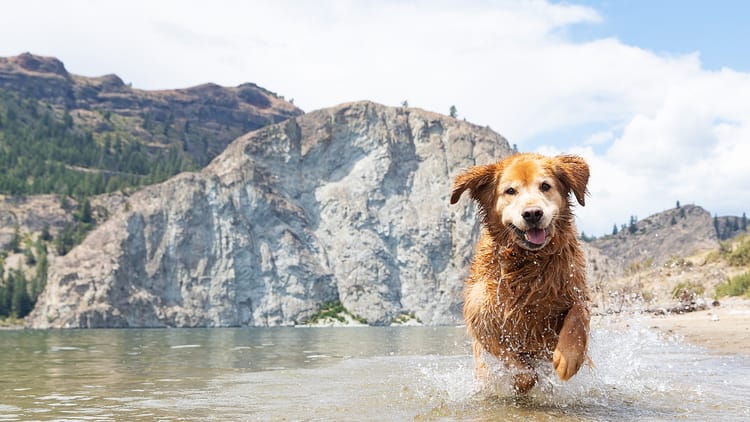
Here is the sentence nobody wants to open with: Yellowstone is one of the least dog-friendly national parks in the country. Dogs are banned from every trail, every boardwalk, the entire backcountry, and all the thermal areas — which is to say, banned from the exact things people drive across the country to see. If you searched this hoping for a list of pawsome trails, that list does not exist here, and any article that hands you one is making it up.
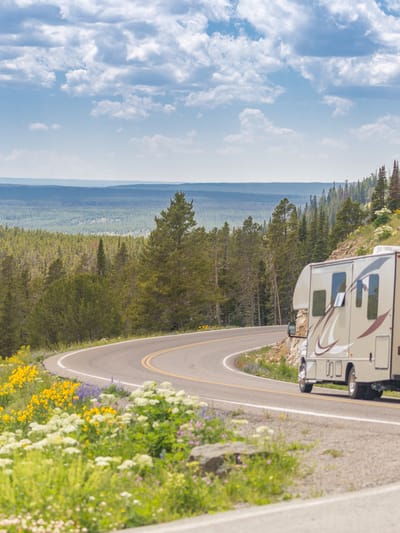
What does exist is a workable plan. RVers actually have an advantage over the hotel crowd on this one: the dog already travels with you, sleeps in your space, and rides shotgun through the park all day. You just have to know where the lines are and build the trip around them. Here is how to do that without leaving your dog somewhere it shouldn't be.
Can You Bring Dogs to Yellowstone? The Short Answer
Yes — with real limits. Dogs are allowed in Yellowstone's developed areas only, and they must stay within 100 feet of roads, parking areas, and campgrounds. They have to be on a leash no longer than six feet, or crated, or in your vehicle, at all times. They are not allowed on any hiking trail, on any boardwalk, in the backcountry, or near thermal areas. That is the whole rule, and the National Park Service pet policy states it plainly.
The Exact Rules, No Interpretation
The park keeps this short, so we will too:
- Pets stay within 100 feet of roads, parking lots, and campgrounds. That 100-foot bubble is the entire map of where your dog can legally be.
- Leash of six feet maximum. No retractable leash paid out to twenty. No off-leash "he's friendly." Physical control, always.
- No trails, boardwalks, backcountry, or thermal basins. The Old Faithful boardwalk, the Grand Canyon of the Yellowstone rim trails, every named hike — all off-limits with a dog.
- Never left unattended, and never tied to an object. You cannot clip the leash to a picnic table and walk off. More on why this rule quietly reshapes your whole itinerary below.
- Bag and pack out the waste. Standard, but worth saying.
Why the Rules Are This Strict
This is not the park being fussy. Yellowstone is active predator country — a small leashed dog reads as prey to a coyote and as a threat to a bear, and both encounters end badly. The thermal features are scalding and have no railings a dog understands; animals have died breaking through thin crust into boiling water. And park wildlife and domestic dogs trade diseases neither one has immunity to. The rules exist because the alternatives are genuinely grim, which makes them easier to follow once you know the reasoning.
The RV Problem Nobody Warns You About: Heat and the Unattended Rule
Here is where RVers hit a wall the guidebooks skip. You cannot take the dog on the trail. You also cannot leave the dog unattended — that is a park rule, not a suggestion. So the obvious move, "leave the dog in the RV while we hike," runs straight into both a safety reality and a regulation.
A closed RV in summer sun becomes an oven fast, even at Yellowstone's elevation where the morning felt cool. Interior temperatures climb into dangerous territory within minutes on a bright day, and a parking lot at Uncle Tom's has no shade to spare. A dog left in that box is in real trouble long before you would guess. This is the single problem that decides how RVers actually tour the park.
The Honest Verdict
Plan not to leave the dog in a hot RV at all. Every reliable version of a Yellowstone dog trip is built so the dog is either with a person or somewhere designed for dogs — never baking in a parked motorhome while you are three miles up a trail with no signal. Build the itinerary around that and the heat problem stops being a daily gamble.
4-DAY YELLOWSTONE RV ITINERARY
GET THE FREE 4-DAY YELLOWSTONE RV ITINERARY
Where Your Dog Can Actually Be in Yellowstone
The 100-foot bubble sounds tiny until you realize how much of a Yellowstone day an RVer spends inside it anyway — in the vehicle, in the campground, at the pullouts. Your dog can be in developed areas, in parking lots, along the road shoulder within that 100 feet, in campgrounds, and inside your RV while you drive. That is more park than it first appears.
Scenic Drives Are the Win
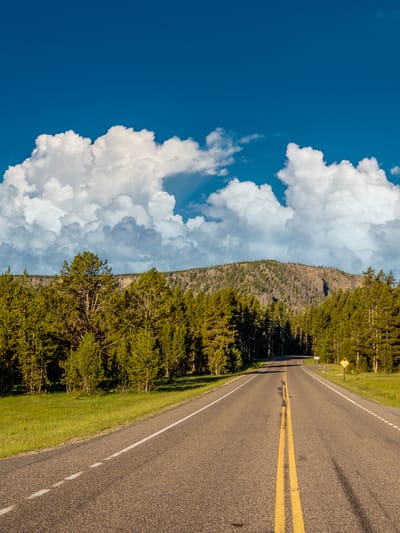
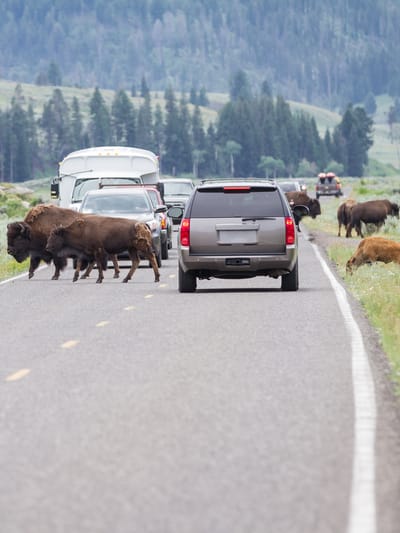
Yellowstone's Grand Loop is 142 miles of the exact scenery people fly in for, and a dog is completely welcome to ride the whole thing. Wildlife in the Lamar and Hayden valleys, the drive past the Yellowstone River, the geyser basins from the road — the dog sees all of it through the window and joins you for leashed stretch-and-sniff breaks at the pullouts. For a dog, a full day of new smells out the window and a dozen roadside stops is a genuinely good day. For you, it is most of the park's greatest hits without breaking a single rule.
Pet-Friendly Campgrounds
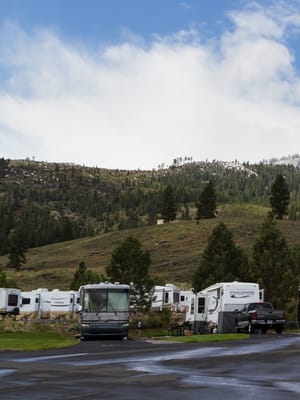
Leashed pets are welcome in Yellowstone's campgrounds, and for an RVer the campground is the dog's home base for the trip — the one place it can relax off the vehicle seat. A few campgrounds have short walking paths inside the developed footprint where a leashed dog gets real exercise without crossing into trail territory. Which campground fits your RV, your hookups, and your route is a bigger conversation, and our full Yellowstone in an RV itinerary handles the campground logistics in depth so this guide does not have to repeat them, and our rundown of the best RV campgrounds in and near Yellowstone gets specific about which loops actually have room to walk a dog.
What to Do With the Dog on a Big-Hike Day
Some days you want the trail — the real one, the one dogs cannot join. Here are the three ways RVers make that work.
Tour in Shifts
The simplest fix costs nothing. One person hikes while the other takes the dog on a scenic drive or hangs at the campground, then you swap the next day. Couples do this constantly in Yellowstone and it turns the dog from a problem into a reason one of you always has an easy, beautiful day. Nobody misses the marquee hikes; you just do them solo and trade stories at the campfire.
Gateway-Town Day Kennels
There are no kennels inside the park, but the gateway towns have day boarding — with a catch worth stating clearly. West Yellowstone is thin on options; plan on essentially one daycare there and book it well ahead, because a single facility fills fast in July. Gardiner, at the north entrance, has more choices. Wherever you land, reserve before your trip, confirm the business is still operating the week you go, and never treat a hot car as the backup plan when boarding falls through. A day kennel is what frees both of you to hike the same trail on the same day — worth planning around, not worth improvising.
Dog-Legal Ground Just Outside the Park
The national forest land surrounding Yellowstone plays by different, friendlier rules, and leashed dogs are welcome on many trails there. On a shift day, the dog-and-driver half of the team can find real hiking just outside the boundary instead of settling for another pullout. Access and parking change season to season, so confirm the specific trail before you commit an RV to a forest road — but the option is there, and it is a good one.
Packing for a Yellowstone Trip With Your Dog (RV Edition)
Yellowstone adds a few things to the standard dog kit:
- A six-foot leash that meets the park's exact limit — leave the retractable at home, since it is not legal here anyway.
- ID tags plus [a GPS collar that pings your phone if the dog bolts](https://amzn.to/4gUY7mz) — this is grizzly and bison country, and a spooked dog that slips a leash is a genuine emergency, not an inconvenience.
- A collapsible bowl and plenty of water for the pullout stops, since developed-area spigots are not everywhere.
- Cooling gear — a battery misting fan for the hot afternoons and an elevated cot-style bed that lets air move underneath at the campsite.
- Waste bags, more than you think you need.
- A crate for safe travel and a settled spot at the campsite.
Making the Call
Yellowstone with a dog is not the trip where your dog summits anything. It is the trip where your dog logs 142 miles of window scenery, holds down the campsite, and reminds you why touring in shifts is secretly a great way to see a park twice. Go in knowing the trails are off the table, build the days around the 100-foot rule and a solid heat plan, and it works. Go in expecting to hike Mount Washburn with the dog at your heel, and you will spend the week frustrated at a park that told you the rules up front. Plan for the park Yellowstone actually is, and it is a genuinely good place to bring the dog along.
For the bigger picture on park rules, RV-size limits, and campground booking across the whole trip, our Yellowstone in an RV itinerary is the map. And if Yellowstone is one stop on a longer western loop, what you need to know before your first RV trip out west covers the ground this guide doesn't. The free Yellowstone 4-Day RV Guide puts those same four days on paper, which matters on a trip where you will be back at the RV checking on the dog more than you expect.
FAQs
Can you bring dogs to Yellowstone?
Yes, but only in developed areas. Dogs must stay within 100 feet of roads, parking areas, and campgrounds, and be leashed to six feet, crated, or in your vehicle at all times. They are not allowed on any trail, boardwalk, in the backcountry, or near thermal areas. In practice that means your dog can ride the scenic drives and stay at the campground, but cannot join you on hikes.
Can dogs go on trails or boardwalks in Yellowstone?
No. Dogs are prohibited on all hiking trails, all boardwalks, throughout the backcountry, and in every thermal area — this includes the Old Faithful boardwalks and every named trail in the park. The rule protects dogs from predators and scalding thermal features, and protects wildlife from disease. There are no exceptions for small or well-behaved dogs; the only animals allowed beyond these limits are trained service animals performing a task.
Are there kennels in Yellowstone?
There are no kennels inside the park itself. Day boarding and daycare are available in the gateway towns — West Yellowstone has limited options and Gardiner has more — but they fill quickly in summer, so reserve ahead and confirm the business is operating the week of your trip. A gateway-town day kennel is the standard way RVers free themselves to hike a dog-prohibited trail without leaving a pet unattended.
Can I leave my dog in the RV at Yellowstone?
No. The park prohibits leaving pets unattended, and a closed RV in summer sun heats to dangerous temperatures within minutes even at Yellowstone's elevation, so a parked motorhome is never a safe place to leave a dog while you are away. Plan the trip so the dog is always with a person: use a gateway-town day kennel or tour in shifts on any day someone wants to hike.
What is the leash rule in Yellowstone?
Dogs must be on a leash no longer than six feet at all times in developed areas, or otherwise physically controlled by being crated or kept in a vehicle. Retractable leashes extended beyond six feet do not comply. Pets also may not be left unattended or tied to an object and left alone, so the leash always has a person on the other end.
Are pets allowed in Yellowstone campgrounds?
Yes. Leashed pets are welcome in the park's campgrounds, which makes the campground the dog's home base for an RV trip. Some campgrounds have short walking paths within the developed area where a leashed dog can get exercise without entering trail territory. Pets still must stay within 100 feet of the campground and developed areas, and cannot be left unattended at the site.
Related Posts
Subscribe to the Swervia Newsletter
The best RV stories, tips, and destinations—expertly curated and always free.