The Best RV Campgrounds In and Near Yellowstone
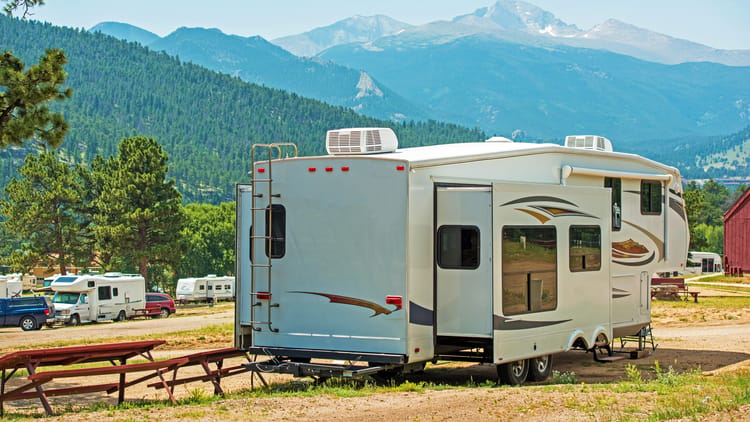
Here is the whole truth up front, because the generic "12 best campgrounds" lists bury it: Yellowstone has exactly one campground with full hookups, and it caps out at 95 feet, takes hard-sided RVs only, and books out months ahead. Everything else inside the park is dry camping on a gravel loop, some of it capped at 25 feet. And two campgrounds that still show up on competing best-of lists are not even open in 2026.
So choosing a campground here is not about ambiance. It is about three numbers: how long your RV is, whether you need hookups, and how early you can commit to a date. Get those right and Yellowstone is one of the great RV trips in the country. Get them wrong and you are the one turning a 40-foot fifth wheel around at a campground entrance sign that says 30 feet.
This is the RV-qualified version of the best RV campgrounds in Yellowstone: real length limits, who has hookups, when each one opens, and how to actually book it. Every 2026 date here is a dated snapshot from the National Park Service and the park's concessioner. Seasons shift with snowpack and staffing, so confirm the current dates at nps.gov/yell before you lock anything in.
Can You Camp an RV in Yellowstone (The Quick Answer)
Yes. Yellowstone runs a network of developed campgrounds, and as of the 2026 season, ten of them take RVs. The catch is that only one, Fishing Bridge RV Park, has hookups. The other nine are no-hookup sites: you get a numbered spot, usually a dump station and potable water somewhere in the loop, and that is the extent of the infrastructure. No electric, no water at the site, no sewer.
There is no dispersed or free camping anywhere inside the park boundary. Yellowstone is developed-campground-only, every site is assigned, and nearly everything is reservation-driven and seasonal. RV length limits are set per campground and enforced, because the loops were laid out decades ago for shorter trailers and tighter turns. If you want the fuller picture of what belongs on a park like this, our guide to national-park RV planning covers the reservation systems and the etiquette that keep a trip from unraveling.
Which campground you land in shapes the rest of the trip, so it is worth reading alongside the route. Our Yellowstone RV trip itinerary maps the four days these campgrounds are meant to serve.
The One Full-Hookup Option in the Park: Fishing Bridge RV Park
If the phrase "no hookups for a week" makes your knees hurt, Fishing Bridge RV Park is the reason you can still do Yellowstone from the inside. It sits near Yellowstone Lake, roughly in the middle of the park, and it is the only in-park campground with water, sewer, and electric at the site.
What You Get
Fishing Bridge runs full hookups: water, sewer, and electric, with both 50-amp and 30-amp service across its roughly 310 sites. Combined RV length is accepted up to 95 feet, which is the most generous limit anywhere in the park by a wide margin. The trade-off is a firm rule with a good reason behind it: hard-sided RVs only. No tents, no pop-up campers, no tent-topped hybrids. Fishing Bridge sits in prime grizzly habitat, and soft-sided sleeping is a genuine bear-safety issue, not a formality.
Because it offers 50-amp service, this is one of the few in-park sites where running the air conditioning and the microwave at the same time is a non-event. It is also the one spot where a full pedestal makes a 50-amp surge protector with a built-in circuit analyzer worth having in the bay. Campground pedestals in remote parks take a beating, and a mis-wired or low-voltage pedestal will cook a converter faster than any storm.
The 2026 Season and How to Book
Fishing Bridge RV Park operates roughly from May 8 to October 17 in 2026. It is a concessioner campground, which means you do not book it through Recreation.gov. You book it through Yellowstone National Park Lodges, the park's in-park hospitality operator. Reservations open well ahead of the season and the full-hookup sites go first, so treat "I will figure out camping later" as the plan that ends with you in a parking lot in West Yellowstone.
One forward-looking note worth putting on your calendar: the park has announced that Fishing Bridge moves to Recreation.gov for the 2027 season. For a 2026 trip, book through Yellowstone National Park Lodges. For 2027 and beyond, check Recreation.gov first.
Who It's For and the Trade-Offs
Fishing Bridge is for the RVer who wants to stay inside the park without rationing water and battery for a week, and for anyone driving a longer RV that simply will not fit anywhere else. The central location is a real advantage: you are within reasonable driving distance of both the geyser basins to the west and the Lamar and Hayden valleys for wildlife.
The downsides are honest ones. It books out fast, it is the priciest in-park option, and it has no tent sites for a traveling group that mixes RVs and tents. It is also a large, fairly dense campground, so it feels more like an efficient basecamp than a secluded forest hideaway. That is a fair swap for being the only place inside Yellowstone where you can plug in.
The Best RV Campgrounds Inside the Park (No Hookups, but You're In Yellowstone)
This is where most RVers actually end up, because dry camping inside Yellowstone means you wake up inside Yellowstone. No hookups, but also no 6 a.m. drive through the entrance gate behind forty other cars. Here is the RV-qualified rundown, sorted by how much RV they will take.
For the big ones, the two 60-foot options are the plan. Madison takes RVs up to 60 feet, has a dump station, and runs one of the longest seasons in the park, roughly May 1 to October 17. It sits near the west entrance and the Madison River, which makes it a strong basecamp for the geyser basins and for wildlife along the river at dawn. Bridge Bay also takes RVs up to 60 feet with a dump station on site, operating roughly May 15 to September 13, and puts you near Yellowstone Lake and the marina. Both are concessioner-reserved through Yellowstone National Park Lodges.
In the mid-size range, Canyon takes RVs up to 40 feet with a dump station, running roughly May 29 to September 19, and it is the closest developed campground to the Grand Canyon of the Yellowstone, one of the park's headline stops. Grant Village, also concessioner-reserved, handles RVs up to 50 feet with a dump station and opens later, roughly June 26 to September 26, in the park's south near West Thumb.
Mammoth is the year-round outlier. It takes RVs up to 45 feet in summer, tightens to 30 feet in winter, has no hookups, and stays open all year, shifting to first-come, first-served in the off-season roughly October 15 to April 1. If your trip lands on the shoulder of the season, Mammoth is often the answer, and it comes with the odd bonus of elk that treat the parade grounds as their own.
Then there are the smaller, tighter loops, all reserved through Recreation.gov and all worth knowing precisely because they end trips when the numbers get ignored. Indian Creek caps at 35 feet (roughly June 12 to September 14). Slough Creek and Tower Fall both cap at 30 feet (roughly June 15 to October 12 and May 22 to September 27, respectively), and Slough Creek in particular is a wildlife-watcher's favorite for its position near the Lamar Valley. Lewis Lake is the strictest at 25 feet (roughly June 15 to October 11) in the park's south. Measure your RV hitched, bumper to bumper, before you book any of these. The reservation system will happily sell a 34-footer a site with a 30-foot limit, and the ranger at check-in will not.
One more thing the outdated lists get wrong, and this is the part worth trusting Swervia on: Norris Campground and Pebble Creek Campground are both closed for 2026. Norris has been closed indefinitely since 2020, tied to staffing, emergency-response coverage, and water-line infrastructure, with no announced reopening date. Pebble Creek has been closed since the June 2022 flood destroyed its water system and sites, and it is not reopening for 2026 either. If a "best campgrounds in Yellowstone" article you read somewhere ranks either one as a top pick, that article has not checked the park's current list. Do not build a trip around a campground you cannot book.
4-DAY YELLOWSTONE RV ITINERARY
GET THE FREE 4-DAY YELLOWSTONE RV ITINERARY
The Best RV Parks in the Gateway Towns (Where the Full Hookups Are)
If you want full hookups, laundry, room for a big RV, and a shorter reservation panic, the answer is usually a gateway town. You give up waking inside the park and take on a 20-to-45-minute drive to an entrance each morning. For a lot of RVers, especially those in larger RVs or traveling with kids, that swap is easy.
West Yellowstone, Montana, sits right at the west entrance and has the densest concentration of full-hookup RV parks near the park. Yellowstone Grizzly RV Park is the anchor here, with around 228 RV sites, most of them full-hookup on 20-, 30-, and 50-amp service, plus cabins, open roughly May through October. West Yellowstone is walkable, has real grocery and gear options, and puts you minutes from the road to the geyser basins. Camping near West Yellowstone is the most popular gateway strategy for a reason: you are close to the busiest, most iconic side of the park.
Gardiner, Montana, guards the north entrance and the only road into the park open to cars year-round. Sun Outdoors Yellowstone North is the full-service option closest to the gate, a quarter mile out with full hookups and a walk into town. If it sounds familiar under a different name, that is because it spent years as Rocky Mountain RV Park before the rebrand, so older lists and your own notes from a past trip may still have it filed that way. It also closes earlier in the fall than the West Yellowstone parks, which matters if you are chasing the north road in October, so confirm dates before you count on it. Yellowstone RV Park is Gardiner's other full-hookup choice, a mile from the entrance on the Yellowstone River, with 46 sites and back-ins that go to 65 feet. Read the fine print on power there: every site has 30-amp, but only a limited number have 50, so ask when you book if you need it. Basing in Gardiner puts you closest to Mammoth and the wildlife-rich Lamar Valley, and it is the natural choice for a fall trip when the north road stays open longest.
The long drives between gateway towns and the park's far corners are the reason to have a solar-charging tire-pressure monitoring system on the dash. Yellowstone's approaches climb over mountain passes, and a slow leak you would never notice at sea level becomes a real problem on a sustained grade in the heat.
How Much Does It Cost, and How Far Ahead to Book
Costs split cleanly along the hookup line. No-hookup in-park sites are the most affordable developed camping in the region, generally in the ballpark of $20 to $40 a night depending on the campground and site type. Fishing Bridge, as the only full-hookup site in the park, runs meaningfully higher, often in the $90-and-up range for a full-hookup site. Gateway-town full-hookup parks vary widely by season and amenities, commonly landing somewhere from about $60 to well over $100 a night at peak summer. Confirm current rates when you book, because summer pricing moves.
The booking window is the number that actually decides your trip. Concessioner sites (Fishing Bridge, Bridge Bay, Canyon, Grant Village, and Madison) book through Yellowstone National Park Lodges and open for reservations many months ahead of the season. The Recreation.gov campgrounds (Indian Creek, Lewis Lake, Slough Creek, Tower Fall) run on a rolling six-month window, meaning sites become available six months to the day before each night. Popular summer weekends at both systems can be gone within minutes of release. Set a reminder for your release date, know your exact dates and RV length before it hits, and book at the open. This is not a park where you improvise the camping. If you want the broader version of this kind of prep, our guide on planning an RV trip out West walks through the reservation-heavy reality of the region.
Dry-Camping a No-Hookup Site: What Your RV Needs
Choosing a no-hookup site inside the park means running self-contained for the length of your stay, and Yellowstone makes that easier than the desert does because water and dump stations exist in most loops. The math still matters. Plan your fresh water and, just as importantly, your gray and black tank capacity, then build in a mid-stay trip to a dump station and water fill. Gray water usually fills before fresh water runs out, which surprises first-timers every season. Our breakdown of how long you can dry-camp without hookups does the water, power, and tank arithmetic so you can size your stay honestly.
Power is the other constraint. Without shore power, your house battery and, if you have it, your solar carry the load. A drop-in lithium house battery roughly triples the usable capacity of the same footprint compared to old lead-acid, which is the difference between charging phones and actually running things for several days. Pair it with a pure sine wave inverter if you want to run standard household appliances cleanly off-grid, and a powered roof vent fan to move air on the surprisingly warm summer afternoons at the lower campgrounds. It draws almost nothing and does the work an air conditioner would if you had the amps to spare.
The in-park loops are gravel and rarely dead flat. An auto-leveling stabilizer kit makes short work of a site that slopes just enough to matter, and a level RV is not a comfort nicety here. Your refrigerator's cooling system needs the RV within a few degrees of level to work at all. Once you are level and set, our setting up at camp checklist covers the arrival routine so nothing gets forgotten between the drive and the campfire.
The Bottom Line
Yellowstone is a park you book, not a park you drift into, and the booking comes down to a single fork. If you need hookups or you drive a long RV, Fishing Bridge is your in-park answer, booked through Yellowstone National Park Lodges as early as you possibly can. If you would rather wake up inside the park and can run self-contained, pick a no-hookup campground that fits your length and dump on a schedule. And if you want full hookups, laundry, and elbow room, base out of West Yellowstone or Gardiner and drive in each day.
Whatever you choose, measure your RV before you book, confirm the current 2026 dates and closures at nps.gov/yell, and get your reservation the day the window opens. Do that, and Yellowstone is exactly the trip the postcards promise, minus the part where you learn about the 30-foot limit at the entrance sign. For the wider list of parks worth this kind of effort, see our roundup of the best national parks for RV camping in the West. And if you would rather have the four days already sorted before you pick a site, download the free Yellowstone 4-Day RV Guide — base camps at every gate, passes, and a day-by-day plan.
FAQs
Which Yellowstone campground has hookups?
Fishing Bridge RV Park is the only campground inside Yellowstone with full hookups. It offers water, sewer, and electric with both 50-amp and 30-amp service across about 310 sites, accepts hard-sided RVs only (no tents or pop-ups), and takes combined RV lengths up to 95 feet. It is booked through Yellowstone National Park Lodges for the 2026 season and moves to Recreation.gov for 2027. Every other in-park campground is no-hookup dry camping.
What is the RV length limit in Yellowstone campgrounds?
Limits are set per campground and range widely. Fishing Bridge takes RVs up to 95 feet combined; Madison and Bridge Bay go up to 60 feet; Grant Village up to 50 feet; Mammoth up to 45 feet in summer and 30 feet in winter; Canyon up to 40 feet; Indian Creek up to 35 feet; Slough Creek and Tower Fall up to 30 feet; and Lewis Lake caps at 25 feet. Measure your RV hitched, bumper to bumper, before you book, because the limits are enforced at check-in even when the reservation system lets you book over them.
Can you camp anywhere in Yellowstone?
No. Yellowstone has no dispersed or free camping inside the park boundary. All camping is in developed campgrounds with assigned, reservation-driven sites, and nearly all of them are seasonal. If you want free dispersed camping, you have to look to the national forests and public land outside the park, near the gateway towns. Inside Yellowstone, you book a numbered site or you do not camp.
When do Yellowstone campgrounds open in 2026?
Season windows vary by campground and shift with snowpack. As a 2026 snapshot: Madison runs roughly May 1 to October 17, Fishing Bridge roughly May 8 to October 17, Bridge Bay roughly May 15 to September 13, Tower Fall roughly May 22 to September 27, Canyon roughly May 29 to September 19, and the higher or later sites (Indian Creek, Lewis Lake, Slough Creek, Grant Village) opening in mid-to-late June. Mammoth is open year-round. Always verify current dates at nps.gov/yell before booking.
Is Norris Campground open?
No. Norris Campground has been closed indefinitely since 2020, connected to staffing, emergency-response coverage, and water-line infrastructure, with no announced reopening date. Pebble Creek Campground is also closed for 2026, following flood damage from June 2022 that destroyed its water system and sites. Both still appear on some older "best of" lists, but neither can be booked for 2026, so plan around the campgrounds that are actually operating.
How much does it cost to camp in Yellowstone in an RV?
No-hookup in-park sites generally run roughly $20 to $40 per night depending on the campground. Fishing Bridge, the only full-hookup site, is meaningfully higher, often around $90 or more for a full-hookup site. Gateway-town RV parks in West Yellowstone and Gardiner vary by season and amenities, commonly landing from about $60 to well over $100 per night in peak summer. Rates change with the season, so confirm current pricing when you book.
Categories
Related Posts
Subscribe to the Swervia Newsletter
The best RV stories, tips, and destinations—expertly curated and always free.