Arizona in January: Where the RV Should Be, by Elevation
You can buy a head of romaine at a Yuma farm stand in a T-shirt at lunch and be scraping ice off the windshield at the South Rim by dark, three hundred miles and one tank of gas later, watching snow settle into a canyon most people only ever see in July. Arizona in January is both of those days, and the only thing separating them is elevation.
That's what makes this the best month of the year to have an RV in the state, and it's also what catches people. Park in the wrong band and you wake up to a frozen hose and a furnace that ran all night. Park in the right one and you sleep with the windows cracked.
If you came for the snow, you aren't wrong. The top of the state is real winter, ski lifts and all, and it gets its own section below. What follows is the month sorted from the bottom of Arizona to the top: what January does in each band, where the RV should sit, and the things to do in Arizona in January that exist in no other month, which come down to a bat cave, a field full of cranes, and seven months of free desert.
Arizona Weather in January: The State Has Two of It
Arizona weather in January depends on elevation, not on which half of the state you're in. Drive I-17 north out of Phoenix and you climb from 1,100 feet to nearly 7,000 in about two hours, and the thermometer drops about 25 degrees on the way up. Two hours. Twenty-five degrees. Same state, different season.
The low desert, meaning Yuma, Phoenix and Tucson, runs highs near 70 and nights in the 40s. That's shorts by lunch and a fleece by the fire, and the water hose can stay connected. The middle band, Sedona and Prescott at roughly 4,000 to 5,500 feet, does mid-50s by day and low 30s at night, so the hose becomes a concern and the furnace runs in earnest before dawn. The high country, Flagstaff and the South Rim near 7,000 feet, sits in the low 40s with nights in the teens. Up there you're winter camping, full stop, and everything in our winter RV camping prep guide applies: tank heaters on, hose stored inside instead of frozen into a hockey stick on the pedestal, propane watched. Above 4,000 feet, a propane tank level sensor stops being a gadget. The furnace empties a cylinder faster than a summer camper expects, and a tank that felt half full at dinner is empty by dawn.
Storms up high come as a day of snow followed by three of sun, so the rim spends the month alternating between postcard and plow.
Two decision facts before you cross the state line. Arizona, outside the Navajo Nation, doesn't change its clocks; it stays on Mountain Standard Time all year, which the National Park Service has to remind Petrified Forest visitors of on its hours page. In January that means Arizona keeps Denver's time, and a driver coming in from California loses an hour at the Colorado River. And State Route 89A through Oak Creek Canyon, the switchback road between Sedona and the Flagstaff plateau, closes in snowstorms. Check az511 the morning you drive it, and take I-17 when it's shut.
Phoenix in January: The Valley's Best Month
Phoenix in January is the month the low desert was built for, and Lost Dutchman State Park, at the foot of the Superstition Mountains on the east edge of the metro, is where the RV should be for it. The park takes its name from Jacob Waltz, a German prospector who died in 1891 dropping hints about a gold mine somewhere in the range behind the campground. Nobody has found it. People still go looking.
You won't need the gold. The Superstitions rise straight off the campground loop, and a January morning on the Siphon Draw Trail toward the Flatiron is a hike that's a heat emergency in June and a T-shirt walk now. Afternoons settle into the 60s. Evenings come with the range going orange behind the saguaros and a city of millions out of sight over your shoulder. If you want that city, it's forty minutes west, and the January collector-car auction at WestWorld in Scottsdale fills the Valley with people who flew in to watch someone else spend money.
The campground is open all year, has electric-and-water sites, and sets no size restriction on RVs, which puts it on a short list in this state. The dump station is not available to the public, so plan the dump around the drive in or out. Arizona State Parks books 365 days ahead with a 14-night cap in any 30-day window, and a January weekend at Lost Dutchman is one of the reservations people set alarms for. A surge protector between the pedestal and the RV is cheap insurance anywhere, and much cheaper than the converter it protects.
Tucson in January: Saguaros by Day, a Furnace by Night
Tucson sits 1,300 feet higher than Phoenix, and January shows the difference after dark: the same near-70 afternoons, then lows around 40 instead of the mid-40s. Not cold enough to bring the hose in. Cold enough that the furnace introduces itself.
The reason to be here is Saguaro National Park, split into two halves on either side of the city, where the saguaros grow thick enough to look planted and stand in the low winter light like a crowd waiting for something to start. The cactus you picture when you picture Arizona is this one, and this is where it lives in numbers. Then, late in the month, the Tucson Gem, Mineral and Fossil Showcase takes over the city: dozens of shows in tents, hotels and convention halls, which Tucson bills as the largest of its kind in the world, running late January into February. It's the reason every RV site within 40 miles is spoken for.
Saguaro National Park has no accommodations for any vehicle camping, RVs included, and it's why Catalina State Park, north of town at the base of the Santa Catalina Mountains, is the base. Catalina is open all year, every one of its 120 sites has electric and water, there's no length limit, the dump stations are inside the park, and in winter it fills. Reservations are capped at 14 consecutive nights. When the main loops fill, an overflow campground with no hookups opens for the winter months. Book Catalina the day your window opens. Then go stand in the cactus at dusk.
Subscribe to our weekly newsletter.
EVERYTHING YOU NEED TO PLAN YOUR WINTER ARIZONA RV TRIP. FREE, EVERY WEDNESDAY.
The Corner That Only Works in Winter: Whitewater Draw and Kartchner Caverns
Southeast of Tucson, Cochise County spends most of the year as the part of Arizona people cross on I-10 without stopping. In January it holds two things you can't have in any other month.
The first is a sound. A sandhill crane is a four-foot bird with a red cap and a call like a rusty gate heard from a mile off, and every winter tens of thousands of them settle on the shallow ponds of Whitewater Draw Wildlife Area, near the farm town of McNeal. Their numbers peak in December and January. At dawn they lift off in waves to feed in the surrounding fields; at dusk they come back, and the sky over the draw fills with birds calling to each other in the cold. Go early. Dress for the mid-20s, and bring a pair of big binoculars. Fifteen minutes of that fly-in and you'll rearrange the week around a second morning.
The second is a cave. In 1974 two young cavers squeezed through a sinkhole in the Whetstone Mountains and found a limestone cave nobody had ever entered, still wet and still growing. They kept it secret for years, then spent more years with the ranch family who owned the land working out how to protect it before a word went public, and the state park that opened in 1999 is the result. Kartchner Caverns is a living cave, its formations still forming, and its largest chamber, the Big Room, is a bat nursery from spring through fall. The Big Room tour runs only from mid-October to mid-April, so January is one of the few months the whole cave is open to you.
The park's own campground makes the base easy: electric and water at every site, back-ins to 35 feet and pull-throughs to 60. An hour east, Chiricahua National Monument is a forest of stone pinnacles and the best day trip in the corner, with one rule to know before you go: vehicles over 24 feet can't drive past the campground, and the campground itself caps at 29 feet.
Snowbirding in Arizona: Yuma, Quartzsite and the Long-Term Season
Snowbirding in Arizona has a capital, and it's a town of a couple thousand people on I-10 that turns into a temporary city with its own grid of dirt streets every January. Quartzsite started as a stage stop on the road to California, and its most famous resident is Hi Jolly, a Syrian camel driver hired for the U.S. Army's 1850s experiment with camels in the desert, who is buried under a small stone pyramid in the town cemetery. The camels didn't last. The town's habit of taking in odd arrivals did.
Now the arrivals are RVs. La Posa Long-Term Visitor Area, just south of town, is Bureau of Land Management desert where an RV can sit for the entire winter on public land. The long-term season runs mid-September to mid-April, the permit is good at every LTVA in the program, and the areas come with water faucets, dump stations, trash service and vault toilets. Your RV has to be self-contained, with a fixed holding tank. A 14-day short-visit permit exists for people who aren't staying the season. In January the town holds its annual RV show, and the desert fills to the horizon. If you've never lived off your tanks for long, our desert boondocking guide and the breakdown of how long you can boondock before something runs out are the two reads before you commit. An inline water filter for the LTVA faucets and a set of leveling blocks for the gravel finish the kit.
Yuma, an hour south on the Colorado River, is where Arizona touches both California and Mexico, and it's the sunniest city on record, a title Guinness made official. It's also where nine in ten of the leafy greens North America eats in winter are grown. The salad on every table in the country in January was probably picked within an hour of your campsite, and the farm stands sell it the same day. Bring an awning shade screen. The low-desert sun is the reason you came, and it arrives without shade.
Sedona in January: Red Rock, White Mornings
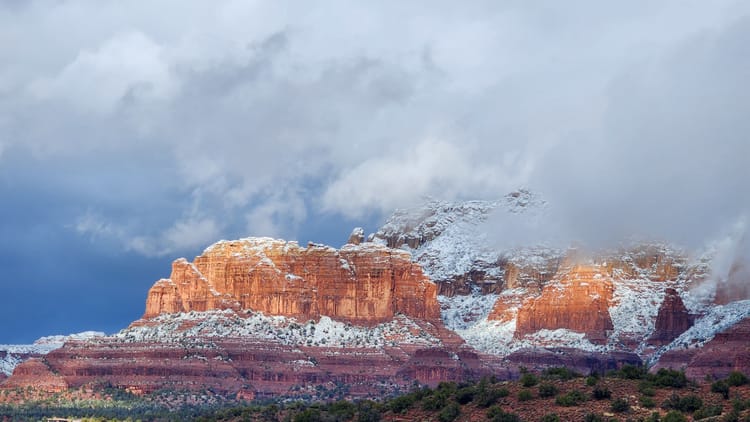
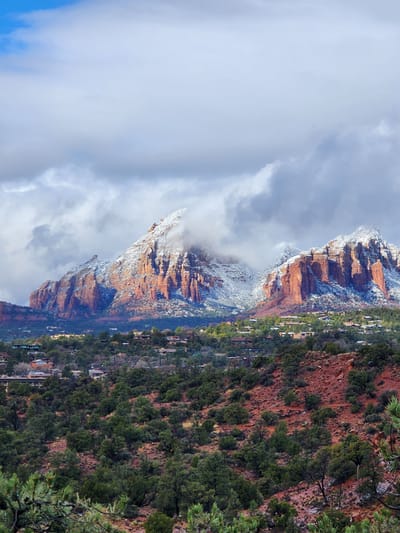
Sedona sits at 4,300 feet: most January nights freeze and most days reach the mid-50s by lunch. A few times a winter a storm drops snow on the red rock, and for a morning the buttes look like a dessert someone dusted with sugar. It's usually gone by afternoon. If you're wondering what to do in Sedona, Arizona, in January, the answer is the thing you can't do in April: park at a trailhead. The lots that fill before breakfast in spring have space now, the canyon is quiet, and the light on Cathedral Rock late in the day is the warmest thing in town.
The RV notices the altitude. Every night below freezing means the hose comes inside and the furnace runs, so a January base here is a middle-band base: warmer than the rim, colder than the desert, and a good place to decide which direction you're going next. Two roads leave town for the north: State Route 89A up Oak Creek Canyon, which closes in snowstorms, and I-17, which is plowed and is the one to take with a trailer whenever 89A is in doubt. Check az511 the morning you leave, not the night before.
Flagstaff and the South Rim in January: The Band That Snows
The top of the staircase is a ski town and a canyon rim, both near 7,000 feet, both getting several inches of snow per storm with hard blue sky in between. Flagstaff runs low 40s by day and teens at night. Arizona Snowbowl, on the San Francisco Peaks above town, is open, and you can ski Arizona in the morning and be back in the low desert for dinner. An hour east, Petrified Forest National Park stays open all year minus two holidays, and the Painted Desert under a January sky is a color the summer haze never shows you.
The South Rim of the Grand Canyon is open year-round, and its roads are drivable except during storms; the park plows and spreads cinders rather than salt, so give the drive time. The North Rim is closed to vehicles from December to mid-May every year, and after the 2025 Dragon Bravo Fire it has no lodging in any season for now. Winter on the South Rim means the rim under fresh snow with a fraction of the summer crowd, and it means Mather Campground, which stays open with a 30-foot maximum vehicle length, winter reservations through recreation.gov, and a water fill at the dump station rather than at your site. Plan the rim days themselves around what the Grand Canyon in winter allows on its trails, which is less than summer: traction devices and poles are the park's standing advice.
Trailer Village, the park's only campground with full hookups, is normally open all winter and would be the obvious base for anything over 30 feet. It closed in late summer 2026, along with the rest of the park's overnight lodging, after a flood destroyed much of the pipeline that carries the South Rim its water, and the park has said reopening will come in phases as the water system comes back. Check the park's current conditions before you plan a rim night around it. If it's open, book it. If it's not, Mather under 30 feet or an RV park in Tusayan or Williams is the winter answer, and our list of national parks with RV hookups has the Trailer Village details for when it comes back.
The Month Everyone Else Already Booked
Arizona's best month is also the one the snowbirds booked last spring. The Tucson gem show fills every site for three weeks. Catalina opens an overflow loop because it has to. State parks sell a year out, and the January weekends at Lost Dutchman go the same morning they open. Anyone who's camped in Yellowstone in July knows the shape of this: the good sites are reserved, and the people who reserved them are already sitting in them.
RVers have an out that hotel guests don't. Public land runs on different rules. The long-term season at La Posa has no booking window at all. Organ Pipe Cactus National Monument, on the Mexican border, has 174 RV sites with no hookups, a dump station with potable water, and a reservation window that opens six months out, and BLM camping across the low desert is the safety valve for anyone who arrives in January without a plan. The other trick is elevation. When the low desert is full, the middle band usually isn't, and a night at 4,000 feet in a fleece beats a night at a truck stop at 1,000. Winter in Arizona is generous with space if you're willing to move up a band. Death Valley in winter, across the California line, runs on the same logic and the same crowds, and if you've done that trip you already know how to work this one.
Pick Your Winter by Picking Your Elevation
Most states hand you one January. Arizona hands you three, stacked on top of each other and two hours apart, and the RV is the only kind of travel where you can change your mind about which one you want on a Tuesday. Pick a band, then build the Arizona winter road trip itinerary around it, the same way you'd plan any of the RVing in national parks trips this state is famous for. And if the cranes, the cave and the free desert are the kind of thing you'd like to hear about before the month they happen, Swervia Weekly lands every Wednesday with the next one.
The Short Version
An Arizona January, band by band:
- Low desert (Yuma, Phoenix, Tucson): highs near 70, nights in the 40s, hose stays connected. Bases: Lost Dutchman and Catalina, both electric and water, no length limit. Saguaro National Park has no vehicle camping.
- Middle band (Sedona, Prescott): mid-50s by day, freezing most nights, hose comes in. SR 89A closes in storms; I-17 is the plowed route north.
- High country (Flagstaff, South Rim): low 40s by day, teens at night, real snow. South Rim open, North Rim closed to vehicles until mid-May, Mather caps at 30 feet, Trailer Village on a phased reopening after the 2026 flood.
- Only in winter: Kartchner's Big Room tour, the cranes at Whitewater Draw, the long-term season at La Posa, Quartzsite's RV show.
- The clock: Arizona stays on Mountain Standard Time all year. In January it matches Denver, not Los Angeles.
FAQs
Is January a good time to visit Arizona in an RV?
Yes, and it's the best month for the low desert. January in Arizona means highs near 70 and nights in the 40s in Phoenix, Tucson and Yuma. The caveat is elevation: Sedona at 4,300 feet freezes most nights, and Flagstaff and the South Rim near 7,000 feet are in real winter with snow, teens overnight and storm closures. Pick your band before you pick your campground.
What is the weather like in Arizona in January?
It depends on elevation, not on where you are north to south. The low desert (Yuma, Phoenix, Tucson) runs highs near 70 and lows in the 40s. The middle band (Sedona, Prescott, about 4,000 to 5,500 feet) sees mid-50s by day and low 30s at night. The high country (Flagstaff and the South Rim, near 7,000 feet) runs low 40s by day and teens at night, with several inches of snow per storm.
Does it snow in Sedona in January?
A few times a winter, and it rarely stays. Sedona sits at 4,300 feet, high enough that a January storm leaves snow on the red rock for a morning before the afternoon sun clears it. Nights are below freezing most of the month, so the water hose comes in every evening. State Route 89A through Oak Creek Canyon closes in snowstorms; I-17 is the plowed alternative to Flagstaff.
Where do snowbirds go in Arizona in January?
Yuma, Quartzsite, Tucson and the Phoenix area, with Quartzsite as the capital. The BLM's La Posa Long-Term Visitor Area outside Quartzsite lets a self-contained RV stay on public land for the whole season, mid-September to mid-April, with water faucets and dump stations, and the town's annual RV show runs in January. Yuma, an hour south, is the sunniest city on record. Tucson and the Phoenix valley take the rest of the crowd at state parks like Catalina and Lost Dutchman.
What is only open in Arizona in the winter?
Three things. The Big Room tour at Kartchner Caverns runs only from mid-October to mid-April, because the chamber is a bat nursery the rest of the year. Tens of thousands of sandhill cranes roost at Whitewater Draw Wildlife Area in Cochise County, peaking in December and January. And the BLM long-term camping season at La Posa is open, the only time of year an RV can sit on that desert for months on one permit.
Can you go to the Grand Canyon in January?
Yes, on the South Rim, which is open year-round with roads drivable except during storms; Mather Campground stays open with a 30-foot maximum vehicle length. The North Rim is closed to all vehicles from December to mid-May. Trailer Village, the park's full-hookup campground, closed after the 2026 flood damaged the South Rim's water supply and is reopening in phases, so confirm its status before booking a rim night around it.
How far ahead do Arizona state parks book in winter?
Up to 365 days, and the popular January dates go early. Arizona State Parks opens reservations a year in advance with a 14-night maximum in any 30-day period per park. Catalina near Tucson opens an overflow campground with no hookups for the winter months because the main loops fill, and Lost Dutchman near Phoenix is the other one to book the day your window opens.

Categories
Related Posts
Subscribe to the Swervia Newsletter
The best RV stories, tips, and destinations—expertly curated and always free.