The Best Time to Visit Death Valley, Month by Month for RVers
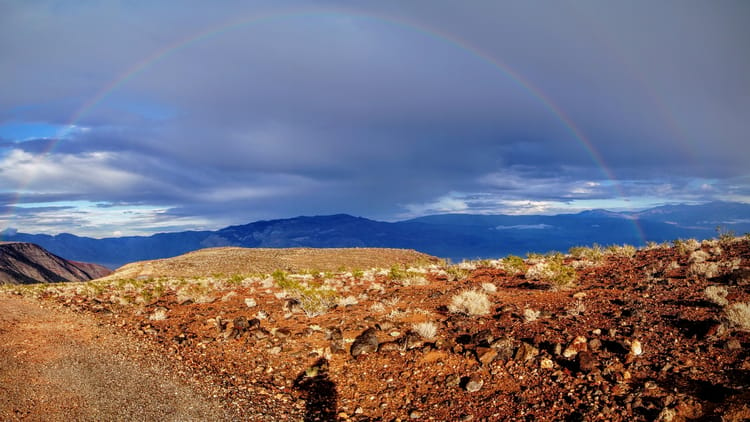
You settle on February, which is what anybody with sense settles on. Then you go to book Furnace Creek and find the sites with power gone months ago, to people who made up their minds faster than you did.
So the real question was never what the temperature would be. It's whether the month with the good weather still has somewhere to plug in, and what the night does to you if it doesn't. February runs about 73 by day and 46 after dark. At 46 the furnace is on all night, and the propane you brought from home turns into a countdown.
Death Valley isn't one climate. The park runs from 282 feet below sea level at Badwater to over 11,000 feet at Telescope Peak, and the National Park Service puts the falloff at 3 to 5 degrees for every thousand vertical feet you gain. Several seasons are running in this park at the same time, all year long. A day visitor gets whatever the valley floor is doing that afternoon. You get to choose.
So the useful question isn't which month is best. It's which month puts the weather you want at the elevation you can park at, with a site you can actually reserve. And if you'd trade a few degrees for an empty park, the months below that look wrong on paper may be the ones you want.
What Makes Death Valley's Climate So Extreme
Picture a long, narrow trough sunk below sea level and walled in on both sides by mountains, with almost nothing in the air to hold water. Air sinks into it, compresses, and heats. The walls hold it there. Nothing in the sky blunts the sun on the way down or moves a breeze through.
It's a machine for making heat. It holds the world record to prove it.
Which is why this is the one national park in the country where the dead of winter is high season. The trailheads that close for heat in July are the ones you walk at midday in January. Campgrounds that sit empty in August fill up over the holidays.
That same geometry runs vertically too. Climb a thousand feet and you drop 3 to 5 degrees, which means a traveler who can move uphill is never stuck with one month's weather. Telescope Peak stands 11,049 feet above the same park whose floor sits 282 feet under the sea.
When Is the Best Time to Visit Death Valley?
October through April is the best time to visit Death Valley, when valley-floor days stay mild enough to walk the salt flats and the canyons at midday. February and March are the sharpest of those months for an RV. Warm afternoons, nights that won't punish an under-insulated trailer, and low light still doing something to the badlands.
Those same months are when the small supply of powered campsites is hardest to get, so the best-weather answer and the best-campsite answer come apart. If you need shore power, the month you should book may be a month down the list.
The Cool Months, October Through April
This is the season the park is built around and the season most people should take. Days run mild on the floor and genuinely cold up high. Anyone who has only pictured this place in July plans for the heat and gets caught by the nights.
November is the softest landing the park offers: the summer heat gone, the holiday traffic not yet arrived, days averaging 77 degrees and nights around 48. If your window is flexible and you've never been here, Death Valley in November is the least demanding version of this trip.
Death Valley in January
January averages 67 degrees by day and 40 at night on the valley floor, and NPS describes the winter nights as cool ones that only occasionally reach freezing. Midday on the salt is jacket weather. By the time you're back at the campsite you're thinking about the furnace.
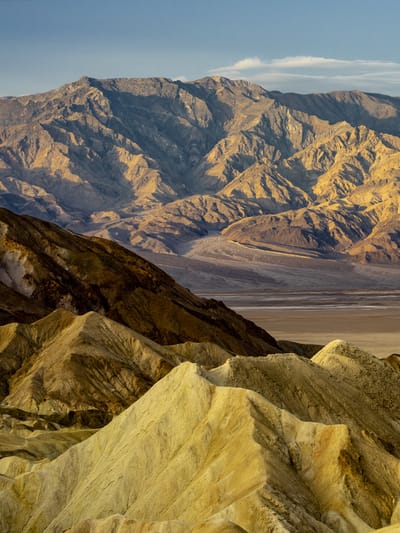
In midwinter the sun never climbs high enough to flatten anything. The badlands hold their shadows straight through the day and the Panamints stay lit from the side, which is the reason so many photographs of this park were taken in the coldest weeks of the year.
December sits alongside January and runs a couple of degrees colder, averaging 65 and 38, with the shortest usable daylight of the year. Cold pulls capacity out of a battery bank on the same night the furnace fan draws harder, and propane empties faster than anyone who has only camped in July expects. Two cheap fixes carry most of the load. Reflective window insulation goes on the glass that poured heat in all afternoon and pours it back out all night, and a heated blanket heats the one cubic yard you're actually in instead of the whole cabin. If winter camping is new to you, our death valley winter itinerary lays out four days built around the same conditions.
Death Valley in February
February is the month to beat. Averages climb to 73 and 46, the narrow window where days are warm enough to spend outside and nights are mild enough that the furnace stops being a project. The crowds haven't peaked the way they do over spring break.
Busy, not overrun. That's the whole difference between a good week here and a frustrating one.
If somebody made you pick one month for a first RV trip here without knowing anything else about the traveler, this is it. Book it the day your window opens, because the hookup sites are gone long before the weather turns.
Death Valley in March
March averages 82 and 55, the last month the valley floor is comfortable all day. It's also when people come hoping for wildflowers. The conditional matters more than the flowers do here: a low-elevation bloom in late March and early April only happens if rain has fallen in several separate storms through the winter and into spring. Plenty of years it doesn't. Come for the park and treat a bloom as a bonus, because the park itself won't promise you one.
April keeps going, averaging 90 and 62, and it's where the trip starts moving uphill. Mornings on the floor still work. Afternoons are better spent climbing, and in a year when the flowers do come, NPS puts the mid-elevation bloom in April and May and the mountains into June.
Death Valley in the Shoulder Months, October and May
October averages 93 and 61. May averages 100 and 73. Both sit outside the cool season, and both are where an RVer's answer to this question stops matching a car visitor's.
A day tripper in May pays for that heat with one miserable afternoon and then drives back to an air-conditioned hotel. You pay for it with a night. What you get back is the park at a fraction of its winter attendance, a real shot at one of the powered sites, and the early hours before the heat sets up, which are the best hours this place has.
It comes down to one question. Can you keep the inside of the RV livable overnight without shore power? On hookups, October and May are easy and badly underrated. Off-grid, the answer turns on airflow and shade more than on air conditioning. A powered roof vent fan pulls the day's stored heat out after sunset, and an awning shade screen keeps the afternoon sun off the wall it's been cooking all day. Our guide to desert boondocking covers the water and power math that makes those months workable.
Subscribe to our weekly newsletter.
ALL THE TIMING INTEL YOU NEED FOR YOUR DESERT RV TRIP. FREE, EVERY WEDNESDAY.
Death Valley in Summer, and the Real Case for the Mountains
July averages 116 degrees by day and 88 at night. NPS puts it plainly: summer temperatures often top 120 in the shade, with overnight lows dipping into the 90s. A car visitor drives out of that at dinnertime. You go to bed in it, in a metal box that spent the afternoon absorbing everything the sun had. The valley floor doesn't cool off at night in summer. It just stops adding.
So the park's own summer guidance is not to hike at low elevation, to stay on paved roads, and to carry a gallon of water per person per day. Take all three seriously. The National Weather Service adds the rest of it: drink before you're thirsty, and move anything strenuous to the coolest hours you've got.
There is still a summer answer here. It's vertical. NPS's own hiking guidance points summer visitors at the high peaks, naming Wildrose Peak and Telescope Peak, and calls them a pleasant escape from the heat. Telescope Peak stands 11,049 feet above sea level over a valley floor that sits 282 feet below it. Run that against the park's own 3-to-5-degree rule and the summit is 30 to 50 degrees cooler than Badwater on the same afternoon. Pines instead of creosote, and a trailhead instead of a boardwalk you can't stand on.
Then there's the road in. Emigrant Canyon Road climbs from the highway past Wildrose toward Mahogany Flat, and it's one of the four roads closed to vehicles over 25 feet. So the high country is a day trip in something small, out of a base camp lower down. Not a place you park the RV.
Two cautions belong to the vehicle rather than the person. Hot pavement is hard on tires, and the tow truck is a long way off in every direction, which is the case for a tire pressure monitoring system out here. Long climbs in that heat also ask more of a cooling system than most of them ever see at home. Never driven a big vehicle this deep into the Mojave before? What you need to know before your first RV trip out west is the primer on fuel, water, and how far apart everything out here sits.
The Best Time of Day to Visit Death Valley
Deep winter here runs about ten usable hours of daylight, and the hours worth photographing sit at both ends of that. Plan two real stops a day. Try to string five together across 20 to 60 miles of valley and you'll drive the last two after dark, which is how a scenic day turns into a commute.
In the warm months the logic flips. The early hours are the only comfortable ones, so the walking happens before breakfast and the driving happens after. Either way, the middle of a Death Valley day is worth less than the edges. In summer it's worth nothing at all.
Camping in Death Valley: The Best Months Are the Hardest to Book
Comfort is one half of choosing a month. Having somewhere to plug in is the other, and that half gets settled months earlier.
Furnace Creek is the only campground in the park that takes reservations, and only 18 of its sites carry 30- and 50-amp power with water and sewer. Eighteen, across 3.4 million acres, in the one season when everybody who wants to camp in a national park in winter is looking at the same map. Book it the day your window opens on recreation.gov and price the trip around having it. And if your tow car is electric, you can't charge it here. NPS says the campground pedestals don't support EV charging, and that plugging into one can damage the car and the campground's wiring both.
Everything else in the park is a different kind of trip. Stovepipe Wells and Mesquite Spring both have dump stations, and Stovepipe Wells also has a concession RV park with hookups, run separately from the campground. Panamint Springs on the west side is private and covers the Sierra approach. Beyond that you're on batteries and tanks, which is fine if the season is mild and a real calculation if it isn't. Our breakdown of how long can you boondock does that arithmetic properly. The fill points that exist get heavy use, which is reason enough to carry a drinking-water-safe hose rather than trusting whatever's coiled at the spigot. Current campground status lives on the park's campground page, which is updated far more often than any article is.
RV Length Limits on Death Valley's Best Roads
One constraint here doesn't move with the season, and it will quietly delete two stops from any list of things to do in Death Valley you've been working from.
Park regulations close four roads to vehicles over 25 feet in total length or 9 feet wide, counting anything you're towing: Dantes View Road, Artists Drive, Emigrant Canyon Road, and Lower Wildrose Road. Twenty Mule Team Canyon carries the same limit as a recommendation. These are standing regulations, not seasonal conditions, and they put two of the must-see stops in Death Valley behind a number. Dantes View is the overlook a vertical mile straight above Badwater, where you can see the highest and lowest points in the Lower 48 without turning your head. Artists Drive is the one-way loop through hills stained green and pink and purple by oxidizing metals.
Know the limit before you pick a month, because it changes what a day here is worth to you. Yellowstone poses the identical problem in a wetter landscape, which we mapped out in our guide to RV size limits there, and it comes up everywhere in RVing in national parks where the road was surveyed before the vehicles got long. Closures are a separate question from limits, and a live one: flash floods take out roads here faster than any article can track them. The park's conditions page carries what's shut inside the boundary on the day you're driving, and Caltrans posts conditions for the state highways you'll use getting there, which is the half most people forget to check until they're already towing.
So Which Month Should You Visit Death Valley?
Three readers, three answers.
Want the best weather? Take February. Warm days, tolerable nights, and the badlands still holding their winter shadows. March is the same trip with a longer afternoon and a chance at wildflowers.
Want the empty park? Take October or May, and go in prepared to sleep warm. You'll trade real comfort for a version of Death Valley most visitors never see. If you're self-contained with good airflow, that trade is a bargain.
Need a hookup site? Book February the hour your reservation window opens, and keep October and late April as the backups that will actually be available. Eighteen sites is eighteen sites, whatever the weather is doing.
Pick the month by where you're sleeping and how, not by the daytime high. Do that and you get a park most of the country has written off for the season, on the week it's at its best. Swervia Weekly sorts trips like this one by when they're worth taking, and it lands every Wednesday.
The Short Version
- Best overall: February. Averages 73 by day and 46 at night, warm afternoons, mild nights, pre-spring-break crowds.
- Best for wildflowers, if there are any: late March into April, and only after a winter of several separate rainstorms.
- Best for an empty park: October or May. Averages 93 and 61, or 100 and 73. Great if you can sleep in it.
- Worst on the valley floor: June through September. July averages 116 by day and 88 at night, with lows in the 90s during the worst of it.
- Summer alternative: the high peaks in the Panamints, which NPS names as the summer escape. Telescope Peak at 11,049 feet runs 30 to 50 degrees below the valley floor.
- Getting up there: Emigrant Canyon Road is one of the four 25-foot roads, so the high country is a small-vehicle day out of a lower base camp.
- Hookups: only 18 sites at Furnace Creek have full hookups, and it's the only reservable campground in the park.
- Length limits: vehicles over 25 feet long or 9 feet wide, towed vehicle included, are closed out of Dantes View Road, Artists Drive, Emigrant Canyon Road and Lower Wildrose Road.
FAQs
What is the best month to visit Death Valley?
February. Valley-floor temperatures average 73 degrees by day and 46 at night, which is warm enough to walk the salt flats and canyons at midday and mild enough that an RV doesn't spend the night running its furnace. The low winter sun is still doing its best work on the badlands, and the heaviest spring-break traffic hasn't arrived. March is the close second, with warmer afternoons and the possibility of a wildflower bloom. Both are inside the park's October-through-April cool season, which is the only stretch most travelers should consider for a valley-floor trip.
How cold does Death Valley get at night in winter?
Colder than most people plan for. Valley-floor lows average 40 degrees in January and 38 in December, and the National Park Service describes winter nights at low elevation as cool ones that occasionally reach freezing. Higher campgrounds run colder still, since temperatures fall 3 to 5 degrees for every thousand feet of elevation. A 25- to 30-degree drop between the afternoon high and the overnight low is normal, and that gap is what drains a battery bank and empties a propane tank faster than any summer trip will.
Can you visit Death Valley in the summer?
Yes, with a serious change of plan. July averages 116 degrees by day and 88 at night on the valley floor, and NPS says summer temperatures often top 120 in the shade with overnight lows dipping into the 90s. The park advises against hiking at low elevations in summer, recommends staying on paved roads, and asks visitors to drink at least one gallon of water per day. The better summer trip goes up: NPS names Wildrose Peak and Telescope Peak as the high-elevation escape from the heat, and Telescope Peak at 11,049 feet runs roughly 30 to 50 degrees cooler than the valley floor on the same afternoon. The access road, Emigrant Canyon Road, is closed to vehicles over 25 feet.
Does it snow in Death Valley?
In the mountains, yes. On the valley floor, effectively never. NPS says the park's high peaks are usually covered with snow in winter and spring, and warns that a winter climb of Telescope Peak, which tops out at 11,049 feet, needs an ice axe and crampons. That's why photographs of a snow-capped ridge above a white salt flat are real rather than composited. The floor itself sits 282 feet below sea level and takes under 2 inches of precipitation a year in any form, so accumulating snow down there is a generational event rather than a seasonal one.
When do the wildflowers bloom in Death Valley?
Low-elevation blooms come in late March and early April, mid-elevation ones in April and May, and the mountains can carry color into June. The catch is that none of it is annual. The Park Service is direct that a bloom requires rain falling in several separate storms spread through the winter and spring, not one big storm and then nothing. Many years produce almost nothing at low elevation. Plan the trip for the park and treat flowers as a bonus.
Is Death Valley crowded in the winter?
Busier than you'd guess for a place with that name. October through April is the park's high season because it's the rare national park that's pleasant in the months when most campgrounds elsewhere are closed, and holiday weekends and spring break are the peaks inside that. The crowding an RVer feels most isn't at the overlooks, it's at the campground: Furnace Creek is the only reservable campground in the park and only 18 of its sites have full hookups, so the best-weather months are also the hardest months to plug in.
Can you bring a dog to Death Valley?
You can, though the rules here are stricter than most parks. NPS allows pets in campgrounds, on roads and in developed areas, and prohibits them more than 50 feet from either, which rules out trails and wilderness and therefore nearly every walk worth taking. The park also prohibits leaving a pet in a vehicle in heat that puts the animal at risk, and that single regulation rules out a summer trip with a dog on the valley floor. A short wait in a parked RV is reasonable in January and lethal in June. Plan a dog trip around road-accessible overlooks and campground time, and plan it for the cool months.

Categories
Related Posts
Subscribe to the Swervia Newsletter
The best RV stories, tips, and destinations—expertly curated and always free.