Adirondacks RV Itinerary: 5 Days at Ausable Chasm + Lake Champlain
Ausable Chasm has been charging admission since the 1870s, which makes it one of the oldest natural attractions in the country and the rare slot canyon that already had a gift shop when your great-great-grandparents were honeymooning there. It sits in a corner of New York where the geography does something useful: Lake Placid is about an hour west, Lake Champlain is right there to the east, a year-round ferry to Vermont leaves from Cumberland Head to the north, Fort Ticonderoga is an easy reach south, and Montreal is a two-hour bus ride north. Five Revolutionary War sites, an Olympic town that hosted the Winter Games twice, a ferry across Lake Champlain to Vermont, and a slot canyon — all inside one tow-vehicle radius.
That's the case for basing an RV trip here rather than driving the whole region. You set up the RV once, level it, and run the tow vehicle out in five directions across five days instead of breaking camp every morning. This corner of the park sits between the Ausable River and Lake Champlain, with full-hookup parks and lakeside state campgrounds to choose from depending on what you want out of a site.
It works whether you're traveling with kids or without — the day trips bend in different directions depending on which version of the trip you're running. The Olympic day is more pulse, the ferry day is more wander, the history day is more substance, the hiking day is more sweat, and the home day is whatever flavor you need. Notes on which days hit harder for kids vs. adults-only travelers are folded into each section.
Why One Base Beats Scattering
Most Adirondacks itineraries scatter — a night near Lake Placid, a night near Lake George, a night somewhere along the Champlain shore — because the region itself sprawls. If breaking camp every morning and pulling into a new lot by lunch is the whole point for you, the Adirondacks reward that style and you should go scatter freely. This itinerary is for the other camp: travelers who'd rather level once, run the tow vehicle light all week, and let the same campfire close out five different days.
The Ausable Chasm area anchors that approach well. It sits in the northeastern corner of the Adirondack Park, 20 minutes south of Plattsburgh and 10 minutes off Interstate 87, which puts you inside about a 45-minute radius of most of what makes this region a trip — Lake Placid's Olympic sites, the High Peaks trailheads around Keene Valley, the Lake Champlain ferry crossings, and the Plattsburgh history corridor. Base on the Lake Placid or Wilmington side instead and the same radius still works; you're just closer to the mountains, farther from the lake, and paying a bit more for the trade. More on that choice in the next section.
The radius runs in two directions from here. South gets you to Fort Ticonderoga in under an hour and to Lake George inside 90 minutes. North gets you to Plattsburgh in 20 minutes and to the Canadian border in 40. East is across the lake to Vermont by ferry. Five days is enough to do the inner ring well; a sixth day buys you one piece of the outer ring without rushing.
Where to Camp: Champlain Side or Lake Placid Side
Where you set up comes down to which half of the trip you want close. The Champlain side around Ausable Chasm keeps the water days — the ferry, the swimming, Plattsburgh — a few minutes away, runs cheaper and quieter, and adds drive time to the peaks. The Lake Placid and Wilmington side flips it: you're minutes from the High Peaks trailheads, Whiteface, and the Olympic sites, but the sites run busier and pricier and the ferry becomes an hour-plus haul. There are full-hookup and dry-camping options on both sides. Book early for July and August wherever you land.
Champlain Side: Quieter, Cheaper, Water Days Close
For full hookups, Ausable Chasm Campground sits on the chasm grounds with 30- and 50-amp sites, Lake Champlain RV Resort five minutes away runs every site full-hookup and handles larger RVs, and Iroquois Campground & RV Park in nearby Peru is a big family-run park with full hookups in both 30- and 50-amp. For a site on the water instead, Ausable Point Campground (NYSDEC, 15 minutes north) is dry camping — no hookups, roughly 123 sites, RVs up to 35 feet — but the natural sand beach on Lake Champlain is the trade. If a no-hookup week is new to you, our complete guide to boondocking without hookups covers the tank math. Cumberland Bay State Park near Plattsburgh has electric-hookup loops and one of the biggest sand beaches on the lake, and makes sense if the Plattsburgh history day is the one you want closest.
A set of reliable RV leveling blocks earns its keep at the state-park sites, where the pads are gravel and rarely flat.
Lake Placid / Wilmington Side: Closer to the Peaks, Busier and Pricier
For full hookups near the trailheads, the Lake Placid / Whiteface Mtn. KOA in Wilmington has full-hookup sites up to 45 feet, split between a riverside section on the Ausable and a quieter wooded one up the hill — it's the main full-hookup park on this side. To dry camp closer to the mountains, Wilmington Notch (NYSDEC, on Route 86 between Wilmington and Lake Placid) and Meadowbrook (NYSDEC, four miles west of Lake Placid) are both no-hookup state campgrounds with hot showers and a dump station. Wilmington Notch tops out around 30-foot sites, and Meadowbrook's season closes in early September, so check dates before you count on it.
Day 1: Roll In, Walk the Chasm, Meet the Underground Railroad
Plan to arrive at camp by early afternoon. Setup at any new site is a 45-minute ritual minimum — level, chock, hook up, sewer, awning, settle the inside — and you want that done unhurried before you walk anywhere. Our RV setup checklist is the running order to follow if it's not yet muscle memory.
Once you're set, head for the chasm — it's minutes away on the Champlain side, and a scenic hour if you based near Lake Placid, in which case it's easy to swap Day 1 and Day 2. Ausable Chasm is not a slot canyon you look at — it's one you walk into. The Inner Sanctum Walk and the rim trails together run about 1.5 miles round trip past Rainbow Falls, Elephant's Head, Column Rock, and the formations the brochure has been pointing out since the Grant administration. The geology is genuinely 500 million years old; the brochures aren't padding. Plan 90 minutes to two hours for the walking part. If your group has tubers and rafters in it, the lower-chasm float adds another 90 minutes and a different angle on the same canyon — worth doing on a separate afternoon during the week rather than the same day you arrive.
Steps from the chasm parking area is the North Star Underground Railroad Museum. It's run by the North Country Underground Railroad Historical Association, free to enter (donations welcomed), and small enough that you read every panel and leave understanding why the Champlain Valley was a load-bearing piece of the route to freedom rather than the periphery of someone else's story. The 2026 season runs late May through mid-October on Fridays, Saturdays, and Sundays, with extended hours in July and August. Plan 45 minutes to an hour. It's the trip's first piece of substance, it's free, and it's right next to the chasm entrance.
For kids, the chasm itself is the whole show on Day 1 — the walking is enough, the bridge crossings are enough, and the museum lands more squarely once they're old enough to follow a panel-by-panel narrative (roughly age 10 and up). For adults-only travelers, both pieces sit comfortably in a half-day. Dinner at camp and an early bed — Day 2 starts before nine.
Day 2: Lake Placid, Olympic Sites, and the Drive Up Whiteface
Lake Placid is about an hour from the Champlain side via Route 9 and Route 86 — 38 miles of mostly two-lane Adirondack road, and a short hop if you based near town — and the route through Wilmington along the Whiteface Highway corridor is the prettiest way in. Plan a full day for this — the town has hosted two Winter Olympics (1932 and 1980), the infrastructure has stayed in place, and the venues are mostly still active under the umbrella of Lake Placid Legacy Sites. You can see five Olympic venues in a day without rushing if you pick well.
Mount Van Hoevenberg is the sliding-sports venue — bobsled, skeleton, luge — and is the morning anchor. The Cliffside Coaster, which runs alongside the historic 1980 bobsled track and bills itself as the longest mountain coaster in North America, returns on June 1, 2026 after a year out for construction. The coaster is closed Wednesdays and Thursdays and tickets reportedly sell out by noon on the days it runs, so book in advance and plan the rest of the day around it. The summer bobsled experience (a wheeled bobsled run guided by an actual driver) is the other Mt. Van Hoevenberg signature; weight limits apply, so check before assuming the whole family rides.
Lunch in Keene Valley on the way back from Mt. Van Hoevenberg toward downtown Lake Placid. Noon Mark Diner has been serving its famous homemade pies since 1981 in a building that was literally moved across the street on logs from the old Tahawus Hotel, and it's the right kind of low-stakes — kid-friendly, dog-friendly on the deck, fast enough that you keep your afternoon. The drive between Keene Valley and Lake Placid runs through the High Peaks corridor with three or four trailhead pull-offs you'll want to clock for Day 4.
Afternoon options diverge by audience. The Olympic Jumping Complex's Sky Flyer Zipline launches from a 70-foot tower next to the ski jumps, drops 256 vertical feet, and carries riders 855 feet down the landing hill at up to 30 mph — the closest most people will get to ski-jumping a real Olympic venue, and the high-pulse afternoon pick. The Veterans Memorial Highway up to the summit of Whiteface Mountain is the high-altitude alternative — drive your own vehicle (or hop on the elevator that punches up the inside of the mountain to the summit observation deck) for a 360° view that on a clear day reaches Vermont, Quebec, and the Green Mountains. For history-leaning travelers, John Brown Farm State Historic Site sits on the south side of town — the abolitionist's home and burial site, free to enter, the kind of stop that takes 45 minutes and reframes the rest of the day.
Dinner on Main Street and home by ten. Lake Placid Main Street has the highest restaurant density in the region; reservations are smart for summer evenings.
The best RV trips aren't the longest — they're the ones with the right base camp. Subscribe to our weekly newsletter.
FOR RV PEOPLE WHO LIKE TO KNOW THINGS. EVERY WEDNESDAY. ONE EMAIL. FREE.
Day 3: Lake Champlain on the Water — the Grand Isle Ferry and Burlington
Day 3 leaves the RV at camp and drops everyone in the tow vehicle for the day across the lake. One scheduling note up front, because plenty of older guides get it wrong: the long, scenic Port Kent to Burlington ferry that used to land you right in downtown Burlington has been suspended since 2019 and is not running. Don't build the day around it. The crossing that does run — year-round — is the Cumberland Head to Grand Isle ferry, a roughly 15-minute hop from a terminal about 25 minutes north of the Champlain-side campgrounds. Vehicle and driver is around $11, additional passengers a few dollars each, no reservations, and it sails around the clock every day of the year. It puts you on Grand Isle, in the Champlain Islands: more sand beach, farmland, and quiet water than downtown bustle. Grand Isle and North Hero state parks both give you lake-view picnic tables and swimming without leaving the islands.
If it's the city you want, Burlington is about a 40-minute drive south from Grand Isle down US-2 and I-89 (further south, the seasonal Charlotte–Essex ferry is the other running crossing). Once you're there, Church Street Marketplace is the four-block pedestrian heart of Burlington and the right lunch destination — restaurants run the price-range gamut, the street performers earn their tips, and the architecture is the New England red-brick storefront grammar at its most concentrated. A few blocks down at the water, ECHO Leahy Center for Lake Champlain (the children's science museum on the lake, about $23/adult, $20/child 3–17, kids 2 and under free) is the kid anchor; the waterfront Burlington Bike Path, which runs onto the Colchester Causeway out into the lake, is the no-kid anchor if you brought bikes.
The on-the-water bonus for this day, if you've packed a kayak or a SUP and the lake is calm: Valcour Island, paddled from Peru Dock on the Champlain side, is a 90-minute round-trip across to the Battle of Valcour Island site, where Benedict Arnold's small American fleet fought a strategic delaying action against the British Royal Navy in October 1776. The Bluff Point Lighthouse on the island is open to visitors on Sundays in season. For families, the lake's south end stays warmer and shallower into July; for adults-only travelers, the paddle is the entire trip.
A soft-sided cooler that survives a beach day earns its place on this day specifically. Whether you cross to the Champlain Islands and picnic on a Grand Isle beach or paddle out to Valcour, you need water and food at the destination — and the carrying matters when you're walking 400 yards from a parking lot to a swimming spot.
Day 4: A High Peak (or a Close Approximation) and a Cold-Water Swim
Day 4 is the active day. The High Peaks trailheads run 30 to 50 minutes from the Champlain side, and a good deal less if you based near Lake Placid. The trail menu spans easy-and-stunning to long-and-serious. The right choice depends on what's in the group and what the weather is doing.
Cascade Mountain, the 36th-tallest of the Adirondack High Peaks at 4,098 feet, is the most-recommended introduction to the High Peaks — roughly 4.4 to 4.8 miles round trip with a payoff summit that gets you a 360° view across the range without requiring a technical alpine push. Mount Jo, by contrast, is a 2.2-mile round trip from the Adirondack Loj that punches well above its weight on the view-per-step ratio and is the right pick for families with kids who can hike but aren't ready for Cascade. Hurricane Mountain's 35-foot summit fire tower (a 6.8-mile round trip from the Route 9N trailhead, with a restored early-1900s tower that observers staffed for sixty years until 1979) is the long-day pick for travelers who want substance. Pitchoff Mountain and the Balanced Rocks pull-off is the if-the-weather-turns alternative, with payoff views from a short scramble and a parking lot on Route 73.
For all of these, an electrolyte mix that doesn't taste like a chemistry set belongs in the daypack alongside water and snacks. The Adirondack summer humidity is genuinely a feature of the experience.
Afternoon is the swim. The Ausable River's swimming holes are the open secret of the region: water cold enough to take your breath away, current strong enough to require respect, scenery good enough that locals don't volunteer the coordinates. Wilmington Flume Falls (off Route 86 between Wilmington and Lake Placid) has the cliff-jumping reputation and earns extra caution with kids — adults can sit on the rocks above the deeper pools and let the older kids swim in the slower water below. Jay Covered Bridge and Jay Rapids, just downstream in the village of Jay, gives you a 1857 covered bridge as the backdrop and a flat-water section for the family contingent. Split Rock Falls (on Route 9 south of Elizabethtown) is the lesser-known third option, smaller crowds, deeper pools, harder to spot from the road.
If your family has a strong swimmer contingent and a non-swimming contingent, our 9 epic RV-accessible swimming holes article covers the criteria that separate a great family swim spot from a single-shot wonder.
Dinner at camp, hot shower, early bed. Day 4 is the one that earns the slower Day 5.
Day 5: Slow Morning, Plattsburgh History, Easy Exit
Last day is a soft landing. Strike-camp day shouldn't be the hardest day of the trip.
Take a slow morning at camp. If kids are along, this is the pool-and-playground day, or the one for the chasm's river float if you're camped nearby. If they're not, it's coffee outside in a folding camp chair that actually holds up and packing up at your pace.
Mid-morning, drive 20 minutes north to Plattsburgh and spend the back half of the day on the Champlain Valley's military and historical layer. The War of 1812 Museum sits in downtown Plattsburgh and tells the story of the Battle of Plattsburgh — the September 1814 naval engagement that effectively ended British ambitions in the Champlain Valley and shaped the negotiations that closed the war later that year. It's a small, free-to-low-admission museum that takes 45 minutes to absorb. The Kent-Delord House, built in 1797 and used by British officers in the lead-up to the battle, is a block away and runs about an hour. Both are more interesting than they look from the curb.
If your family balance pulls more toward beach than museum, Cumberland Bay State Park's natural sand beach is a 10-minute drive from downtown Plattsburgh and free with a New York State day-use parking fee — a flat, gently-sloping, lifeguarded swim that's the right closer for the kid contingent.
Strike camp after lunch and roll out. Route 9 south to I-87 is the cleanest exit; the Ausable Chasm area sits right off the interstate. The Catskills are three hours south on the same highway; New York City is five.
Worth Adding If You Have a Sixth Day
A handful of pieces sit outside the five-day frame above but are real options if you have a sixth day or you want to swap one of the lighter mornings on the itinerary.
Fort Ticonderoga + Crown Point (south, ~50–65 minutes)
Fort Ticonderoga sits on the southern end of Lake Champlain about an hour south of the Champlain side. The 2026 Campaign Season runs May 2 through October 25, Tuesday through Sunday from 9:30 AM to 5:00 PM, with a buy-one-day, get-the-next-day-free admission structure that makes a two-day pace possible. Cannon firings, reenactors, the King's Garden, the Carillon Hiking Trail, the Mount Defiance overlook — it's the rare historical site that delivers as much for kids as for adult history travelers, because the smoke and the noise are the point. Crown Point State Historic Site, 20 minutes farther south, has the French and British fort ruins side by side and a fraction of the crowd. Together they make a long-but-rewarding day trip.
The full Revolutionary War forts spoke in this cluster covers both sites plus a long-day extension to Saratoga National Historical Park (the 1777 battlefield where the Americans' victory persuaded the French to enter the war).
Lake George (south, ~65 minutes)
Lake George is on the far edge of a day-trip radius from Ausable Chasm — 65 minutes south, 130 round trip — which makes it either a long single day or a worthwhile two-night detour rather than a casual side trip. The reasons to go are the Adirondack Extreme Adventure Course (treetop ziplines and ropes, teens love it, weight limits apply), Revolution Rail's rail-biking through the Hudson River corridor, Hudson River rafting through Warrensburg (Class III–IV most of the season, bigger in spring), and Million Dollar Beach on the south end of the lake. If you want it as a real piece of the trip rather than a fast taste, the Lake George spoke in this cluster lays out a one-day vs. two-night frame.
Montreal (north, ~2 hours by bus from Plattsburgh)
Driving an RV across the U.S.–Canada border is logistically possible but adds friction the rest of this itinerary doesn't carry — Canadian RV insurance, customs declarations, currency, and the question of whether the rest of your week can absorb a border-day. The easier move: leave the RV at camp, drive to Plattsburgh, and take Adirondack Trailways to Montreal as a day trip or overnight. The bus runs about 2 hours 17 minutes each way and prices start around $30. You'll want a passport or enhanced driver's license. Old Port, Notre-Dame Basilica, and Jean-Talon Market do the work of a day; Voiles en Voiles aerial park in the Old Port is the kid anchor.
This is the only outer-ring option we'd flag a hard caveat on: it's a real trip, not an afternoon, and it eats a calendar day you might prefer to spend on the chasm.
Trip Logistics: Driving, Fuel, and the Border Question
Total driving across five days: about 250 miles in the tow vehicle (Lake Placid + ferry day + High Peaks + Plattsburgh + local), plus whatever it took to get into the region in the RV. The day trips read short individually but stack up on the tow vehicle across the week.
Fuel in this stretch of New York runs with the state average; Clinton and Essex counties tend to sit a few cents below the I-87 corridor pricing because they're slightly off the interstate. Most of the full-hookup parks in the area sell propane and have a dump station on-site, so tank math is a non-issue if you're plugged in; the state campgrounds are dry, so plan a dump-station stop on your way out.
For the sixth-day Montreal option: U.S. citizens need either a passport, a passport card, or an Enhanced Driver's License (NY issues one) to cross the border. Bring two forms of ID for everyone in the party, including kids. The Trailways bus terminal in Plattsburgh handles customs paperwork at the border crossing; build an extra 30 minutes into the schedule. If you're considering driving your own vehicle across, our broader guide to RV maintenance and pre-trip checks covers the documentation a cross-border RV trip actually needs.
Cell coverage on the Champlain side is generally workable on the major carriers, and the sites aren't deeply tree-shaded so satellite internet has open sky; check your own carrier's coverage map before counting on a remote-work-from-camp setup. Tree cover gets serious at the High Peaks trailheads and on some of the inland Ausable River swimming spots; download your maps before leaving the RV.
A Note on Pacing
Five days is the right length for this itinerary if you want one easy day, one moderate day, two big days, and one relaxed close. If you only have four days, drop Day 5's Plattsburgh history afternoon and roll out after a slow breakfast — the trip still works. If you have seven, add a Fort Ticonderoga + Crown Point day and a recovery day near camp (a river float, a swim, a hammock and a book). Setting up camp once and using the radius instead of moving every two nights is the structural difference between a trip that feels like a vacation and one that feels like a tour.
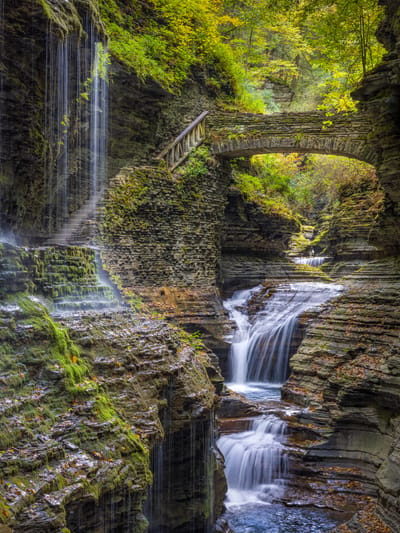
This cluster will add six spokes around this pillar — a deep Lake Placid day, the High Peaks hikes spoke, the swimming holes spoke, the Lake Champlain ferry day spoke, the Revolutionary War forts spoke, and the Lake George day-trip spoke — each one extending one piece of this itinerary into a full standalone guide. For a comparable single-base-camp approach in a different region, our Watkins Glen RV itinerary across five days in the Finger Lakes runs the same structural play on a different geography.
FAQs
How many days do you need at Ausable Chasm with an RV?
Five days is the sweet spot if you want to cover the chasm itself plus the Lake Placid, Lake Champlain ferry, High Peaks hiking, and Plattsburgh history day-trip arms without rushing. Three days is enough if you focus only on Ausable Chasm and one direction of day trip — typically Lake Placid for the Olympic-site travelers or the ferry crossing for the lake travelers. Seven days adds room for a Fort Ticonderoga + Crown Point day to the south and a slower mid-week recovery day on or near the chasm.
Where should you camp for an Adirondacks RV trip near Ausable Chasm?
It depends on which half of the trip you want closest. The Champlain side around Ausable Chasm keeps the ferry, the swimming, and Plattsburgh close and runs cheaper and quieter: full-hookup options include Ausable Chasm Campground, Lake Champlain RV Resort, and Iroquois Campground & RV Park in Peru, with dry camping and a sand beach at Ausable Point (NYSDEC) and electric-hookup sites at Cumberland Bay State Park near Plattsburgh. The Lake Placid and Wilmington side puts you minutes from the High Peaks trailheads, Whiteface, and the Olympic sites but runs busier and pricier: the Lake Placid / Whiteface Mtn. KOA has full hookups, and Wilmington Notch and Meadowbrook (both NYSDEC) are dry-camping state campgrounds closer to the mountains. Book early for July and August either way.
Can you take an RV on the Lake Champlain ferries?
Yes — Lake Champlain Transportation Company's ferries take vehicles of essentially all sizes, including RVs and trailers, and pricing scales with vehicle length. Note that the scenic Port Kent to Burlington crossing has been suspended since 2019 and is not running; the crossing closest to the Champlain-side campgrounds is the Cumberland Head to Grand Isle ferry, a roughly 15-minute hop that runs 24 hours a day, 365 days a year. For most travelers the easier move is to leave the RV at the campground and take the tow vehicle across.
Is Lake Placid worth a day trip from Ausable Chasm?
Yes — Lake Placid is about an hour from Ausable Chasm via Route 9 and Route 86 (38 miles), and the Olympic infrastructure (Mt. Van Hoevenberg's Cliffside Coaster returning June 1, 2026, the summer bobsled experience, the Olympic Jumping Complex's Sky Flyer Zipline, the Whiteface Veterans Memorial Highway summit drive) is concentrated enough that you can hit four or five anchor venues in a single full day. The town hosted the 1932 and 1980 Winter Olympics, the venues remain active, and Main Street has the highest restaurant density in the region. Plan dinner reservations for summer evenings.
What's the best time of year for an Adirondacks RV trip?
Summer (mid-June through August) is peak season — the Lake Placid sites operate at full capacity, lake swimming is in play, the seasonal Charlotte–Essex ferry is running, and the campgrounds open all sites. Early September into mid-October is the underrated window: the leaves turn through the High Peaks corridor in late September and crowds drop. Memorial Day weekend opens most campgrounds but the High Peaks trailheads are still mud-season-soft and the swimming holes are still cold enough to be a brief commitment. Winter RVing in the region is the exception, not the norm; the Cumberland Head to Grand Isle ferry is the only year-round crossing.
Can you visit Montreal from Plattsburgh without driving an RV across the border?
Yes — Adirondack Trailways runs daily bus service from Plattsburgh to Montreal, with a roughly 2 hour 17 minute crossing and one-way tickets starting around $30. U.S. citizens need a passport, passport card, or Enhanced Driver's License (New York issues one) for the border crossing. Bring two forms of ID for everyone in the party including kids. The bus is the right call for a day trip or overnight; driving an RV across the border adds Canadian insurance, customs declarations, and currency complications that the rest of an Ausable Chasm itinerary doesn't carry.
Is the Adirondacks itinerary good for RVing with kids?
The itinerary holds up well for families because the day trips bend in different directions and the right campground absorbs the off-day energy. Many area campgrounds have a pool, a playground, or a sand beach for burning off restless afternoons. Day 1's chasm walk is stroller-tolerant on the rim trails. Day 2's Lake Placid mix (Cliffside Coaster, Sky Flyer Zipline, bobsled experience) is built for ages 8 and up. Day 3's Burlington waterfront includes ECHO Leahy Center for Lake Champlain, a children's science museum directly on the lake. Day 4's swimming holes are family-tolerant with adult supervision (avoid the Wilmington Flume cliff-jump section with younger kids). Day 5's Plattsburgh museums land more squarely for ages 10 and up; the Cumberland Bay beach is the better closer for younger kids.
Categories
Related Posts
Subscribe to the Swervia Newsletter
The best RV stories, tips, and destinations—expertly curated and always free.