Free Things to Do in Niagara Falls: The No-Ticket RV Itinerary
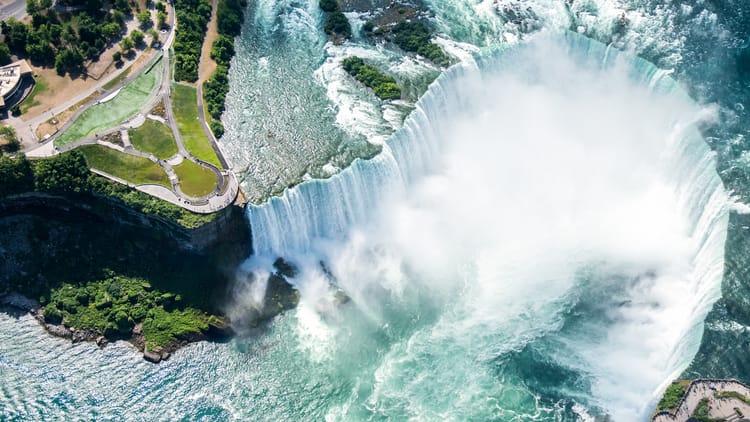
Niagara Falls State Park has never charged admission. It's free to walk in, it's open 365 days a year, the falls are lit every night from dusk until the early hours, and from mid-May through mid-October there are fireworks over the gorge at 10 p.m. that cost exactly nothing to stand and watch.
What costs money at Niagara is a pretty short list: the boat, the elevator, the deck under Bridal Veil, and the parking lot. Two of those four are genuinely optional. And the parking lot is free or not free depending on what day of the week you show up, which is a strange thing to say about a parking lot.
Some people will want the Maid of the Mist, and that's a fine way to spend an afternoon and some money. This is the plan for the trip where you don't. Two days, both sides of the border, nothing ticketed, and a total spend you can carry in quarters.
Only One Niagara Falls State Park Parking Lot Takes an RV
Lot 3, at 50 Goat Island Road, is the only lot in Niagara Falls State Park that accepts RVs and buses. Lots 1, 2, and 4 are automobiles only. That isn't a preference or a suggestion about tight turns. It's the posted rule, and it means three of the park's four lots are closed to you before you've even chosen a day.
Lot 3 also caps out at 40 feet. No RVs or trailers longer than that, and the park notes RV parking is limited even under the cap, so a summer Saturday arrival at noon is a gamble regardless of length.
Now the part that reshapes the trip. Lot 3 charges RVs $20, and it charges that rate only on Fridays through Mondays and holidays, 8:30 a.m. to 5 p.m., between May 22 and September 7, 2026. Every other day of the year, Lot 3 is free. Free Tuesday, Wednesday, and Thursday year-round. Free from September 8 straight through May 21. The Niagara Falls State Park parking page publishes the whole schedule, and it's worth a look before you pick your dates.
So an RVer who rolls into Lot 3 on a Wednesday in late September parks at the most-visited attraction in New York State for nothing. No admission, no parking, no ticket. If your dates flex at all, flex them midweek.
Two conditions on that. If you're over 40 feet, leave the RV at camp and bring the tow vehicle instead. Lots 1 and 2 run $10 on weekdays through the season, which is still a cheap day. And no lot in the park permits overnight parking, so the free window is a daytime window. You're paying for a campground either way, which is a separate line item and covered further down.
Check Your Height Before You Check Your Length
The 40-foot cap is the rule everyone quotes. The one that actually strands people is overhead.
Coming in from the I-190 side, the Niagara Scenic Parkway is a Robert Moses parkway in the literal sense, built in an era when low bridges were a design feature rather than an oversight, and its underpasses are posted right around 12 feet. The parkway ramp off I-190 is also signed for no commercial vehicles. A Class A at 13 feet 6 inches does not fit, and neither does most of what has an air conditioner on the roof.
The workaround is boring and it works: stay on the surface streets into downtown Niagara Falls and approach Goat Island from there rather than taking the scenic route in. Put your RV's actual height into your GPS before you leave camp, and when a posted clearance sign disagrees with your app, the sign wins.
Day One: Free Things to Do on the Niagara Falls US Side, Entirely on Foot
Once the RV is in Lot 3, the American side is a walking day. Nothing below sits more than about a mile and a half from that lot, and you will not move the vehicle again until dark.
Here's the number to plan around: Prospect Point, the Goat Island loop, Luna Island, Terrapin Point, and the Three Sisters and back is roughly three miles on the day. Not a hike, but not the quarter-mile stroll the park brochures imply either, and it's three miles of pavement rather than trail.
There is almost no elevation in it. The Goat Island loop is flat and paved end to end, the mainland approach is flat, and the footbridges out to the Three Sisters have short slopes rather than climbs. The only stairs on the whole route are the ones down to Luna Island, and there's a paved no-stair path to the same platform if knees are a factor in your group.
Wear the shoes you'd wear for a real hike, because a full day on pavement is harder on your feet than a trail somehow is, and a pair of high-cushion ankle socks does more for a Niagara day than most people expect.
Prospect Point and the Brink of the American Falls
Start at Prospect Point, because it's the single best free view of the American Falls and it's a five-minute walk from Lot 3. You stand at the brink, close enough that the water goes over the edge beside you rather than in front of you, and close enough that the mist finds you whether the wind cooperates or not.
That mist is the reason to bring a quick-dry travel towel that clips to a bag. Niagara soaks people for free all day long, and being damp at 9 a.m. is a different experience than being damp at 4 p.m.
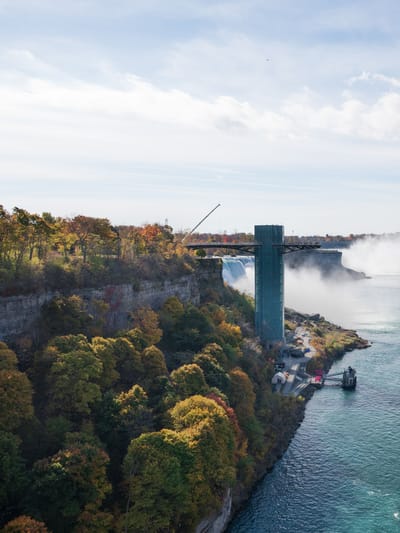
There's a ticketed elevator down to the base and an observation deck out over the gorge here. The fee is nominal, it's waived if you're holding a boat ticket. The overlooks at rim level cost nothing and give you the falls from above, which is the view most people picture anyway.
Goat Island, Luna Island, and Terrapin Point
Goat Island is the walk that puts you between the two waterfalls, and it's the strongest hour of the free itinerary. Cross the bridge from the mainland and you're on the island that splits the American Falls from the Horseshoe, with paved loop paths, shade, and benches at every overlook.
Work it clockwise. Luna Island is a small platform wedged between the American Falls and Bridal Veil, and it's the closest you get to falling water without buying anything. Terrapin Point sits at the far end, looking straight into the Horseshoe from the American side, and on a sunny afternoon the spray throws a rainbow that sits there long enough to photograph badly several times.
None of it is ticketed. All of it is walkable from Lot 3 in under fifteen minutes.
Three Sisters Islands, Where the Crowd Stops
Most visitors turn around at Terrapin Point. Keep going. A short chain of footbridges runs south from Goat Island out to the Three Sisters Islands, which sit in the upper rapids above the Horseshoe, and the crowd thins to almost nothing within a hundred yards of the first bridge.
What you get is the river doing what it does immediately before the drop: white, fast, loud, and close enough to sit beside on a rock. It's the quietest place in the park with the most violent water in it, and it's the stretch people describe afterward when they've forgotten what the boat cost.
What You're Skipping, and Why the Free Version Still Holds
Three things carry a ticket here: the Maid of the Mist boat, Cave of the Winds and its deck below Bridal Veil, and the Prospect Point elevator. They're good. They're also the only things you're leaving out of a very full day, and none of them shows you the falls in a way the rim doesn't.
Know the numbers before you decide, because they add up faster than people expect. Cave of the Winds posts $23 for adults and $19 for youth in high season, running through October 18, and drops to $14 and $10 the rest of the year. The Maid of the Mist starts at $30.25. Tickets are walk-up at the booth, not online, so a family of four choosing both attractions is looking at a couple hundred dollars decided while standing in a line. Worth deciding in the campground instead.
The Discover Niagara Shuttle, and the Season Gap Nobody Mentions
The Discover Niagara Shuttle is free, and it runs from Niagara Falls State Park north along the river corridor to Lewiston, Youngstown, and Old Fort Niagara. If you want to see free historic sites around Niagara Falls or reach the Lake Ontario waterfront without moving the RV out of a free parking spot, this is how.
The catch is the calendar, and it's the detail every listicle drops. The 2026 season runs May 22 to October 12, but seven-days-a-week service happens only between June 19 and September 7. On both shoulders it's Friday through Sunday: May 22 to June 14 in spring, September 11 to October 12 in fall. Note what that leaves. September 8 through 10 has no service at all, which is a genuinely strange three-day hole right after the free parking kicks in. Arrive on a Tuesday in late September and you get the free parking and no shuttle, which is a fine trade as long as nobody planned around it. On Fridays and Saturdays the Falls-to-the-Fort route runs until 10 p.m., which matters later.
The separate Lockport route, out to the Erie Canal, is Friday through Sunday for the entire season with no daily stretch at all.
More New York RV intel where this came from. Subscribe to our weekly newsletter.
THE LOTS THAT TAKE AN RV, THE DAYS THEY'RE FREE, AND THE TOLLS NOBODY WARNS YOU ABOUT. FREE, EVERY WEDNESDAY.
Day Two: The Niagara Gorge, and the Dollar Walk Into Canada
Day two goes north and then across. The gorge parks are both on the American side, a few minutes up the river from the falls, and they're free to enter and free to park at on any day of the week. The border comes at the end of the day, on foot, and the Rainbow Bridge costs a dollar to walk and $6.00 per axle to drive, which is the most expensive way anyone has ever moved an RV four hundred yards.
Whirlpool State Park, Free Parking and One Closed Trail
Whirlpool State Park is open year-round, dawn to dusk, and parking there costs nothing on any day of the week. The rim overlook is the draw: the Niagara River hits a wall of rock, turns ninety degrees, and spins into a standing whirlpool a couple hundred feet below you.
One hard note. Trail 5, the lower Whirlpool Rapids Trail south of the Flats, is closed because of fallen rock and unstable conditions. That closure was posted in October 2024 and it's still up. Do not route yourself onto it, and don't assume a printed trail map from a previous trip is current. The rim overlooks are open, they're where the view is anyway, and our guide to Niagara Gorge hikes for RVers covers which descents are actually open and what each one asks of you.
Devil's Hole and the Niagara Gorge Rim Trail
A few minutes further north, Devil's Hole State Park is also free to enter and free to park at, and it's the free gorge access most visitors never reach because it's four miles past the thing they came to see. The rim trail threads Niagara Falls, Whirlpool, and Devil's Hole state parks and stays flat the whole way, so you can walk as much or as little of it as the group has legs for.
Trail status here changes with the rock and the weather, and the posted sign at the trailhead outranks anything you read in advance. Check it before you commit to a descent.
Walking the Rainbow Bridge for a Dollar
The Canadian side has the better view of the Horseshoe. That isn't a debate, it's geometry, and you can go get it for a dollar.
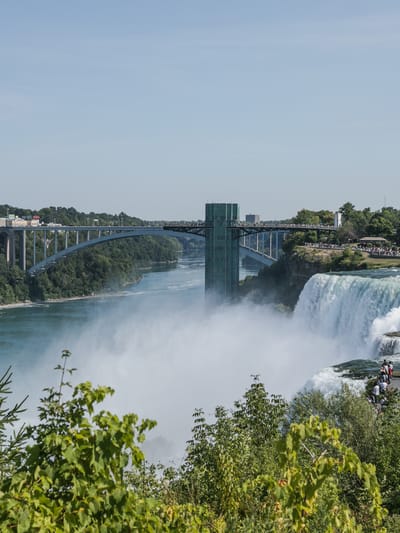
Walking into Canada across the Rainbow Bridge is free. Walking back is where the toll lives: the pedestrian toll is collected US-bound only, on the Canadian side before you step onto the walkway. It's $1.00 in US cash, $1.25 in Canadian, or $1.25 CAD if you tap, and the turnstile takes Visa, Mastercard, debit, and Apple Pay as well as coins.
The requirement that actually stops people is documents. Every traveler needs a passport or passport card in both directions, and there is no version of the walk that works without one, so this is the item to confirm for every person in the group weeks before the trip rather than at the turnstile. The full toll and document rules are on the Niagara Falls Bridge Commission site.
Once across, the Canadian promenade runs level with the Horseshoe brink and gives you the whole curve at once. It's the best free view of the trip, and the total cost of getting it is a dollar on the way home.
Why You Don't Drive the RV Across
Because the toll is charged per axle for an RV, motorhome, or anything in tow, at $6.00 US each, collected one way into Canada. A passenger car is a flat $6.00. A three-axle motorhome is $18 before you've found a place to put it, and a truck-and-trailer is more than that.
Then you're in downtown Niagara Falls, Ontario, hunting RV parking in a district built for hotel valets. Park it. Walk.
The Free Show After Dark: Niagara Falls Illumination and Fireworks
The falls are lit every night of the year, from dusk until somewhere between 1 and 2 a.m. depending on the season, and watching from public park space costs nothing. Prospect Point is the spot on the American side, and the lights hit the American Falls straight on from there.
Fireworks run nightly at 10 p.m. from May 15 to October 12, 2026, with extended displays on July 1 and July 4. The nightly show is about five minutes long, weather permitting, which is a useful expectation to set with anyone who's picturing a municipal Fourth of July.
The pacing consequence is real. A 10 p.m. show means you're walking back to the lot around 10:20 and driving to camp after that, so this belongs at the end of a day you planned around it rather than tacked onto a day that already ended. Bring layers, because the gorge pulls cold air even in August, and a packable camp chair turns forty-five minutes of holding a spot into something you'd volunteer for.
Where to Park the RV Overnight
None of the state park lots allow overnight parking, so the free day still ends at a campground. HTR Niagara on Grand Island is the base camp this whole itinerary is measured from: full hookups, open April 10 through October 25 in 2026, and roughly twenty minutes from Lot 3 by way of the river. Our full Niagara Falls RV itinerary covers the base camp and its alternatives in detail, along with the longer six-day version of this trip for anyone with more days than this plan uses.
If the budget frame extends to where you sleep, the methods in our guide to finding free camping in the US work in western New York the same as anywhere, with one caveat: Niagara County is developed enough that the free options sit a real drive out. At that distance you're trading the parking savings back in diesel.
Wherever you land, pack the day out of the RV rather than buying it at the falls. There's no food inside the park that isn't priced for a captive audience, and an insulated cooler bag that expands plus a divided snack box with built-in ice packs covers two people for a full day for the price of one park sandwich.
Two Days, and What It Actually Cost
Add it up out loud. Park the RV in Lot 3 on a Tuesday, Wednesday, or Thursday: nothing. Walk Prospect Point, Goat Island, Luna Island, Terrapin Point, and the Three Sisters: nothing. Drive north on the American side to Whirlpool and Devil's Hole and park at both, no border involved: nothing. Walk into Canada across the Rainbow Bridge: nothing. Walk back into the US: one dollar. Stand at Prospect Point for the illumination and the 10 p.m. fireworks: nothing.
One dollar, plus fuel and a campground.
The condition on that number is the calendar. Show up Friday through Monday between May 22 and September 7 and the RV lot is $20, which turns the same two days into $21. Still a bargain. Just a different one, and entirely avoidable by moving your arrival forty-eight hours.
If you've got more days than this plan uses, spend them. There are day trips from Niagara Falls in every direction, and most of the good ones are cheaper than the falls themselves.
FAQs
Can you park an RV at Niagara Falls State Park?
Yes, but only in Lot 3 at 50 Goat Island Road. Lots 1, 2, and 4 are restricted to automobiles. Lot 3 does not accept RVs or trailers over 40 feet, and the park notes that RV spaces are limited even within that cap. Watch your height on the way in as well: the Niagara Scenic Parkway underpasses are posted right around 12 feet, so approach through downtown on the surface streets instead. Overnight parking is not permitted in any park lot, so plan on a campground for the night regardless of where you park during the day.
Is Niagara Falls free to visit?
Admission to Niagara Falls State Park is free every day of the year, and always has been. Parking is the conditional part. For an RV in Lot 3, parking costs $20 only on Fridays through Mondays and holidays between May 22 and September 7, 2026, and it's free Tuesday through Thursday year-round and free from September 8 through May 21. The falls themselves, the overlooks, Goat Island, and the nightly illumination cost nothing at any time.
Where can you park for free in Niagara Falls?
Lot 3 in Niagara Falls State Park is free for RVs on Tuesdays, Wednesdays, and Thursdays year-round, and free every day from September 8 through May 21. North of the falls, Whirlpool State Park and Devil's Hole State Park both have free parking with no seasonal fee at all, open dawn to dusk year-round. Those two lots are the reliable free option if your dates land on a summer weekend.
Do you need a passport to walk across the Rainbow Bridge?
Yes, in both directions, for every person in the group. A passport or a passport card both work. The pedestrian toll is charged only heading back into the United States, at $1.00 in US cash, $1.25 Canadian, or $1.25 by tap, and it's collected on the Canadian side before you step onto the walkway. Walking into Canada costs nothing.
Are the Niagara Falls fireworks free?
Yes. Fireworks run nightly at 10 p.m. from May 15 through October 12, 2026, with extended displays on July 1 and July 4, and they're free to watch from anywhere in Niagara Falls State Park. Each nightly show runs about five minutes and is weather dependent. The falls illumination is separate, runs every night of the year from dusk, and is also free from public park space.
How do you see Niagara Falls for free in one day?
Park in Lot 3 midweek, walk to Prospect Point for the American Falls from the brink, cross to Goat Island for Luna Island and Terrapin Point, then continue to the Three Sisters Islands for the upper rapids. That's about three miles of flat paved walking with one optional set of stairs at Luna Island, and it covers every major free viewpoint on the US side. Stay for the illumination after dusk and the 10 p.m. fireworks if you're there between mid-May and mid-October.
Categories
Related Posts
Subscribe to the Swervia Newsletter
The best RV stories, tips, and destinations—expertly curated and always free.