Niagara Waterfront for RVers: Beaches, Kayak Launches, and the Canal Beyond the Falls
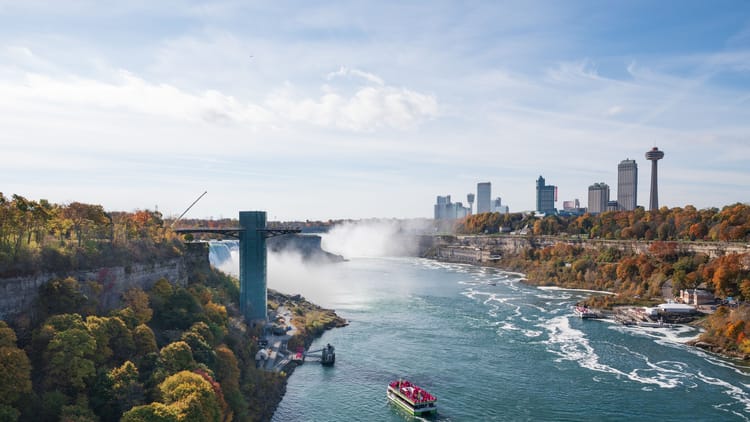
The Niagara River runs thirty-six miles from Lake Erie to Lake Ontario. The part everybody photographs is about one mile of it, and it happens to be the one mile you cannot get into.
The other thirty-five are a different proposition entirely. North of the tourist strip there's a half-mile sand beach on the same island most RVers are already parked on, a chain of free launches where you can put a kayak in the upper river, a Lake Ontario beach town forty minutes out, and a state-park campground on the lake with a free shuttle to the falls. Almost none of it costs anything, and most of it is empty on a Tuesday.
If you came to Niagara for the falls and only the falls, you're well served by a straightforward two or three days at the state park and you should go do that. This is for the traveler with a week, a kayak on the roof, and a growing suspicion that there has to be more water here than the mile with a railing around it.
Two rules run through everything below. Don't swim in the river, and check the calendar, because every beach on this list closes Labor Day.
Where You Can Actually Swim Near Niagara Falls
Start with the hard part. The Niagara River is not a swimming river. Niagara Parks states plainly that swimming is not permitted in the river, and the reasoning holds well upstream of the falls: current in the rapids runs faster than most people can jog, and the stretches that look calm carry an undertow that doesn't care how strong a swimmer you are. Paddlers get the same answer. The upper river above Goat Island is off-limits, and the sections that are paddleable are the ones a local outfitter already runs. If you want to be on that water, hire someone who does it daily.
Now the useful half. The swimming near Niagara Falls happens in Lake Ontario, twenty to forty minutes north, at supervised state-park and county beaches. The lake is cold into June, comfortable by late July, and genuinely pleasant in August, the same August everyone else spends standing in a parking garage line at the falls.
The window is short, though. Lifeguarded swimming on this shoreline runs only from Memorial Day to Labor Day. Show up the second week of September and the water is still there, the beach is still open to walk, and nobody is watching you swim.
Beaver Island State Park: The Beach on Your Base Camp Island
If you're staying on Grand Island, the closest real swim is a ten-minute drive from your site. Beaver Island State Park sits at the south end of the island where the river splits, and it's a day-use park in the most literal sense: open dawn to dusk, year-round, no camping, no gates after dark. Bring the tow vehicle rather than the RV.
The Half-Mile Beach, and the Season That Gates It
The beach is a half mile of actual sand, which on a river island in western New York is not a given. Lifeguards work it midday into early evening, weekends only starting Memorial Day weekend, then daily through Labor Day once the full summer schedule opens. That changeover lands a few days differently each year, so check the park page before you build a June swim around it.
There's a per-vehicle entrance fee, and it's charged only when the beach is open. Weekends from Memorial Day through Juneteenth, then daily until Labor Day. The rest of the year the same park with the same views costs nothing to drive into. An Empire Pass covers it all season if you're working a longer New York loop and expect to hit more than a dozen state parks.
Bring your own everything. There's no meaningful concession operation, and a beach day with four people runs smoother out of a six-pack of oversized towels that survive sand and lake water and a wheeled 52-quart hard cooler you can drag across a parking lot than out of whatever's left in the RV fridge.
One note if the dog is coming. Highly pathogenic avian influenza is a standing feature of New York's wild bird population rather than a passing scare, widespread enough in waterfowl that the state monitors it instead of trying to contain it. Both Beaver Island and Wilson-Tuscarora carry a posted notice, worded for hunters. The CDC puts the risk to the public as low, and nobody needs to cancel a beach day over it. Keep the dog off dead birds, advice that was already good.
Launching a Kayak at Beaver Island
The park has a car-top boat launch plus multiple canoe and kayak launches, and none of them charge a launch fee. In beach season the fee at the gate is the entire cost of a paddling day, and outside it the day costs nothing at all. You're putting in on the West River, the quieter channel on the Grand Island side, rather than the main navigation channel. Quieter water, and the practical reason to bring the boat at all.
One live caveat: the park is in the middle of a multi-year West River Shoreline Enhancement Project, roughly six and a half miles of invasive-species removal. It's real work with real equipment, so look for posted access notices before you plan a launch around a specific put-in.
If what you're towing is bigger than a kayak, the park also runs two marinas, Beaver Island and Big Six, from early May to mid-October. Both price seasonal slips by the foot. Beaver Island is the one that takes day and overnight boats, at a daily rate plus a reservation fee, and its 80 slips fill up in July.
None of it is overnight, though, and enough people show up towing something to make that worth knowing before you turn in. The lake-adjacent state-park campground you want is Four Mile Creek, forty minutes north in Youngstown, and it's the best-kept secret in this region.
This trip is planned. Subscribe to our weekly newsletter.
FOR RV PEOPLE WHO LIKE TO KNOW THINGS. EVERY WEDNESDAY. ONE EMAIL. FREE.
Lewiston and Artpark: The Gorge From the Bottom
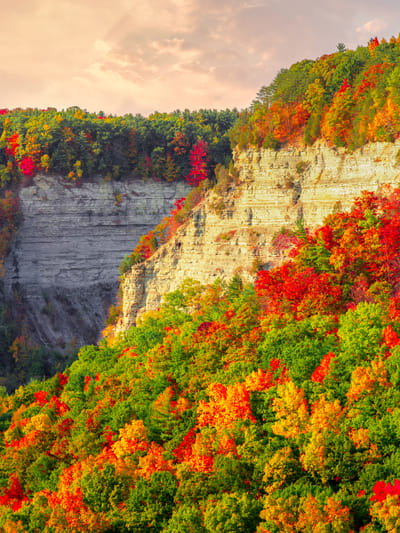
Seven miles downriver the gorge walls drop away and Lewiston sits at river level, and that alone is worth the drive. Everywhere else in this region you meet the gorge from the rim, looking down over a railing at something happening below you. Here you're at the bottom of it, level with the water, close enough to feel how much of it there is. Same gorge, completely different scale.
Artpark anchors the town, and most visitors never find out that the best version of it is free. It's a state park first and a concert venue second: an amphitheater built out over the river, art installations worked into the grounds, and trails and picnic tables that stay open whether or not anything is playing that night. An afternoon spent wandering it costs nothing and asks nothing of you.
If a show is the draw, buy ahead and leave the RV at camp. A sold-out amphitheater on a summer night is the wrong place to find out how much room you need.
The trails here connect to the larger gorge network, a subject of its own. Our guide to Niagara Gorge hikes for RVers covers which descents are open, which are closed, and what each one asks of your knees on the way back up.
Wilson-Tuscarora State Park Is a Launch, Not a Beach
Wilson-Tuscarora State Park has no swimming beach, whatever the regional beach roundups keep telling you. What it does have is a good launch open most of the paddling season, a small marina where an overnight slip costs less than anywhere else on this stretch of shoreline, disc golf that runs year-round, and a nature trail that loops out through the creek mouth where Twelve Mile Creek meets the lake. There's a boat cleaning station and a pump-out too, which matters more than it sounds like if you've been hauling the same hull between lakes.
Fishing is a serious regional draw here, not a consolation prize for people who ran out of waterfall. If the boat is the reason you came at all, New York State DEC keeps a list of public launch sites across Niagara County that stays more current than any tourism page, including a run of municipal ramps on the upper river between Grand Island and the falls that no visitor guide bothers with.
Take Wilson-Tuscarora for what it is and it's worth the drive: paddle the protected creek mouth, walk the trail, eat lunch, go home dry. Take it for a beach day and you'll spend twenty minutes looking for sand that isn't there.
Olcott and Krull Park: The Lake Ontario Beach Town
Forty minutes east of the falls, Olcott is a small harbor village at the mouth of Eighteenmile Creek that isn't selling you anything, which after a few days on the tourist strip is its own kind of amenity. Krull Park spreads along the lakefront above the village with ballfields, courts, playgrounds, a splash park, and shelters you can rent for an afternoon.
The stretch north of Main Street is what people mean when they say Olcott Beach: sandy shoreline, a pier, and a view that runs to the horizon with nothing in it. It's a county-permitted beach, which means the health department samples the water weekly through the summer and closes it when bacteria levels spike, usually after heavy rain pushes the creek into the lake. That happens often enough that the county beach report is worth a look the morning of, not after a forty-minute drive. If a supervised swim is the actual goal, Beaver Island is the surer bet and Olcott is the walk-the-shoreline afternoon.
For anyone traveling with small kids the splash park quietly outperforms the beach. Free, shallow, and completely indifferent to whatever Lake Ontario decided to do with its temperature that week.
The Canal Thread: Lockport and the Erie Canal Discovery Center
The Erie Canal cuts east from Lockport, twenty-five minutes inland, and it's the third water story in this region after the river and the lake.
The free version is the good one. The Discover Niagara Shuttle runs a Lockport route in season at no charge, so you can park once, ride out, stand over a flight of nineteenth-century locks that still do the job they were cut for, and ride back without ever moving the RV. If the bikes came along, the Erie Canalway Trail leaves town in both directions and doesn't climb.
The lock-boat cruise that headlines every Lockport listicle is a separate question. Confirm it's actually running the week you go, rather than driving twenty-five minutes on the strength of a search result.
Where to Park the RV on the Water: Four Mile Creek State Park
This is the stop that should be on far more Niagara itineraries than it is.
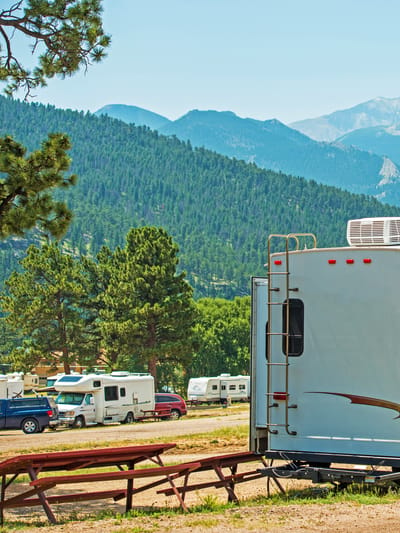
Four Mile Creek State Park is a state-park campground sitting right on the Lake Ontario shore outside Youngstown, twenty minutes north of Niagara Falls. It's large, it's open roughly May through October, and the back-in driveways run 50 feet, which comfortably fits most of what shows up here. Camp store, laundry, showers, playgrounds, nature trails, and lake access are all on site.
And then the fact that reframes the whole trip: the campground is a stop on the free Discover Niagara Shuttle, which connects it to Old Fort Niagara and runs through to the falls. Service is daily at the height of summer and drops to weekends on the shoulders of the season. You can leave the RV leveled for a week, never tow anything anywhere, and still see the whole corridor.
The tradeoff is real. Sites are electric only, 30 amp. No water hookup, no sewer. There's a dump station and a water fill-up on site, so this is a tank-discipline stay rather than a plug-and-forget one. Come prepared with a drinking-water-safe hose light enough to coil one-handed and a 20-foot heavy-duty sewer hose kit, and treat the dump station as a scheduled event rather than an emergency.
One more logistic, and it's the one that catches people. Pets are capped at two per site, leashes are short and enforced, and current rabies paperwork is required at check-in. That last one is a genuinely common way to arrive at a campground after a long tow and have a bad conversation. Pull the vet record onto your phone before you leave home, and if a strict leash rule is going to be a problem for a dog used to running, a GPS tracker collar is cheaper than the alternative.
Compared with the full-hookup resort option on Grand Island, this is a different trip: less amenity, more shoreline, forty minutes farther from Buffalo, and twenty minutes closer to the lake. Our full Niagara Falls RV itinerary works through the base-camp math in detail. Either one works. At Four Mile Creek you fall asleep listening to Lake Ontario.
If you're towing a boat trailer to any of the launches above, a magnetic solar-powered wireless backup camera makes a ramp with a line behind it substantially less stressful than it needs to be.
Planning the Water Days Around Labor Day
These stops pair cleanly into single days. Beaver Island in the morning and a paddle on the West River after lunch is one day and barely any driving at all. Wilson-Tuscarora and Olcott is a second, running east along the lake. Four Mile Creek, Old Fort Niagara, and Lewiston is a third if you're basing on Grand Island rather than at the lake.
Every one of them wants the tow vehicle. These are day-use lots built for cars, and Artpark on a concert night is a firm no.
The one date that governs all of it is Labor Day. Lifeguards come off the beaches, the Beaver Island entrance fee stops being charged, loops at Four Mile Creek start closing, and the shuttle drops back to weekends. So the shoulder-season version of this trip is quieter, cheaper, and entirely dry. Plan a September visit around launches and trails, and plan the swimming for August.
Water is one thread here. Most of the best free things to do in Niagara Falls are on foot inside the state park, a different day entirely. The forts, lighthouses, and canal towns along this corridor are their own subject, as are the longer day trips from Niagara Falls that run east toward Rochester and south toward Buffalo.
Thirty-five miles of shoreline sit north of that railing, and most people drive straight past all of it on the way to the mile they came for.
FAQs
Can you swim near Niagara Falls?
Not in the Niagara River. Niagara Parks prohibits swimming in the river, and the current above and below the falls is dangerous even where the surface looks calm. Swimming near Niagara Falls happens in Lake Ontario, roughly twenty to forty minutes north, at supervised beaches. The closest is Beaver Island State Park on Grand Island, with a half-mile sand beach and lifeguards on duty midday into early evening, weekends starting Memorial Day weekend and daily through Labor Day once the full summer schedule opens. Check the park page for the current year's changeover date.
Is there camping at Beaver Island State Park?
No. Beaver Island State Park is a day-use park, open dawn to dusk year-round with no overnight camping of any kind. The nearest state-park campground on the water is Four Mile Creek State Park in Youngstown, about forty minutes north, which runs 266 sites, open roughly May through October, with 30-amp electric hookups, a dump station, and 50-foot back-in driveways.
Can you camp on Lake Ontario near Niagara Falls?
Yes. Four Mile Creek State Park sits directly on the Lake Ontario shore outside Youngstown, twenty minutes north of Niagara Falls, with 260 campsites and five yurts. Sites are electric only at 30 amp, with no water or sewer hookups, but there's a dump station, a water fill-up, a camp store, laundry, and showers on site. The campground is also a stop on the free Discover Niagara Shuttle, which runs daily at the height of summer and drops to weekends on the shoulders of the season.
Do you have to pay to enter Beaver Island State Park?
Only when the beach is open, and only per vehicle. That means weekends from Memorial Day through Juneteenth, then daily through Labor Day. Outside those dates the park is free to enter, which is most of the year. An Empire Pass covers unlimited entry to New York state parks for the season if you're visiting more than a dozen. Check the park page for the current rate.
Can you kayak the Niagara River?
Only in specific sections, and the upper river between the Peace Bridge and Goat Island is off-limits regardless of skill level. The practical launches for recreational paddling are on the calmer West River channel at Beaver Island State Park, which has a car-top launch and multiple canoe and kayak launches at no charge, plus the municipal ramps along the upper river listed by New York State DEC. For anything closer to the falls or the gorge, go with a licensed local outfitter rather than putting in on your own.
Are there beaches in Niagara Falls, NY?
Not at the falls themselves. The Niagara River has no swimming beaches anywhere along its length, and Wilson-Tuscarora State Park, which frequently appears on regional beach lists, has a boat launch and trails but no swimming beach according to New York State Parks. The real beaches are on Lake Ontario: Beaver Island State Park on Grand Island and the Olcott Beach section of Krull Park, about forty minutes east.
Categories
Related Posts
Subscribe to the Swervia Newsletter
The best RV stories, tips, and destinations—expertly curated and always free.