The Amazon Camper Accessories Full-Timers Order After Year One on the Road

Year one of full-time RV living is mostly about figuring out what you didn't know. You buy the surge protector, the water hose, the leveling blocks. You learn which cabinet latch fails first on a rough state highway and what "we'll be fine without a mat" looks like after a rainy weekend. By the time year two starts, you have a different list — not the essentials that got you through that first year, but the specific accessories that make the day-to-day actually work. The ones nobody told you about because you have to live in a rig for a while before you know what you're missing.
This is that list. If you're still navigating year one, our breakdown of what full-time RV living actually looks like in the beginning is a better starting point. If you've got the basics handled, keep reading.
The Stability Upgrades That Should Have Come First
Most full-timers spend months not realizing how much movement their rig is generating at rest. If the dinette shakes when someone walks across the floor, or coffee ripples in the mug while you're parked, you don't have a bad site — you have an unsolved stabilization problem. Two products fix most of it.
X-shaped wheel chocks grip the tire from multiple contact points simultaneously, resisting forward, backward, and lateral movement with a single piece of equipment. Unlike basic wedge chocks that prevent rolling in one direction, the x-frame design creates multi-directional resistance that holds on everything from paved pads to soft ground. Drill-adjust versions let you dial in the fit precisely without shimming. A set of x-shaped stabilizing wheel chocks is the stability fix that full-timers consistently report discovering too late — usually after months of wondering why the rig still moved.
Drive-on leveling ramps handle the other half of the arrival equation. Where stacking interlocking blocks requires guessing the site grade and resetting repeatedly, a tapered ramp lets you pull forward and stop when the bubble hits center. A drive-on leveling ramp set works on any tire size, handles most campsite grades without stacking adjustments, and stores flat in a side compartment. For full-timers moving sites multiple times a week, the accumulated time savings are real.
For a complete arrival walkthrough, our RV setup checklist covers the full sequence from pulling in to hooking up.
The Outdoor Room, Actually Set Up Like One
Full-timers who have been on the road long enough stop treating the outdoor space as a bonus and start treating it as a room with a furniture problem. The goal is a setup that breaks down in under ten minutes and packs into what's already there.
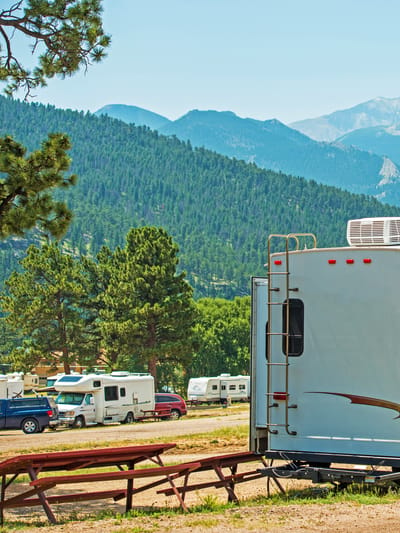
A tire-mounted folding table is the accessory almost nobody knows about until they've seen one in use. It clips directly to any vehicle tire using the tire itself as the primary support structure, which means it's stable regardless of what the ground underneath is doing. The steel frame holds 50 pounds and fits tires up to 40 inches, covering everything from standard trailer tires to oversized truck tires on a tow vehicle. Full-timers use it as a grill side table, a camp kitchen staging area, or a flat working surface during setup. No legs to level, no ground contact required. A tire-mounted folding camp table folds flat when not in use and stores in a cargo compartment without taking up meaningful space. It's also a great accessory to bring along on day trips for picnic lunches while staring at the prettiest mountain you ever saw.
A ladder-mounted aluminum drying rack solves the wet towel situation that follows full-timers to every site near water. An aluminum ladder-mounted rack with 180-degree swivel arms hooks over the existing rungs of the RV ladder and provides 24 inches of arm length for towels, swimsuits, and wet gear. The swivel arms adjust to whatever angle actually catches airflow at the site, and the whole thing folds flat on drive days without removing it. No modification to the rig.
A smokeless tabletop fire pit matters for full-timers specifically because open wood fires are prohibited at a growing number of campgrounds, BLM sites, and state parks — particularly across the West during dry months. A compact tabletop fire pit uses double-wall airflow design to burn wood pellets or small wood with dramatically less smoke than a traditional fire. It packs in a carry bag, fits on a picnic table without dominating it, and works at sites where a standard fire ring would get you a citation.
A battery-heated outdoor chair extends usable time outside during shoulder seasons and at higher elevations where temperatures drop sharply once the sun goes down. A heated camp chair with multiple heat settings and a padded seat keeps you outside two to three hours longer per charge rather than retreating inside when the thermometer drops. Full-timers moving through varied climates rather than chasing warm weather year-round get the most consistent use out of this one.
Power and Propane, Caught Up
Two accessories that address problems which feel minor until they happen at the wrong time — which for full-timers is regularly.
Wireless propane tank sensors are small magnetic discs that attach to the base of each propane tank and send real-time fill levels to a smartphone app. No lifting, no weighing, no going outside to check. A wireless propane level sensor reads the liquid level through the tank wall using ultrasonic measurement, runs on coin batteries for approximately a year, and works with dual-tank setups so you can monitor both tanks independently. For full-timers running propane simultaneously for heat, cooking, and hot water, knowing where each tank stands in real time is the kind of change that seems small until the first cold night it prevents a problem.
A 3-sided wall outlet extender with USB ports is the no-tools, no-installation fix for the RV charging situation that accumulates over time. Most rigs have fewer outlets than a full-timer actually uses, and few or none include USB-C unless they're brand spankin' new. An outlet extender with USB-C ports plugs into one existing outlet and expands it to five AC receptacles plus four USB ports — including two USB-C — on a three-sided frame that keeps bulky adapters from blocking adjacent ports. Built-in surge protection adds a layer of safety on campground power that varies more than it should, and the low-glow built-in night light is genuinely useful in a rig where you navigate in the dark more often than you expect at home.
Our RV solar setup guide covers what to pair with your power setup if shore hookups aren't reliably covering what you're running.
Full-timers know the gear changes after year one. Subscribe to our weekly newsletter.
WHAT FULL-TIMERS ACTUALLY ORDER. EVERY WEDNESDAY, FREE.
Cooking Like You Actually Live Here
Weekenders cook simply because they're only there for two nights. Full-timers using the same galley every day eventually develop a different relationship with what they're willing to do for a good meal. Three accessories raise that ceiling without touching the built-in kitchen.
A portable induction cooktop is the most practical kitchen upgrade for full-timers on shore power because it runs on electricity rather than propane, which matters when you're stationary for a week and want to conserve tank levels for heat and hot water. It also generates no combustion heat inside the rig — relevant in summer when the AC is already working. A countertop induction burner with digital temperature controls adds a second burner, handles a precise simmer as well as a rolling boil, and stores in a cabinet when not in use.
A sous vide precision cooker clips to any pot, holds water at an exact temperature for the full cook time, and produces results with proteins that a stovetop or camp grill can't reliably match. For full-timers who spend the day outside, the actual advantage is that it requires almost no attention once running. Set the temperature, seal the protein in a bag, drop it in, and leave. An immersion precision cooker runs on any 120V outlet, stores in a drawer, and turns a small galley into something that can produce a genuinely good dinner on a Tuesday.
A countertop gravity water filter is where most full-timers eventually land after inline hose filters stop feeling like enough. Where an inline filter reduces chlorine and sediment, a countertop gravity filter removes bacteria, heavy metals, and a broader range of contaminants without power or a plumbing connection. It sits on the counter (yes, it takes precious counter space, but we wouldn't put it on here if it wasn't worth it), fills from the top, and dispenses from a spigot. For full-timers drawing from water sources across dozens of different municipalities and campgrounds in a year, the consistency in taste and safety is the point. Our RV water filter guide covers the full range of filtration options if you're comparing systems.
The Small-Space Fixes Nobody Packages as a List
These don't fit a single category. They solve problems that only become visible after months of living in the rig.
Museum putty is the one that makes people ask why nobody told them sooner. A small amount of removable adhesive putty pressed under a picture frame, a kitchen canister, a Bluetooth speaker, or any object on an open surface keeps it exactly where it was when you left. It holds through normal drive conditions, releases cleanly without residue on most surfaces, and repositions as many times as needed. A two-pack handles most of a rig interior. Under ten dollars, immediate results, and a permanent solution to coming home from a long drive to a counter of objects that went somewhere interesting.
An over-door shoe organizer at the main entry solves the management problem that gets worse the more time you spend outside. Every full-timer reaches for the same items every time they walk out: sunscreen, bug spray, dog leash, headlamp, keys, hat. An over-door entry organizer puts all of it in one visible, consistent place. No floor footprint, no tools, uses a surface that's otherwise doing nothing. The pockets work equally well for charging cables, small tools, and anything else that tends to redistribute itself across the rig between sites.
Under-shelf clip-on baskets convert the dead space below upper cabinets into actual storage without tools or screws. The gap between the bottom of a cabinet and the shelf below runs roughly the height of a cereal box — which is exactly what clip-on under-shelf baskets are sized for. They slide over the shelf edge and lock in place. In the kitchen, they hold foil, wraps, spice packets, and small pantry overflow. In the bathroom, they catch daily-use toiletries that would otherwise take up counter space.
The Bathroom, Actually Fixed
Two upgrades that most full-timers wish had been in the rig from the beginning.
An RV-specific bidet attachment makes practical sense for full-timer logistics: less toilet paper consumption, less storage demand, and no campground supply run for TP. If you've ever watched a 24-pack claim an entire storage bay while the sewer hose kit waited outside, the math on this purchase is pretty straightforward. A dual-nozzle RV bidet attachment with self-cleaning nozzles connects to the existing water supply line at the toilet shutoff valve, requires no power, and installs with the fittings included in the kit — typically about twenty minutes. RV-specific models are designed for the tighter clearances in RV bathrooms that residential versions don't account for. Winterization is closing the shutoff valve and draining the line — the same process as the toilet supply itself.
An adjustable curved shower rod changes how the RV bathroom feels to use every single day. Standard RV shower stalls are narrow, and a straight rod keeps the curtain at your elbows. A rod that bows outward adds several inches of elbow room — enough to make getting dressed in a small shower a non-event instead of a production. An adjustable curved shower curtain rod from 38 to 72 inches fits the range of RV bathroom widths, installs with standard mounting hardware, and costs under $30. Full-timers reliably put this in the "should have done it first week" category.
The Vacuum Situation, Resolved
Most full-timers start with a handheld vacuum. They move to a cordless stick sometime in year one after realizing that a 40-foot rig accumulates floor debris at the same rate as a house, and a handheld makes you crouch for every square foot of it.
A cordless stick vacuum with a detachable handheld component handles both jobs — floor passes and spot cleaning — without taking up significantly more space than the handheld alone. The two-in-one configuration matters specifically for RV interiors: the full stick handles open floor areas, the detachable unit handles the dinette seating, slide channels, and the tight gap between the bed and the wall. A wall-mount charging dock keeps it off the floor and in one consistent location so it's not occupying cabinet space. Alternatively, some break down into individual pieces so you can store in a small plastic bin hidden somewhere.
What Actually Changes in Year Two
The year one accessories are still in the rig. They still matter. But the list shifts from getting through the learning curve to actually living well in the space. The products here aren't upgrades for their own sake — they're solutions to specific friction points that only become visible once you've been doing this long enough to feel them.
For a grounded picture of what full-time RVing costs before you invest further in the setup, our full-time RV cost breakdown covers monthly expenses across different travel styles and rig types. And if recurring maintenance surprises are still showing up, our complete RV maintenance checklist is worth running through before the next season.
FAQs
What amazon camper accessories do full-timers typically buy in their second year on the road?
Second-year purchases move away from basic utilities and toward stability, outdoor infrastructure, and kitchen quality. The most consistent include x-shaped wheel chocks, drive-on leveling ramps, tire-mounted folding tables, ladder-mounted drying racks, wireless propane sensors, countertop gravity water filters, sous vide cookers, RV-specific bidet attachments, curved shower rods, and cordless stick vacuums. These address problems that only surface after months of daily use — friction points that are difficult to anticipate before you've actually been living in the rig through different seasons and sites.
What are x-shaped wheel chocks and why do full-timers recommend them?
X-shaped wheel chocks grip the tire from multiple directions simultaneously, resisting forward, backward, and lateral movement with a single unit. Standard wedge chocks primarily prevent rolling in one direction; the x-frame design creates multi-directional resistance that holds more reliably across different surface conditions. For full-timers parking on everything from concrete pads to gravel to grass, the difference in overall rig stability is immediate. They don't require any modification to the rig and fit standard wheel and tire sizes. Most full-timers who add them report wishing they had done it significantly earlier.
Can you use a sous vide cooker in an RV, and is it worth it?
A sous vide precision cooker is well-suited to RV cooking because it works with any pot, requires only a standard 120V outlet, stores in a drawer, and runs almost entirely unattended. For full-timers who spend most of the day outside, the ability to start a protein cooking before heading out and return to a finished meal is a genuine quality-of-life improvement. Common cook times run from 45 minutes for fish and thin chicken to about two hours for thicker cuts. The cooker draws 1,000 to 1,200 watts, which falls within a standard shore power connection.
What is museum putty and how do full-timers actually use it?
Museum putty is a removable, non-damaging adhesive originally developed for securing display objects from vibration. In an RV, it keeps anything on an open surface — frames, small appliances, decorative objects, anything not in a closed cabinet — from shifting or falling during drive days. A small amount pressed to the base of an object holds through normal travel, releases cleanly without residue on most surfaces, and repositions indefinitely. A two-pack covers most of a rig interior and costs under ten dollars. It's the accessory that consistently surprises full-timers with how much difference it makes for how little it costs.
How do wireless propane tank sensors work and are they worth buying?
Wireless propane sensors use ultrasonic measurement to read the liquid level inside a tank through the tank wall without removing or opening it. A small magnetic sensor attaches to the base of the tank and transmits data to a smartphone app, showing a percentage fill level for each connected tank. Battery life runs approximately one year on coin batteries. For full-timers running dual tanks simultaneously for heat, cooking, and hot water, real-time visibility into each tank's level removes a recurring and entirely preventable problem. The sensors pair with most standard propane tanks and take about five minutes to set up.
Is a bidet attachment practical to winterize in an RV?
RV-specific bidet attachments connect to the existing cold water supply line at the toilet shutoff valve and require no power or permanent modification. Installation uses the fittings included in the kit and typically takes about twenty minutes. Winterization is closing the shutoff valve and draining residual water from the attachment — a two-step process that takes under five minutes and poses no additional challenge beyond winterizing the toilet supply line itself. RV-specific models are designed to fit the tighter clearances in RV bathrooms that standard residential bidets don't account for, which matters more than it sounds in a small space.
What makes a cordless stick vacuum work well in a full-time RV?
The most important features for RV use are a detachable handheld component, a battery rated for at least 30 to 40 minutes of runtime, and a wall-mount charging dock rather than a freestanding base. The two-in-one configuration lets you run the full stick for open floor areas and the handheld for upholstered surfaces, slide channels, and tight gaps that are specific to RV interiors. A dust cup in the half-liter to one-liter range handles several days of cleaning between empties without requiring daily maintenance.








Categories
Related Posts



Subscribe to the Swervia Newsletter
The best RV stories, tips, and destinations—expertly curated and always free.