Lake George Day Trip: How to Spend the Perfect Day (and the Easy Drives Out)
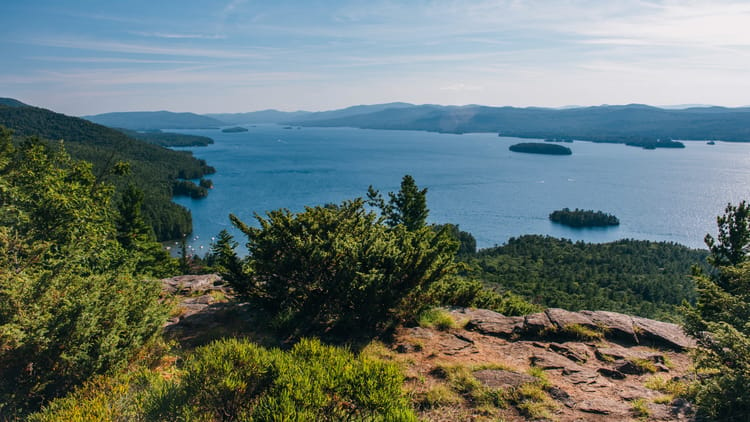
New York rates Lake George's water Class AA-Special, the highest grade the state hands out, which is the bureaucratic way of saying you can stand in twelve feet of it and count your toes. There are more than 160 islands scattered down its 32 miles, 148 of them owned by the state, and 387 campsites spread across three island groups you can only reach by boat. People have been coming here on purpose since the 1800s, and they were right to.
A Lake George day trip is really two different days, though, and which one you get depends on a decision you'll make before you've finished your coffee. Ten minutes south of those islands is a strip of arcades, fudge shops, and mini golf that gets genuinely loud in July. Ten minutes north, the shoreline goes quiet and stays that way for thirty miles. Both are Lake George. Both are a good day. They are not the same day.
Here's how to spend either one, plus the drives out that are worth a whole afternoon.
Lake George Village or the Lake Itself: Pick Before Breakfast
If breaking camp is the last thing you want to do and the plan is a chair, a cooler, and water you can see through, the lake will hold up its end of that all day. If you came to the Adirondacks to cover ground, this is one of the better places in the region to launch from, and the village is a twenty-minute errand rather than a destination.
The one plan that doesn't work is trying to do both halfheartedly. Lake George Village is a compact resort strip that's charming for about two hours and a parking lot with a view after three. The lake north of it will take a whole morning and give you every minute back. Split the difference and you get the worst of a crowd and none of the water.
Traveling with kids who've been strapped into a vehicle for three days? Take the village. The mini golf is a legitimate strategic decision and nobody here is going to judge you for it.
A Perfect Day at Lake George
Morning on the Water: the Steamboats, the Narrows, and Million Dollar Beach
Looking at Lake George from the shore is fine. Being out on it is the reason the Gilded Age built hotels here.
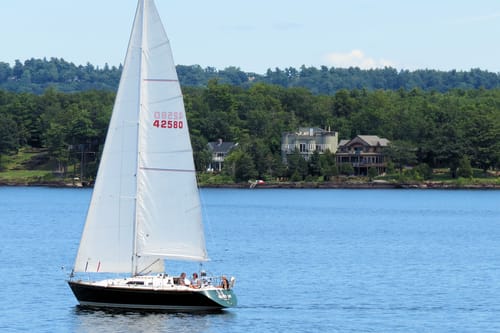
The Lake George Steamboat Company has been running boats off the Steel Pier for well over a century, and one of the three is the Minne Ha-Ha, an actual paddlewheeler with an actual working steam engine you can watch turn. The hour-long run is the cheap trick that works: it takes you out past the islands and up toward the Narrows, where the lake pinches from three miles wide to less than one and squeezes between the Tongue Mountain Range and the peaks on the far shore. Camps built by people with railroad money still sit in the trees along that stretch. You'll pass islands with a single dock and a single fire ring on them, which is the moment most people realize you can sleep out there. You can. They're state campsites and they book up months ahead.
If you'd rather be in the water than on it, Million Dollar Beach is the state day-use beach at the south end, and it's the rare public beach where the view up the lake is better than the beach itself. Sand, a swimming area with lifeguards, picnic tables with grills, and thirty-two miles of mountains stacked up in front of you.
Two rules matter here more than the price of the parking. Swimming is only allowed when a lifeguard is on duty, and pets are banned outright. Not "leashed pets in designated areas." Banned. If the dog is on this trip, that one reshapes your whole day, and there's a section on it below.
Either way, pack the lunch before you leave. Village prices are village prices, and an insulated expandable cooler bag handles a boat and a beach better than wrestling the hard cooler off the RV.
Lake George Village Without Losing the Whole Afternoon
The village is walkable end to end in about twenty minutes, and everything good about it happens in the first hour. Canada Street is arcades, ice cream, souvenir shops, and the boat docks, and it's doing exactly what it has been doing since your grandparents came here. That's the appeal. Nobody is pretending this is refined.
Budget two hours: something cold, a look at the lake from the docks, and whatever the passengers negotiate at the mini golf. Treat it as the intermission rather than the show and it's a good time. The trouble starts when the village becomes the plan, because the lake is right there and it's better.
If the Dog Is on This Trip
The dog changes the shape of the day more than anything else at Lake George, and the reason is a rule most people don't find out about until they're standing at a dock.
The campground itself is the easy part. Dogs are welcome at Lake George Battleground and at New York's other mainland state campgrounds, on a leash of six feet or less, once you show proof of a current rabies vaccination. Bring the paperwork. They do ask.
The water is where it falls apart. Dogs are barred from the state beach, and they're barred from the Lake George islands, the docks, and any boat tied up at a dock, which takes the island campsites and most of the on-the-water day off your list in one stroke. And you can't solve it by leaving the dog at the site, because state campground rules don't allow a dog to be left unattended.
So the day splits, and it splits early. Either somebody stays behind while the rest of you go out on the lake, or you all skip the boat and spend the day where the dog is welcome, which is most of the Adirondacks outside the swimming beaches. Our guide to Adirondack swimming holes for RVers covers the free river spots an hour north, and most of them have no opinion about your dog at all. On a leashed hike in country the dog has never smelled before, a GPS dog tracker collar is worth the room it takes up.
Looking for more Adirondack RV intel? Subscribe to our weekly newsletter.
THE ISLAND CAMPSITES YOU BOAT TO, THE ADIRONDACK DRIVES WORTH THE GAS, AND WHERE A THIRTY-FIVE-FOOTER ACTUALLY FITS — FREE, EVERY WEDNESDAY.
Easy Day Trips Out From a Lake George Base Camp
Half the people searching for a Lake George day trip aren't asking what to do at the lake. They're parked here and want to know what's within reach. The radius is small and the payoff per mile is unusually good. Closest first.
Glens Falls and the Hyde Collection: Twenty Minutes South, and the Best Rainy Day in the Region
Every lake trip needs a plan for the day the weather turns, and this is the best one in the Adirondacks by a wide margin.
In 1865 a man named Samuel Pruyn started a paper mill on the Hudson at Glens Falls. It made the family rich. His daughter Charlotte married a lawyer, tore down the Second Empire pile on the bluff above her father's mill, and by 1912 had replaced it with an Italian Renaissance villa. Then she and her husband spent the next fifty years filling it with old masters. When she died in 1963 the house opened as a museum, and that's where it still is: a Rembrandt, a Rubens, an El Greco, a Botticelli, plus Homer, Eakins, Whistler, Degas, and Picasso, hung in the rooms of a private home overlooking a working paper mill.
The Hyde Collection is a small museum. That's the pleasure of it. You are standing a normal person's distance from a Rembrandt in what is essentially somebody's living room, and there is no line. Two hours covers it comfortably. It's closed Mondays and Tuesdays, and admission is free to everyone on the second Thursday of the month if the timing happens to work.
Bolton Landing and the Quiet West Shore of Lake George
Twenty minutes north on Route 9N and Lake George quits being a resort town. This is the drive itself as the attraction: two lanes with the water on one side, Tongue Mountain rising on the other, and the mansions of what people still call Millionaires' Row set back in the pines along the shore.
Those mansions are why Bolton Landing exists in its current form. In 1883 a hotel operator talked four Philadelphia millionaires into buying an island off the village and building a resort on it, and The Sagamore has been sitting on Green Island ever since, throwing a shadow of Gilded Age money over an otherwise very small town.
Then there's the other reason to drive up here. From 1918 to 1934, Georgia O'Keeffe spent part of nearly every year at the Stieglitz family place just north of Lake George Village, painting in a converted shack she called the shanty. She produced more than two hundred works here, and it was the most prolific stretch of her career. The birches, the barns, the water folding in on itself: that's this shoreline. You're driving through her most productive decade.
Bolton Landing today is a marina, a handful of restaurants, a public beach, and a conspicuous absence of arcades. Half a day, and the right pairing with a village morning. Two completely different versions of the same lake, ten miles apart.
Saratoga Springs: Thirty Minutes South, and a Full Day Once You Get There
Saratoga Springs is the strongest day trip from Lake George, and it isn't a close contest. Thirty minutes south on the Northway you land in a real nineteenth-century spa city with broad streets, a downtown where the menus aren't laminated, and the strange geology that made it famous.
The strange geology is the reason to go. Carbonated mineral water comes up out of the ground here under its own pressure, and Victorians took trains from three states to drink it. Saratoga Spa State Park has thirteen of those springs, each tasting distinctly different from the one before, most of them tasting frankly terrible, and all of them free to walk up to and drink. Locals show up with five-gallon jugs. Do the tasting tour. Make everyone in the family try the worst one.
The park holds a lot more than the springs across its two thousand acres: two historic swimming pools, an automobile museum, a children's museum, two golf courses, and the Saratoga Performing Arts Center. The Victoria Pool is the swim to plan for, an Italianate courtyard pool that looks like it belongs at a European hotel rather than a state park.
And then there's the track. Saratoga Race Course opened in 1863, a month after Gettysburg, when a former bare-knuckle prizefighter turned casino owner turned congressman decided this town should have thoroughbred racing. It's the oldest organized sporting venue in the country still hosting major events, it runs through the summer, and being in the grandstand on a July afternoon is one of the genuinely great American sporting experiences whether or not you know a thing about horses.
Give Saratoga a full day. It's the one drive on this list that would still be worth it if Lake George weren't here.
Fort Ticonderoga: Forty Five Minutes North, and the Reason Boston Got Its Cannon
Most historic forts are a reconstruction, a gift shop, and a plaque. Fort Ticonderoga is a real fort on the real ground at the hinge between Lake George and Lake Champlain, and the thing that happened here changed the outcome of the Revolution.
Before dawn on May 10, 1775, Ethan Allen and the Green Mountain Boys walked into this fort and took it from a sleeping British garrison without firing a shot. What they took with it was artillery, and that turned out to matter enormously. That winter, Henry Knox hauled fifty-eight guns weighing sixty tons three hundred miles to Boston on ox sledges over frozen ground, in fifty-six days. In March they went up on Dorchester Heights, the British looked up at them, and the British left.
You can stand where those guns sat. There are daily cannon and musket firings, interpreters working eighteenth-century trades, one of the best collections of eighteenth-century artifacts in North America, a restored formal garden, and the overlook on Mount Defiance with the whole Champlain corridor laid out below it. Tickets are good for two consecutive days, which tells you what the place thinks of your three-hour plan.
Forty five minutes each way is the longest drive here, and the fort wants three or four hours minimum. It's covered in more depth in our Adirondacks RV itinerary, where it fits the route better than it fits a Lake George day. Go if the Revolution interests you even slightly. Skip it if today is the only day you have.
How Far Is Everything From Lake George
The radius is small, which is what makes basing here work. Rough planning figures, all from Lake George Village:
Under Half an Hour
- Glens Falls and the Hyde Collection: about 20 minutes south
- Bolton Landing: about 20 minutes north on Route 9N
- Saratoga Springs: about 30 minutes south on the Northway
Half an Hour to an Hour
- Fort Ticonderoga: about 45 minutes north
- Lake Placid and Whiteface: closer to two hours, which puts it outside day-trip range from here
Confirm each against current routing before you go. These are planning numbers, and summer traffic on Route 9 through the village can add fifteen minutes to any of them. If you're headed north anyway, our Adirondack day hikes guide covers what's worth stopping for on the way.
Where to Stay in Lake George for an RV Base Camp
Here's the part that surprises people: you can camp a quarter mile from the village at a state campground and walk to the beach.
Lake George Battleground Campground is a New York State facility with 68 tent and trailer sites, hot showers, flush toilets, and a dump station, sitting a quarter mile south of the village. Sites run $22 a night. Walking to the beach means you skip the day-use fee and the parking problem in one move, and that's worth more than it sounds, because Lake George Village has no oversized parking at all. Narrow streets, car-sized lots, nothing published anywhere in the strip as taking anything longer. Every plan in this article assumes the RV stays put.
The tradeoff is real and you should know it before you book: there are no hookups. No electric, no water, no sewer. Dry camping with a dump station is fine for two or three nights with full tanks. It is considerably less fine in an August heat wave with an air conditioner you can't run. There's no published length limit either, so call before you commit anything long, and book through the state system well ahead for summer weekends.
If you need hookups, the commercial parks along Route 9 and out in Warrensburg have them, and they put you fifteen or twenty minutes further from the water.
One note on geography. If you're working from the Ausable Chasm base camp in our Adirondacks itinerary, Lake George is about 65 minutes south, which makes for 130 miles of round-trip driving to spend a day at a lake. Lake George works far better as its own base camp for two or three nights than as a long haul from the north.
FAQs
How do you spend one day in Lake George?
Split the day and commit to the split. Spend the morning on the water, either on the hour-long paddlewheel run from the Steel Pier out toward the Narrows or swimming at Million Dollar Beach, then give Lake George Village about two hours in the afternoon and no more. From there you either stay put on the water or drive twenty to thirty minutes out to Bolton Landing, Glens Falls, or Saratoga Springs. The one plan that fails is trying to do the village and the lake halfheartedly on the same day.
What are the best day trips from Lake George?
Saratoga Springs is the strongest, about 30 minutes south, where Saratoga Spa State Park has thirteen free mineral springs you can drink from and the country's oldest active sporting venue runs thoroughbreds all summer. Glens Falls is 20 minutes south and holds the Hyde Collection, a Rembrandt and a Rubens hung in a 1912 villa above a working paper mill. Bolton Landing is 20 minutes north for the quiet version of the same lake and the drive along Millionaires' Row. Fort Ticonderoga is 45 minutes north, where Ethan Allen took the fort without a shot in 1775, and it wants a longer day than the others.
How long is Lake George?
About 32 miles from the village at the south end to Ticonderoga at the north, with a maximum depth of roughly 200 feet and more than 160 islands. That length is why it feels like two different lakes. The southern basin around the village is developed and busy, while the Narrows and the northern half stay largely undeveloped, and the state owns 148 of the islands with 387 boat-access campsites on them.
How far is Lake George from Saratoga Springs?
About 30 minutes, roughly 25 to 30 miles south on the Northway. It's the easiest day trip from the lake and the one most worth a full day rather than an afternoon. Saratoga Spa State Park alone holds thirteen mineral springs, two historic pools, an automobile museum, and the Saratoga Performing Arts Center across two thousand acres, and the racing season runs through the summer.
Where should I park an RV near Lake George Village?
Not in the village. Streets are narrow, the lots are sized for cars, and no oversized parking is published anywhere in the strip. The practical answer is to camp at Lake George Battleground Campground a quarter mile south, where sites run $22 a night and the beach is a walk rather than a drive. It has hot showers and a dump station but no hookups of any kind, so plan for dry camping.
Is Million Dollar Beach dog friendly?
No. Pets are prohibited entirely at the Lake George Beach Day Use Area, and dogs are separately banned from the Lake George islands, the docks, and any vessel moored at a dock. The dog is welcome at the mainland state campgrounds, including Lake George Battleground, on a leash of six feet or less with proof of a current rabies vaccination. What catches people out is that state campground rules also forbid leaving a dog unattended at the site, so a beach or boat morning means somebody stays behind. Swimming at the beach is only permitted when a lifeguard is on duty in the designated area.
Can you camp on the islands in Lake George?
Yes, and it's the best thing about the lake. New York State owns 148 of the islands and maintains 387 campsites across three groups, most with a private dock, a fire ring, and a picnic table. They're boat-access only, you launch from a marina around the lake, reservations go through the state system, and summer weekends book up months ahead. Dogs are not allowed on the islands, the docks, or boats moored at them.

Categories
Related Posts
Subscribe to the Swervia Newsletter
The best RV stories, tips, and destinations—expertly curated and always free.