The Do-Nothing Camping Trend, a $30 Thanksgiving at the Lodge, and a Beach of Tree Skeletons

Estimated Read Time: 5m12s
Good morning! It's Wednesday, November 18 — a coyote just beat a $114 million bridge to its own grand opening, Route 66 turned 100 last Wednesday, and a Kansas ball of twine has hit 29,000 pounds.
First time reading? This is your quick catch-up on everything that happened in the RV and outdoor world this week — timely, useful, and a little brighter than the rest of your inbox. Join us and sign up here.
Know someone who'd love this? Forward it. Thoughts on this issue? Hit reply (we read every one), or email hello@swervia.com.
— OK WHAT IS EVEN HAPPENING —
10,000 Elephant Seals Are About to Show Up
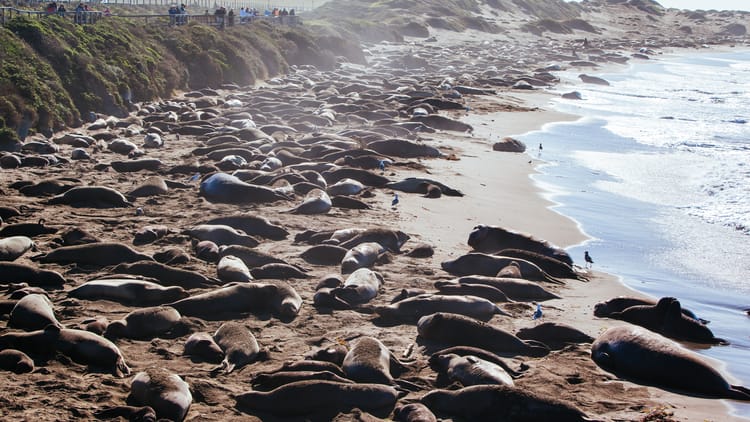
> The crowds go home in winter; the wildlife does the opposite. The West's great winter migrations are starting right now, and Sunset's new field guide to seeing them reads like a trip-planning menu: monarch butterflies clustering by the thousands in Santa Cruz, coho salmon pushing up Marin creeks after the first big rains, and about 10,000 elephant seals hauling out below Año Nuevo. Every one of them is a short drive from a campground that spent all summer booked solid and is suddenly wide open.
The homebodies made headlines this week, too. A trail camera just caught a coyote trotting across the world's largest wildlife crossing, a $114 million bridge spanning all 10 lanes of the 101 outside Los Angeles, weeks ahead of its official December opening. A second coyote followed a few days later; nobody posted signs, the animals just figured it out. First winter trip out that way? Start here.
— OK BUT A LOT MORE HAPPENED —
A $30 Thanksgiving Dinner, a 42-Mile Detour, and the Night Sky of the Year
> The night-sky title just went to Minnesota. DarkSky International named Voyageurs its 2026 Dark Sky Place of the Year, and the award turns out to be as much about the park's neighbors as its sky. (More)
> A 42-mile stretch of desert-season driving just became a construction zone. Mojave National Preserve opened a multiyear road rehab this week, starting with South Kelbaker Road; closures rotate through 2029, so check conditions before you route through. (More)
> Olympic National Park wants to know what the new Hurricane Ridge lodge should be. The old day lodge burned in 2023; if you've ever warmed up in it between snowshoe laps, the planners want your two cents. (More)
> The top camping trend for 2027 is accomplishing nothing, per Campspot's survey of 2,521 campers: 84 percent say they're likely to spend an entire vacation day at the campground without leaving, and 71 percent would rather skip the sights and come home rested. (More)
> West Virginia's state parks will cook Thanksgiving dinner for you. Ten park lodges are serving on November 26, starting around $30 at Hawks Nest, and most want a reservation first. (More)
— OK BUT YOU SHOULD KNOW THIS —
Pack a Whistle, a Mirror, and a Roll of Tape
> The person search and rescue teams go out for isn't the guy summiting in crampons; it's the casual day hiker who left the campground after lunch. A Sunset writer just sat through survival school, and the instructor's day-pack list is short, cheap, and a little surprising: stormproof matches that stay lit in a glass of water, a whistle you blow in rounds of three, a signal mirror you have to practice aiming, and four more items (one is a roll of tape). The full list, prices included, is behind the link; half of it belongs in the gear you're carrying anyway.
— OK BUT YOU SHOULD TOTALLY GO HERE —
4 Winter Trips to Plan This Week
> Walk a beach of bleached tree skeletons a half-mile from your site — Jekyll Island, Georgia stays mild long after the rest of the coast empties out, and its campground sits in the maritime forest half a mile from Driftwood Beach, where dead oaks bleach in the surf like sculpture. Bring bikes for the quiet paths, and give the beach the first morning; everything else on the island can wait a day.
> Build a December route out of Christmas markets — eleven American markets do the European Christkindlmarkt thing without the jet lag, from Chicago's Daley Plaza to a 65-foot Ferris wheel in Philadelphia to Savannah's parade of 30-plus lit-up boats on November 28. Most are free to enter and run from this week through late December, when campgrounds hit their easiest booking of the year.
> Put the Platte's cranes on the spring calendar now — Nebraska's Platte River stages one of the continent's great sandhill crane gatherings every spring, and the RVers who see it up close are the ones who booked a riverside site back in winter. While you wait, Audubon's new piece makes the case that the cranes are the least of what this river does, right down to the water in Nebraska's coffee.
> Follow the winter sun across Arizona — the week your home campground freezes solid is the week RV season starts in Arizona's low desert. Our itinerary strings the route together, campgrounds included, before the January snowbird wave takes the good sites.
— OK BUT DID YOU SEE THIS —
> Physics has finally ruled on whether a squirrel really can survive a fall from any height.
> Somebody named the best hike in every single national park, according to AllTrails.
> A pair of empty nesters left the Florida house behind for full-time RV life.
> You can now restore trails and log wildlife sightings from the couch: a national park simulator just arrived on Xbox.
> A Texan spent his 26th wedding anniversary hiking 60 miles of Big Bend, beachcombing a desert that used to be a shallow sea.
> The Park Service found $36 million for Thurmond, the New River Gorge railroad town, and not all of its buildings will make it.
The Dump Station A Kansas farmer started winding a ball of twine on Christmas Eve 1953; Cawker City has kept it going to a reported 29,000 pounds, and visitors are still invited to add more.
The Odometer 100. That's how many birthdays Route 66 hit last Wednesday. The Mother Road joined the federal highway map on November 11, 1926, lost its official number in 1985, and never really needed it back; NPR marked the centennial by tracing how a retired highway ended up all over pop culture.
— OK BUT WHO EVEN IS THIS PERSON —
The Gin Riots Behind Jekyll Island
> If you camp on Jekyll Island this winter, the name on your reservation belongs to a man who never saw Georgia. Sir Joseph Jekyll was a London judge, Master of the Rolls, forty years in Parliament, and a true believer in good causes that kept costing him. One of those causes was his friend James Oglethorpe's new Georgia colony: Jekyll and his wife reportedly gave 600 pounds toward getting it off the ground, and in 1733 Oglethorpe said thank you by putting their name on a barrier island four thousand miles from London. Three years later Jekyll pushed a steep tax on gin through Parliament, London rioted, and sixty soldiers were posted at his door. He died in 1738, still in office, still unpopular. The thank-you gift did better: the island became a private winter club for America's richest families, hosted the secret 1910 meeting that sketched the Federal Reserve, and is now a state park where the loudest thing is surf on those dead oaks.
Categories
Related Posts
Subscribe to the Swervia Newsletter
The best RV stories, tips, and destinations—expertly curated and always free.