How to Raise Kids Who Actually Follow RV Leave No Trace Rules (Without the Constant Nagging)
Your seven-year-old just asked if they can keep that "really cool" pinecone they found at your remote boondocking spot. Your teenager wants to carve their initials into that perfect Instagram tree. And your toddler? They're currently trying to feed Cheetos to a curious chipmunk.
Welcome to the real world of RV camping with kids, where every nature moment becomes a teaching opportunity — and every teaching opportunity feels like herding cats in hiking boots.
Teaching kids to respect Leave No Trace ethics isn't just about following rules; it's about raising a generation of adventurers who understand that the places we love to explore need our protection. When you're camping in remote locations with your RV, these lessons become even more critical — and thankfully, more impactful. The same curiosity that makes kids want to pocket every rock and feed every squirrel is exactly what makes them capable of becoming genuinely great environmental stewards — if you channel it right.
Why RV Leave No Trace Kids Education Matters More Than Ever
Remote RV camping puts your family in pristine environments where human impact is magnified. Outdoor education is best taught through movement and play, making it perfect for active RV families who want their kids to truly connect with nature. If you're approaching full-time RV life or extended trips, that cumulative impact across dozens of campsites makes these habits all the more essential to build early.
Unlike developed campgrounds where mistakes might be quickly corrected by maintenance crews, remote sites rely entirely on campers to preserve their natural state. Your kids' actions — positive or negative — have lasting consequences that they can actually see and understand.
The beauty of teaching Leave No Trace principles in an RV setting is that you have all your educational tools right at your fingertips. Your RV becomes a mobile classroom where kids can learn proper waste disposal, understand minimal impact camping, and develop a genuine respect for the outdoors. Our complete guide to boondocking without hookups covers the logistics of remote camping in detail — but the human behavior piece, especially with kids, is its own education.
The Seven Principles Made Kid-Friendly
Plan Ahead and Prepare: The Adventure Begins Before You Leave
Turn trip planning into a family affair. Give each child a specific responsibility: the weather checker, the wildlife researcher, or the campsite scout.
Create a "Leave No Trace Kit" that belongs specifically to your kids. Include items like:
- A small trash bag for pocket litter
- Biodegradable soap for washing hands
- A portable camping potty for emergencies
- Reusable water bottles
- A nature journal and pen for documenting discoveries without disturbing them
The journal is the move here. Kids who draw what they find — a beetle under bark, a specific leaf shape, the way light hits a stream — stop feeling the urge to take things home. The drawing becomes the souvenir.
Travel and Camp on Durable Surfaces: The Ground Rules Game
Make this principle stick with the "Stepping Stone Challenge." Mark off different ground types around your campsite — rocks, gravel, established paths, and fragile vegetation. Have kids hop between "approved" surfaces while carrying a water balloon. If they step on vegetation and pop the balloon, they have to start over.
This game teaches kids to naturally look for durable surfaces without feeling like they're being restricted. They'll start automatically choosing the rock path over the wildflower meadow.
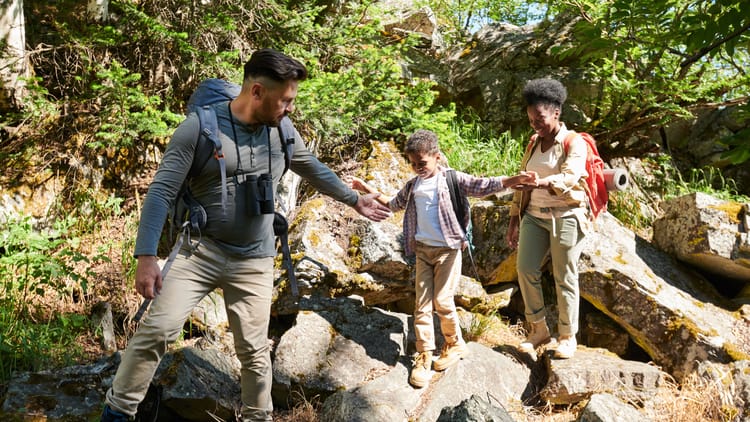
When it comes to exploring beyond established trails, teach kids to read the landscape. Climbing on large, stable boulders and rock formations is generally acceptable — these durable surfaces can handle foot traffic without damage. However, scrambling up loose rock faces, walking on fragile desert cryptobiotic soil, or stepping on vegetation-covered slopes can cause lasting damage. Help kids distinguish between "adventure-ready" rock formations and sensitive areas by having them ask: "Is this rock bigger than our RV and completely stable?" If yes, it's probably okay to explore. If they're unsure, it's better to admire from a distance. Before you even arrive at camp, our RV setup checklist can help you identify a durable site footprint that protects surrounding vegetation from the start.
Dispose of Waste Properly: Turning Cleanup into Competition
Transform waste management into kids camping ethics lessons through the "Campsite CSI" game. Before setting up, walk your campsite together and document any existing trash or damage with photos. Your kids become the "evidence collectors" responsible for leaving the site better than they found it.
For human waste education, be direct but age-appropriate. Teach the "6-inch rule" for catholes using a tent stake as a measuring tool. Make it memorable with the phrase "deeper than your thumb, further than your throw" (200 feet from water sources).
Create a "Pack It In, Pack It Out" points system where kids earn rewards for proper waste disposal. Every piece of trash they pack out equals points toward a special camping privilege or treat. An insulated food bag designated as the family "Pack It Out" cooler gives kids physical ownership of the concept — food goes in, wrappers come out, nothing gets left behind.
Leave What You Find: The Photography Challenge
Instead of collecting natural treasures, challenge your kids to "collect" memories through photography. Give younger kids disposable cameras or older models they can handle. Create themed photo challenges like "textures in nature" or "animals in their homes."
For the pinecone dilemma mentioned earlier, teach the "one-minute rule." Your child can hold and examine any natural object for one minute, then must return it exactly where they found it. This satisfies their curiosity while preserving the environment.
Protecting wild places starts with the kids in your rig. Subscribe to our weekly newsletter.
THE SMARTEST RESOURCE FOR MODERN RVERS — EVERY WEDNESDAY, FREE.
The Great Rock Stacking Debate: Teaching Kids When Cairns Cross the Line
Here's where things get interesting — and controversial. Your kids will inevitably want to stack rocks, especially near streams and rivers where smooth stones seem perfectly designed for balancing. But should they?
The answer depends entirely on location and context. In designated wilderness areas, national parks, and sensitive ecosystems, rock stacking (also called cairn building) is generally discouraged or prohibited. These human-made structures can:
- Disrupt aquatic ecosystems by removing stones that provide habitat for insects, fish, and other wildlife
- Alter natural water flow patterns in streams
- Create visual pollution in pristine landscapes
- Confuse hikers who rely on official trail cairns for navigation
However, in appropriate locations — like established recreational areas where rock stacking is common and accepted — it can be a harmless creative outlet that connects kids to nature.
Teach your kids to be "cairn detectives" by asking these questions before stacking:
- Are there signs prohibiting rock stacking or cairn building?
- Are we in a designated wilderness area or sensitive ecosystem?
- Are there existing rock stacks nearby, suggesting this is an accepted activity?
- Are we taking stones from a stream or river that might be wildlife habitat?
If the answer to any of the first, second, or fourth questions is yes, encourage kids to appreciate the rocks where they are. If it's an appropriate location, set time limits and teach them to dismantle their creations before leaving, returning stones to their original positions.
This nuanced approach teaches kids that environmental responsibility isn't always black and white — it requires thinking critically about impact and context. The same critical thinking transfers beautifully to everything else you'll encounter on the road, from choosing which national parks are actually RV-accessible to navigating different land use rules across BLM, Forest Service, and state park systems.
Minimize Campfire Impacts: Fire Safety and Responsibility
In remote RV camping, campfires become magical family gathering spots. Teach kids to build fires responsibly by putting them in charge of gathering appropriate fuel. Create a "fire fuel hunt" where kids compete to find the best tinder, kindling, and fuel wood following the "wrist-thick" rule for dead and downed branches.
Make fire safety visceral and memorable. Let kids feel the heat at different distances from the fire. Teach them that fires should be "dead out" — cold enough to touch. Put them in charge of the final fire check, using their hands to verify no heat remains.
For nights when fire conditions are risky or fire bans are in effect, a small tabletop smokeless fire pit gives kids the campfire experience — the gathering, the warmth, the marshmallow situation — with a dramatically smaller footprint and zero risk of escaping embers. It also opens a useful conversation: why do fire bans exist, what causes them, and what does responsible fire use actually look like?
Respect Wildlife: The Animal Behavior Detective Game
Transform wildlife encounters into learning opportunities with the "Animal Behavior Detective" activity. Equip children with binoculars and wildlife guidebooks to help them identify different species while teaching them to move quietly and respect animals' space.
Create "wildlife viewing rules" that kids can remember:
- "If an animal changes its behavior because of you, you're too close"
- "Food is for humans, not for our wild friends"
- "Quiet voices help us see more animals"
Teach kids to recognize animal signs — tracks, scat, feeding areas — turning them into nature detectives rather than animal disturbers. This builds observation skills while maintaining appropriate distance. It also ties directly to mindful RV living habits that research shows are genuinely good for how kids process and remember experiences in natural environments.
Be Considerate of Other Visitors: The Courtesy Code
Even in remote locations, you'll encounter other campers. Teach kids about "sound bubbles" — their voices and activities should stay within your campsite's boundaries. Practice this at home by having kids gauge how far their normal speaking voice carries.
Create a "good neighbor checklist" that includes:
- Keeping music and voices at reasonable levels
- Respecting others' space and privacy
- Sharing trails courteously
- Cleaning up common areas after use
Practical Activities That Make Leave No Trace Fun
Nature Scavenger Hunts with a Twist
Scavenger hunts make fun, educational camping activities for people of all ages, but modify traditional hunts to reinforce Leave No Trace principles. Instead of collecting items, kids must find, photograph, and return objects to their exact locations.
Create lists like:
- Find three different types of animal homes (but don't disturb them)
- Photograph five different leaf shapes
- Locate evidence of human impact and clean it up
- Find the perfect campfire wood (dead, down, and wrist-thick)
If your family is newer to remote camping, our list of essential camping and RVing gear includes several items — headlamps, packs, and containers — that double as scavenger hunt tools and trash pack-out gear.
The Leave No Trace Obstacle Course
Set up stations around your campsite where kids practice different principles:
- Station 1: Proper food storage techniques
- Station 2: Setting up camp on durable surfaces
- Station 3: Waste disposal challenges
- Station 4: Fire safety skills
- Station 5: Wildlife-safe camping setup
Time each child through the course, but award points for accuracy rather than speed. This reinforces that doing things right matters more than doing them fast.
Nature Education Through Storytelling
Create bedtime stories where the campfire characters face Leave No Trace dilemmas. "The Case of the Disappearing Wildflowers" might teach about not picking plants, while "The Chipmunk's Food Problem" addresses wildlife feeding issues.
Let kids contribute to the stories, proposing solutions to the characters' problems. This builds critical thinking about environmental impact while keeping the lessons engaging.
Making It Stick: Reinforcement Strategies
The Leave No Trace Badge System
Create a progression system where kids earn badges for mastering different principles. Start with simple achievements like "packed out all trash for three consecutive camping trips" and progress to more complex ones like "taught Leave No Trace principles to another family."
Display badges prominently in your RV so kids can see their progress and feel proud of their environmental stewardship.
Regular Family Meetings
Hold weekly "campfire councils" where family members discuss upcoming trips and review Leave No Trace principles. Let kids lead these discussions, explaining principles in their own words and suggesting improvements to your camping practices.
Connect Actions to Consequences
When camping in areas with visible human impact, use these as teaching moments. Show kids eroded trails, fire-damaged trees, or littered campsites. Explain how these problems developed and what could have prevented them.
Conversely, celebrate pristine areas by pointing out how previous visitors followed Leave No Trace principles. Help kids understand that they're part of a community of responsible outdoor enthusiasts. This sense of stewardship connects naturally to the broader conversations about RV healthy living — taking care of your environment and taking care of your body come from the same instinct when kids grow up doing both on the road.
Advanced Lessons for Older Kids
Environmental Impact Science
Turn your RV into a mobile laboratory where older kids can measure their family's environmental impact. Track water usage, waste generation, and energy consumption. Calculate your carbon footprint and discuss ways to reduce it.
Use apps like Seek or iNaturalist to identify plants and animals, building a database of species encountered during your travels. This connects technology to nature education in ways that resonate with tech-savvy kids. If water sourcing is part of your off-grid routine, a gravity-fed water filtration system is worth walking kids through as well — understanding how water filtration works, and why treating your water source matters, reinforces the same respect for natural resources that LNT is built on.
Teaching Others
The ultimate test of understanding is teaching others. Encourage your kids to share Leave No Trace principles with friends, cousins, or other camping families. Create presentation materials they can use to educate others about responsible camping.
Consider having older kids lead portions of campfire programs or nature walks, putting their knowledge into practice while building confidence and leadership skills. This is also where roadschooling and Leave No Trace education intersect most powerfully — teaching environmental stewardship isn't a lesson you plan, it's a lifestyle kids absorb when it's woven into how their family actually operates on the road.
Overcoming Common Challenges
The "But Everyone Else Is Doing It" Problem
When kids see other campers breaking Leave No Trace principles, use these as discussion opportunities rather than confrontation moments. Explain that being a leader sometimes means doing the right thing even when others don't.
Focus on the positive impact your family makes rather than criticizing others. "Look how much better this campsite looks because we cleaned up" resonates more than "Look at what those people did wrong."
Age-Appropriate Expectations
Adjust your expectations based on developmental stages. Toddlers can participate in simple activities like throwing away their own trash, while teenagers can take responsibility for entire Leave No Trace principles.
Don't expect perfection immediately. Celebrate progress and use mistakes as learning opportunities rather than reasons for frustration.
Making It Fun, Not Preachy
The key to successful nature education is maintaining the fun factor. If kids associate Leave No Trace with lectures and restrictions, they'll resist the lessons. Instead, frame principles as adventures, challenges, and opportunities to be environmental heroes. The same principle applies to beach RVing — coastal ecosystems are particularly sensitive, and kids who already understand LNT basics adapt quickly to tidal zone rules and dune protection guidelines when the concepts are already part of how they think.
Building Lifelong Environmental Stewards
Teaching your kids RV Leave No Trace ethics isn't just about following camping rules — it's about raising environmental stewards who will protect the places we love for future generations. When kids understand that their actions matter, they develop a sense of responsibility that extends far beyond camping trips.
The remote locations you explore in your RV provide perfect classrooms for these lessons. Away from the distractions of developed campgrounds, kids can focus on their relationship with nature and understand the real impact of their choices.
Remember, the goal isn't to restrict your kids' outdoor experiences but to enhance them. When children understand how to interact responsibly with nature, they're free to explore, discover, and adventure with confidence. They become partners in conservation rather than obstacles to overcome. And the habits they build — regular maintenance of gear, consistent pre-trip checklists, attention to how their presence affects a space — carry forward into how they take care of everything, not just wilderness.
Your next remote camping trip is an opportunity to continue this education. Pack your Leave No Trace kit, plan your activities, and prepare to watch your kids transform from nature visitors into nature protectors. The wilderness needs their advocacy, and they need the wilderness to thrive.
The lessons you teach around remote campsites today will influence decisions your kids make for decades to come. Make them count.
Resources for Further Learning:
- Leave No Trace Youth Education Resources — Official materials and activities
- Bigfoot's Playbook — 38 structured activities for kids
- National Park Service Leave No Trace Principles — A list to live by
FAQs
What are the 7 Leave No Trace principles kids need to know for RV camping?
The seven Leave No Trace principles are: Plan Ahead and Prepare, Travel and Camp on Durable Surfaces, Dispose of Waste Properly, Leave What You Find, Minimize Campfire Impacts, Respect Wildlife, and Be Considerate of Other Visitors. For RV families, the most commonly taught starting points are waste disposal (particularly around black and gray water), leaving natural objects in place, and campfire management. The Leave No Trace Center for Outdoor Ethics recommends introducing these sequentially by age, starting with the most concrete and visible principles for younger children and building toward the more nuanced ones (like campfire impact and wildlife distancing) as kids develop judgment.
At what age can kids start learning Leave No Trace principles?
Toddlers as young as two or three can participate in simple Leave No Trace behaviors, such as placing their own trash in a bag or understanding that animals don't eat human food. By ages five to seven, most kids can grasp the core concepts of "pack it out" and "leave what you find" through games and hands-on activities. Tweens and teenagers are capable of leading Leave No Trace practice for the whole family and can handle nuanced discussions about land use regulations, cairn building ethics, and the ecological science behind the principles. The key is matching the lesson to the developmental stage — concrete activities for young kids, systems thinking for older ones.
Is rock stacking allowed in national parks?
Rock stacking (building cairns) is prohibited or strongly discouraged in most national parks and designated wilderness areas. The National Park Service notes that unofficial cairns can disrupt aquatic ecosystems by removing rocks that serve as habitat, alter natural stream flow, create visual pollution in pristine landscapes, and confuse hikers who rely on official trail markers for navigation. Some recreational areas outside protected wilderness do allow rock stacking informally. The safest approach to teach kids: always check posted signs and land management rules before stacking, and default to leaving rocks in place when in any doubt.
How do you teach kids about campfire safety in remote RV camping?
Start with the basics: fires should only be built in existing fire rings where permitted, fuel should come from dead and downed wood no thicker than your wrist, and every fire must be completely extinguished — cold to the touch — before leaving the site or going to sleep. Let kids lead the "dead out" fire check, pressing the back of their hand near (not on) the ash to verify no heat remains. For nights when fire bans are in effect or fire risk is high, a contained tabletop fire bowl offers the same gathering experience with far less environmental exposure. Always check current fire restrictions through the local land management agency website before your trip.
What wildlife rules should RV families teach kids?
The core rule is distance: if an animal reacts to your presence by changing its behavior — moving away, stopping feeding, looking alert — you are already too close. The National Park Service recommends staying at least 25 yards from most wildlife and 100 yards from bears and wolves. Teach kids that feeding wildlife, even well-intentioned feeding like bread or fruit, disrupts animals' natural foraging behavior and can make them dependent on human food, which typically ends badly for the animal. Framing these rules as "how we make sure we get to see more animals" rather than restrictions tends to land better with kids who are inherently motivated by the experience of wildlife encounters.
How can I make Leave No Trace education stick across multiple camping trips?
Consistency and reinforcement matter more than any single teaching moment. The most effective approaches include assigning kids specific environmental responsibilities on each trip (waste monitor, campfire checker, wildlife lookout), creating a visible badge or points system for mastered principles, and holding brief pre-trip family discussions that revisit the rules in context of where you're going. When kids see the visible consequences of irresponsible camping — eroded trails, littered sites, fire-scarred trees — use those moments to connect actions to outcomes without lecturing. Kids who feel a sense of ownership over the campsite's condition, rather than feeling policed by adults, internalize Leave No Trace as their own standard rather than an external rule.
What should be in a kids' Leave No Trace kit for RV camping?
A practical Leave No Trace kit for kids includes: a small dedicated trash bag for pocket litter and foraged wrappers, biodegradable soap for hand washing away from water sources, a reusable water bottle, a nature journal for documenting findings without taking them, and a small flashlight for nighttime campsite checks. For older kids on boondocking or remote trips, add a trowel for cathole waste disposal and a compact water filtration option for understanding water sourcing responsibilities. Keeping the kit in a designated spot in the RV and letting kids pack it themselves before each trip reinforces that they are the responsible party — not just passengers.

Categories
Related Posts

Subscribe to the Swervia Newsletter
The best RV stories, tips, and destinations—expertly curated and always free.