RVing in Cold Weather: What Changes When the Cold Doesn't Break
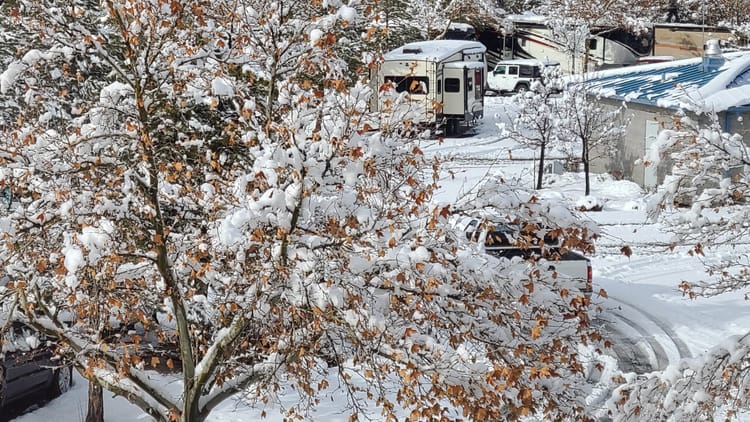
Day nine is the one that surprises people. Day one is fine. Day one is novelty, and the furnace sounds industrious rather than expensive. By the ninth morning of a cold month you've wiped the same four windows nine times, you know which propane place opens on Sunday, and there's a towel in the shower that hasn't dried since you got here. Nothing is broken. The prep worked. What's wearing on you isn't the cold, it's the number of small things the cold added to your morning.
Cold doesn't make RV life harder so much as it makes it less forgiving. Every system has less slack than it had in July, and the slack was what you were living on without noticing. Four things run short: propane, power, water, and patience. A cold snap doesn't beat you. A Tuesday does.
Plenty of people read that and go to Arizona. Reasonable answer, very good trip. This is for the other group: people whose rv living doesn't stop when the temperature does. Parked somewhere cold on purpose, or driving through it, for longer than a weekend. What you get is a national park in the off-season: no reservation scramble, no shuttle queue, and a low sun that makes the whole place look better than it does in August.
Can You Live in an RV in the Winter? Yes, and Here's What You're Signing Up For
Yes. People do it every year, in ordinary RVs. What changes isn't whether it's possible, it's how you spend the first half hour after you wake up.
How to live in an RV during winter comes down to a handful of small jobs you do before coffee. You wipe the condensation off the glass. You look at a tank level. You read the forecast properly instead of glancing at it, because the shape of the next three days is how you know whether today is the day you go get water. None of it is hard. None of it is optional either, and it's waiting for you every morning whether you feel like it or not.
It suits some setups well. Parked for a season with hookups, a heated underbelly, and a propane supplier within a sensible drive, this is a comfortable way to spend a winter and a lot cheaper than relocating twice. If you like empty places you'll get plenty of what you came for. And if you're already deep into full-time rv living and following the weather anyway, adding a cold month is a smaller step than it looks.
It suits others badly. A first winter trip, in January, in an RV with an open underbelly, 100 miles from a propane refill, is a lot of first-time problems arriving together. That's not a reason to skip it. It's a reason to do four days somewhere mild before six weeks somewhere cold, and to know what winter rv camping prep actually involves before committing a season to it.
One thing to settle first: none of this applies to an RV that's already been winterized. How to winterize an RV is the storage job, and it ends with no running water at all. You're either living in it or putting it away.
Propane Is the Clock You're Living On
In summer the furnace is a guest. In a cold month it's the largest consumer in the RV by a distance, and it runs on a cycle that repeats all night: fires, blows, quits, comes back.
Consumption is what catches people. This isn't a percentage over summer use, it's a multiple, and a big one. A supply that felt bottomless in July is a few days of real cold.
Which rewrites how you plan. In warm weather you answer one question, where you'd like to go next. In a cold month you answer two: where next, and can you fill bottles there. That bites hardest in the places that make winter worth doing, because a lot of the outfits selling propane up a mountain valley are seasonal. Call one before you plan a week around it.
Buy the second bottle. It turns a midnight emergency into a Saturday errand, and past one cold trip a year it stops being optional. Put a wireless propane tank sensor on the bottles too, so the number lives on your phone. Guessing by heft is fine in July. It's less fine in the dark at 15 degrees, when the furnace goes quiet and the RV starts cooling at a rate you can feel through the blanket.
On full hookups an electric heater changes the arithmetic, letting the campground's power carry mild nights so your propane is there for the cold ones. Two cautions. Where the underbelly is heated at all, it's heated by furnace air ducted into that space, so switching the furnace off switches that off too. And the pedestal has a limit that people find by tripping it, so check what your rv shore power connection can carry before plugging in three heaters and going to bed.
The Battery Stops Taking a Charge and Nothing Is Broken
Bright cold morning, sun straight onto the panels, and the state of charge is going down. Not holding. Going down.
Every instinct says something died in the night. Nothing did. Lithium chemistry has a charging temperature floor and it sits right around freezing, 32 degrees. Below it the battery management system, the BMS, refuses the charge on purpose, and that refusal is the feature you paid for: charging a cold cell plates metallic lithium onto the anode, and that damage is permanent. It doesn't cycle back out in spring. So the BMS blocks the charge, and you get a bad state-of-charge reading this morning instead of a permanently smaller battery for the rest of the RV's life.
Discharging is unaffected. The RV still runs, the furnace still cycles, the lights still work. The pack just won't take power back until it warms, and charging typically resumes on its own once the battery gets into the low 40s. Where the batteries physically live counts for more than what you spent on them. A pack in a heated compartment behaves nothing like an identical pack in an unheated bay, and some models carry built-in heaters that let them charge below freezing under their own control.
Go read the spec sheet for the batteries you own. It answers this for your pack, with your numbers.
Put a battery monitor somewhere you'll see it with coffee in your hand. Watching the cutoff happen once turns it into known behavior, not a first-light emergency. And if the bank was already unreliable before the temperature dropped, cold isn't your problem yet. Start with why an rv battery keeps dying.
Subscribe to our weekly newsletter.
EVERYTHING YOU NEED TO RV THROUGH A COLD MONTH. FREE, EVERY WEDNESDAY.
How to Insulate an RV for Winter Without Sealing Yourself Into a Wet Box
Every measure that holds heat in also holds water in. That trade is why winter interiors get miserable, and it runs backwards from instinct, so people tend to make it worse before they make it better.
Two adults breathing, one shower, and a pot of something on the stove put a startling volume of water into the air of a small heated box. In July it leaves through the open windows and nobody thinks about it. In February it has nowhere to go, so it finds the coldest surface it can reach and turns back into liquid there. Glass first. Then the metal frames. Then the places you can't see: behind the mattress, inside the closet on the outer wall.
Day one this is a wet window. Day thirty it's something you have to cut out of the closet wall.
Give the moisture somewhere to go every single day, and accept that it costs heat. Crack a roof vent at night. Run the bathroom fan through the whole shower and afterwards. Wipe the glass before you make coffee, which takes 90 seconds and tells you more about how the RV is doing than any gauge on the wall.
Two purchases carry most of this load, and both are mid-season buys, not September ones. A powered roof vent pulls air out on demand and has a cover over it, so you can run it in weather without inviting the weather in. A small dehumidifier is the backstop for nights too cold to want anything open, and emptying its tank each morning is an unnervingly good education in how much water four days of living put into your walls. Skirting is the bigger heat win, but how to skirt an RV for winter is a pre-season job. Fit it before it's cold if you're parking for a season.
Blocking cold surfaces still helps: insulation cut to the windows, a cushion in an unused vent, a fresh seal on a door that whistles. What doesn't work is closing everything up once you're tired of being cold. A winter that was going well becomes a spring repair that way.
Water When There Is No Warm Part of the Day
Filling during the warm part of the day works for most of the season. Some weeks there isn't one.
When the high stays below freezing for a stretch, the city-water connection stops being a utility and becomes a liability. Disconnect it before it fails, not after. A hose lying on frozen gravel holds the smallest volume of water in the system and has nothing protecting it, so it's always first to go.
The fresh tank moves from fallback to default, and that reshapes a week more than the temperature does. You're living on a fixed number of gallons and refilling on purpose, which is boondocking with a power pedestal attached. The same arithmetic applies exactly, so learn how long can you boondock on your own RV before you're doing that math in a parka.
Hauling water stops being an emergency and gets a slot in the week. Two jugs, the bathhouse spigot or a frost-free hydrant, and a fill hose you coil up and keep inside so it isn't a frozen sculpture when you need it.
Then there's the other end. Grey and black tanks fill on schedule regardless of the weather, and in real cold the dump station runs out before anything else does. A frozen or closed one isn't a repair bill. It's a clock you can't argue with, and a full black tank ends a stay faster than a cold night will. If you're fuzzy on which tank fills fastest and why, our rv plumbing primer sorts it out.
Keep the tanks fuller than you would in summer, incidentally. Volume takes a long time to give up its heat. An inch of liquid freezes.
Driving It in the Cold, Not Just Parking It
Winter changes the driving more than people expect. Cold weather RV camping that involves moving is a different proposition from the kind that stays parked.
Start with tires, because it's the cheapest failure to avoid and it's probably sitting there right now. NHTSA's winter driving guidance is blunt about it: inflation pressure drops as the outside temperature drops, and the number you want is the one on the door placard, checked cold. The usual rule of thumb is about 1 psi lost for every 10-degree drop, which stacks up fast behind a real front. So the pressure you set on a mild October afternoon isn't the pressure you're driving on in January. A tire-pressure monitor watches it continuously and warns you on the highway, before the tire does.
Chains are legally required on some routes, in some conditions, in some states, and the rules shift by pass and by storm. Carry them if there are mountains in your route and check the state DOT for the specific road on the day you drive it. Five-minute lookup, occasionally saves a very long one.
The bigger shift is how you decide to move at all. Summer relocation runs on mileage: four hours feels fine, so you drive four hours. In winter you relocate on weather windows and the distance is whatever fits inside one. Sometimes that's 300 miles. Sometimes it's a Wednesday parked, watching a system come through, and you want enough slack in the plan that losing a day costs nothing.
Short days help more than they sound like they should, because wet roads freeze after dark and arriving with light left is the difference between a setup and an ordeal. Same for route choice: some roads that are hard on big vehicles are merely unpleasant in July and genuinely bad in ice.
Does Your RV Make This Easy or Hard?
Under the floor is where this gets settled, because that's where the plumbing runs. An underbelly that's enclosed and actively heated by furnace air makes most of this article a routine. One that's open to the air makes the same article a series of small emergencies.
Ignore the badge on the side. "Four-season" and "arctic package" are marketing labels that vary by manufacturer with no shared definition behind them, and published R-values are calculated figures rather than tested ones. RVIA certification is a real standard, and what it covers is electrical, plumbing, heating, fire and life-safety systems and construction. How a given RV holds up over a long freeze is a separate question, and you answer it with a flashlight. Go look underneath.
Any RV can do a cold month with enough propane and enough effort. A better-built one just needs less of both. If you're shopping with winter in mind, the best RV for winter and what makes a good cold-weather travel trailer both deserve more room than a paragraph here.
Why RVing in the Cold Is Worth the Routine
The reason isn't the cold. It's what the cold clears out.
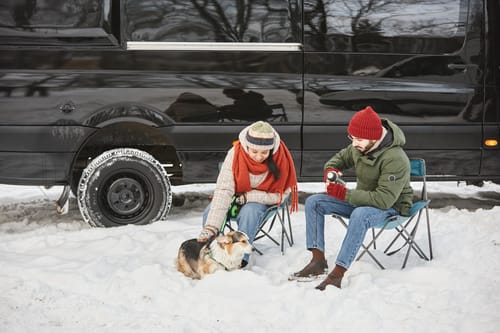
Empty bathhouses. A dump station with nobody in front of you. Trails you'd have queued for in July, walked in a jacket, with the whole thing to yourself. And the sound a campground makes after snow, which is almost none. There's a version of a place that only exists in the off-season, and the chores are how you get to see it.
Propane on the calendar, windows wiped, tanks watched, a forecast read properly. Short list. Same list every morning.
The Short Version
- Propane: think in multiples of summer use, not percentages. Carry a second bottle and put a sensor on it. Refill availability, not price, is what constrains a winter route.
- Power: lithium won't accept a charge below about freezing. That's deliberate, not damage, and discharging is unaffected. A heated compartment does more for a pack than a bigger budget did.
- Moisture: everything that holds heat holds water. Ventilate on purpose, daily, and eat the heat loss.
- Water: the hose comes off before it fails, not after. Fresh tank becomes the default and hauling becomes routine.
- Tanks: the dump station, not the temperature, is usually what ends a stay.
- Driving: re-check pressure cold, carry chains for mountain routes, and move on weather windows, not mileage.
- The RV: an enclosed and heated underbelly does the work. The badge doesn't.
- The daily cost: a short round of chores every morning. Glass wiped, tanks checked, forecast read. Budget for it and winter is pleasant; ignore it and it compounds.
FAQs
Can you live in an RV in the winter?
Yes, and it's a normal thing to do, not an extreme one. What limits people is their tolerance for chores, not the RV's tolerance for cold. Four things change: the furnace becomes the dominant propane draw, the interior needs venting every day or it goes damp, the city-water hose comes off during hard freezes so you run on the fresh tank, and the dump station starts governing how long you can park. Sitting still somewhere with full hookups and a warm underbelly is comfortable. Deep winter as a first attempt, in an RV with the tanks hanging in open air, is where people get discouraged.
Why won't my RV battery charge in cold weather?
Because it's protecting itself. Below about 32 degrees, lithium won't take a charge, and the battery management system, the BMS, is what blocks it. Cold forces the lithium to plate onto the graphite surface, where it stays, and the capacity it locks up never comes back. The BMS refuses the charge on purpose. Nothing is broken. Discharging works normally, and charging usually resumes once the pack warms into the low 40s. A heated compartment sidesteps the problem, and some models have heaters built in. Check your own battery's spec sheet.
Why is the inside of my RV so wet in winter?
Condensation, and there's far more of it than people expect. Breathing, showering and cooking put a lot of water vapor into a small heated space, and cold weather gives it nowhere to go except the coldest thing in the room. Window glass shows it first. Metal frames next, then places nobody looks, like the closet wall on the outside of the RV. Sealing everything up makes it worse. Vent on purpose: a cracked roof vent overnight, the bathroom fan left running past the end of a shower, the glass wiped every morning, and a dehumidifier for nights too cold to open anything. Left alone for a few weeks this turns into mold.
How much more propane does an RV use in winter?
Enough that the right unit is multiples, not percentages. In summer the furnace barely runs and propane mostly serves the fridge, stove and water heater. In sustained cold it cycles all night and swamps everything else on the system, and a supply that lasted weeks in July can be measured in days. Treat refills as a scheduled errand, carry a second bottle, and confirm that wherever you're headed sells propane in winter, because plenty of seasonal operations don't.
How do you get water in an RV when everything is frozen?
You stop using the hose and start using the fresh tank. A garden hose between the spigot and the RV freezes long before anything inside does, so disconnect it ahead of a hard freeze, not after it fails. Haul jugs from the bathhouse or a frost-free hydrant and store the fill hose inside between uses. Keep tanks fuller than you would in summer, because a nearly empty one freezes far faster. Watch the grey and black side too: a frozen or closed dump station usually ends a stay before the cold does.
Can you use an RV in the winter without winterizing it?
Yes, and in fact you have to pick one or the other. Winterizing is the storage procedure: it takes all the water out so nothing can freeze while the RV sits unused, which leaves you with no working faucets, shower or toilet. If you're camping through the cold you never winterize. You keep water in the system and work to keep it liquid, using a heated hose, tank heat, skirting and extra propane. Doing the storage job and then trying to camp means de-winterizing first, an afternoon you weren't planning to spend.
Is it safe to drive an RV in cold weather?
It is, with a couple of adjustments. Tire pressure falls as the temperature does, so re-check it cold against the door placard, not against an autumn reading. Carry chains if your route crosses mountains, and look up the requirement for the road you'll actually be on, on the day you'll be on it, because it changes by pass and by storm. The rest is scheduling: move on weather windows, not mileage targets, arrive in daylight, and leave enough slack that sitting out a bad day costs nothing.


Categories
Related Posts
Subscribe to the Swervia Newsletter
The best RV stories, tips, and destinations—expertly curated and always free.