This 30-Day RV Gratitude Challenge Will Make You Fall in Love With the Road Again

our laptop's open, your coffee's gone cold again, and you're staring at the same email you've been trying to answer for twenty minutes while your RV rocks gently in the Utah desert wind. Sound familiar? If you're like most digital nomads, you've mastered the art of working from anywhere—but somewhere along the way, the magic of RV life started feeling more like just another office with better views.
Enter the RV gratitude challenge: a simple daily practice that's about to flip your entire perspective on life on the road. Over the next 30 days, you'll discover how shifting your focus from what's missing to what's abundant can transform not just your travels, but your entire approach to nomadic living. If you've hit a wall with your remote work routine, this is often where the reset actually begins — not with a new productivity app, but with a different lens on what you already have.
Why Digital Nomads Need a Positive Mindset Reset
Let's be honest — RV life isn't always Instagram-worthy sunsets and perfectly staged coffee shots. As modern nomads know, "gratitude turns what you have into enough," but that mindset doesn't always come naturally when you're dealing with spotty WiFi, cramped quarters, or the hundredth "where do you shower?" question from well-meaning strangers.
Digital nomads face unique challenges that traditional gratitude practices don't always address. You're constantly adapting to new environments, managing work deadlines from ever-changing locations, and often feeling disconnected from stable communities. Research shows that gratitude can be a powerful tool for staying present and making the most of our travels, helping us maintain a positive mindset and deepen our connection with the people we meet along the journey.
The beauty of an RV gratitude challenge is that it meets you exactly where you are — literally. Whether you're boondocking off the grid or plugged into a resort in Florida, this practice adapts to your lifestyle, not the other way around.
Building Your Foundation for Nomadic Joy
Before diving into the daily prompts, let's establish what makes this challenge different from your typical gratitude journal. This isn't about forcing positivity or pretending every day on the road is perfect. Instead, it's about training your brain to notice the unique gifts that come with your mobile lifestyle. Interestingly, the same mental recalibration that researchers point to in our piece on mindful RV living — where slow travel actually changes the way your brain processes time — is exactly what a consistent gratitude practice activates.
Week 1: Getting Your Bearings Start with the basics that make RV life possible. Notice your rig's capabilities, the freedom in your schedule, and the simple luxury of waking up somewhere new.
Week 2: Embracing the Unexpected Focus on the serendipitous moments that only happen when you're truly mobile — chance encounters, spontaneous detours, and those perfect parking spots that appeared just when you needed them.
Week 3: Community and Connection Celebrate the RV community, the kindness of strangers, and the deep conversations that happen around campfires with people you met three hours ago.
Week 4: Integration and Intention Look at how this practice is changing your daily experience and set intentions for carrying this mindset forward.
Daily Gratitude Prompts for Life on the Road
Days 1–7: Foundation Week
Day 1: Three things your RV provides that a traditional home couldn't
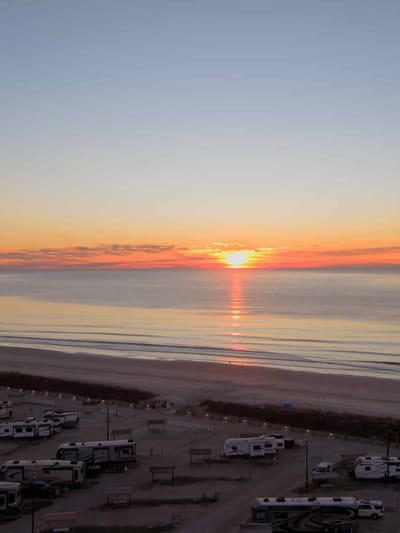
Day 2: A sunrise or sunset you witnessed from your mobile front porch
Day 3: The technology that makes your nomadic work possible
Day 4: A meal that tasted better because of where you were eating it
Day 5: The weather today and how it enhanced (or challenged) your experience
Day 6: A small space in your RV that serves multiple purposes beautifully
Day 7: Someone who helped make your RV life possible (mechanic, friend, fellow nomad)
Days 8–14: Serendipity Week
Day 8: An unexpected conversation with a stranger
Day 9: A route or destination you discovered by accident
Day 10: A problem that turned into an adventure
Day 11: Wildlife you encountered on your journey
Day 12: A local business that welcomed you warmly
Day 13: Perfect timing that worked in your favor
Day 14: A skill you've developed since living on the road
Days 15–21: Community Week
Day 15: A fellow RVer who shared valuable advice
Day 16: Someone who went out of their way to help you
Day 17: A campground host who made you feel at home
Day 18: A virtual community that supports your lifestyle
Day 19: Local knowledge someone shared that enhanced your experience
Day 20: A moment when you were able to help another traveler
Day 21: The diversity of people you've met through RV life
Days 22–30: Integration Week
Day 22: How your perspective on "home" has evolved
Day 23: A challenge that taught you resilience
Day 24: The freedom to change your mind and your location
Day 25: Something ordinary that RV life made extraordinary
Day 26: How your work has benefited from your mobile lifestyle
Day 27: A moment of pure contentment in your rig
Day 28: The natural world you've experienced more deeply
Day 29: How you've grown as a person through this lifestyle
Day 30: Your vision for continuing this journey with intention
Making Your Practice Stick in Small Spaces
Living in an RV means every inch matters, so your gratitude practice needs to be as streamlined as your belongings. Here are practical ways to maintain this habit without adding clutter:
Digital First: Use your phone's notes app, a simple journaling app, or even voice memos while driving. The key is consistency, not fancy tools. A compact leather pocket notebook kept in your cupholder or drawer works just as well — something to jot three lines in before you start the engine each morning. It adds no weight and takes up less space than a paperback.
Anchor to Existing Habits: Pair your gratitude practice with something you already do daily — your morning coffee, evening routine, or that moment when you're settling into a new campsite. If you're someone who builds out intentional RV office setups for your workday, think of this the same way: a designated space in time, not just in square footage.
Keep It Simple: Research shows that nature, fresh air, and calming nature sounds can assist in encouraging mindfulness, which may help in practicing gratitude. Your RV provides the perfect environment for this practice. A portable white noise machine doubles beautifully here — it quiets campground noise during your morning practice and creates a consistent sensory cue that signals reflection time, regardless of where you're parked.
Share the Journey: Start a group chat with fellow nomads doing the challenge, or share one daily gratitude on social media with the hashtag #SwerviaGratitudeChallenge.
A daily practice can change how you experience the road. Subscribe to our weekly newsletter.
THE ROAD GETS BETTER WHEN YOU KNOW WHAT TO LOOK FOR. EVERY WEDNESDAY, FREE.
Beyond the Challenge: Sustaining Nomadic Joy
The real magic happens after day 30, when gratitude becomes as automatic as checking your tire pressure. Mindful travel experts emphasize staying present, connecting with local cultures, and embracing the journey as key components of meaningful adventure.
This practice rewires your brain to notice abundance instead of scarcity, opportunity instead of inconvenience. Suddenly, that propane leak becomes an interesting detour through a charming small town. The WiFi outage transforms into quality time for reading that book you've been carrying around for months. The unexpected expense reminds you how resourceful you've become. If you want to deepen that sense of community belonging that emerges from weeks three and four of this challenge, our guide to RV membership programs walks through the campground networks where that campfire-stranger-turned-friend dynamic happens most reliably.
It's also worth noting that the physical environment of your rig matters more than people expect. Full-timers who invest in better sleep, better air quality, and better wellness routines tend to report the highest satisfaction with nomadic life overall. Our RV self care guide covers the specific products that make the biggest difference for bodies crossing climate zones on a regular basis.
The goal isn't to eliminate challenges — it's to change your relationship with them. When you're grateful for the journey itself, not just the destinations, every day becomes an adventure worth celebrating. If you're just starting out and wondering whether full-time nomadic life is right for you, the honest breakdown of what full-time RV living actually costs is a grounding companion to this challenge — because knowing what you're actually signing up for makes the gratitude more specific, and more real.
Your RV gratitude challenge starts now. Pick up that phone, open that notebook, or just pause for thirty seconds to notice something beautiful about your current view. Day one is whenever you decide to begin.
FAQs
What is the RV gratitude challenge and how does it work?
The RV gratitude challenge is a structured 30-day daily practice designed specifically for people living or traveling in RVs. Each day has a single prompt focused on a specific aspect of nomadic life — from the capabilities of your rig to unexpected community moments to how you've grown personally. The challenge is organized into four weekly themes: foundation, serendipity, community, and integration. You can journal responses, use a notes app, or record voice memos — the format doesn't matter as much as the daily consistency.
How long should I spend on each daily gratitude prompt?
Most practitioners find that two to five minutes per prompt is sufficient to generate a genuine response. The goal is reflection, not length. A single specific sentence — "I'm grateful for the campsite host in Moab who pointed us to the unmarked trailhead" — carries more value than a paragraph of vague positivity. Quality and specificity outperform quantity in gratitude research consistently.
Can I do this challenge if I'm a part-time or weekend RVer, not a full-timer?
Yes. While the prompts are written with frequent travelers in mind, the underlying framework works for anyone who spends meaningful time in an RV. Casual RVers and weekenders may find that some prompts feel more aspirational than immediate — that's useful too. Anticipatory gratitude (appreciating something before it happens) is one of the more durable forms of the practice, and thinking forward to your next trip counts.
What if I miss a day — does that reset the challenge?
No. Skipping a day doesn't invalidate the practice or require starting over. Most behavioral research on habit formation suggests that missing one day has minimal effect on long-term consistency, while the pressure to never miss a day often causes people to abandon the practice entirely after the first slip. If you miss a day, simply pick up on the next prompt and continue.
Does gratitude practice actually have measurable benefits for people who travel full-time?
Studies across several disciplines show that consistent gratitude practice is associated with lower baseline cortisol levels, improved sleep quality, and a stronger sense of social connection — all of which are areas where full-time RVers commonly report challenges. Research published by UCLA Health documents specific health benefits of gratitude including improved psychological well-being and reduced feelings of isolation. For nomads whose routines, communities, and environments shift constantly, a daily anchoring practice like this provides measurable cognitive and emotional stability.
How does this challenge help with the "RV burnout" feeling?
RV burnout typically stems from novelty fatigue — when the constant stimulation of new places starts registering as stress rather than excitement. The gratitude challenge works against this by training attention toward specific, concrete details rather than the general experience. Noticing that a particular campground had especially dark skies, or that a local diner owner refilled your coffee four times unprompted, pulls you out of the blur. It recreates the texture of early travel — when everything felt significant — through deliberate attention rather than newness.
What should I do after the 30 days are finished?
After completing the challenge, most people find it useful to condense the practice to a single open-ended daily prompt: "What from today is worth remembering?" This removes the structure while preserving the habit. Some people cycle back through the original 30 prompts seasonally, which also works well because the answers change as your circumstances evolve. The goal is to make gratitude a reflex, not a project.





Categories
Related Posts


Subscribe to the Swervia Newsletter
The best RV stories, tips, and destinations—expertly curated and always free.