Best Cold-Weather Travel Trailer: Why the Warm Ones Are Heavier
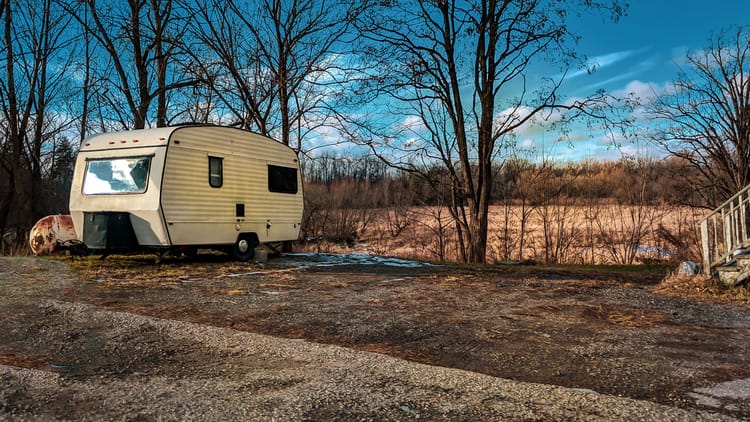
Somebody is standing on a lot in October with a hand on a trailer door, reading a decal that says four-season. It sounds like a rating. It isn't one. The trailer parked next to it can wear the same word and mean something completely different by it, and both sellers are telling the truth as they understand it.
The fact that reorganizes this whole search: on a towable, warmth weighs something. Insulation weighs something. A second pane of glass in every window weighs something, and a trailer has glass everywhere. Seal the underbelly, duct furnace air into it, bolt heating pads to the tanks, and all of that weighs something too. Stack it up and you get a trailer that holds temperature through a cold night attached to a tow rating that may have just walked past what's in your driveway.
So this is a weight question wearing a trailer question's clothes.
None of which disqualifies a lighter towable camper from winter. Plenty of people camp comfortably through January in trailers with an open frame and single-pane glass. They skirt them, they run a heated hose, they burn more propane, and they're not doing it wrong.
What "Four Season Travel Trailer" Means, and What the Best 4 Season Camper Lists Leave Out
All weather campers. All season travel trailer. Climate package. Polar. Arctic package. The vocabulary is wide and it isn't standardized between makers. One builder's arctic package is an enclosed underbelly plus tank pads. Another's is thicker sidewall insulation and a bigger furnace. A third's is dual-pane glass and not much else. Shop for a 4 season trailer and the phrase buys you a different feature set from every company using it. Each builder decides what its own badge covers.
The R-value printed in the brochure has a similar problem. Those numbers are calculated from the materials in the wall assembly rather than measured on a finished trailer. A calculated value describes an uninterrupted panel. Your trailer's roof is not one. It has a vent fan, a skylight, an air-conditioner cutout and a run of fixtures punched through the same layer the number came from, and heat leaves through all of them.
Home insulation is a different animal. The FTC's R-value Rule governs the number printed on the package, and that number has to rest on "the results of standard tests" before anyone prints it. Narrow, but checkable. A trailer's brochure figure was arrived at another way.
That certification sticker near the door is answering a different question. What RVIA certification covers is electrical, plumbing, heating, fire and life safety systems, and construction. That's the wiring, the pipes, the furnace as a piece of equipment, and the structure holding it all together. It's a safety and build standard, and a good one.
So the vocabulary is loose. Nobody's lying to you, and treating a salesperson as an adversary over a word each maker defines for itself will just make the afternoon worse. The general six-point version of this check, the one that works on any RV, is what to check to find the best RV for winter. What follows here is the part that only applies to a box you tow.
Insulated Travel Trailer, or Just a Lighter One? The Weight Trade Nobody Mentions
Start with the glass, because it's the easiest thing to see and the thing most likely to be pointed out to you. A dual-pane window is two sheets with a sealed gap between them. It weighs meaningfully more than one sheet. Now count the windows on a travel trailer. Count the door glass. That weight sits nowhere useful. It's distributed along both sidewalls, up high.
Everything else in a genuine cold-weather build does the same thing. Thicker insulation in the walls and the floor. A sealed sheet closing off the underbelly. Ducting run into that cavity. Heating pads adhered to whichever tanks hang below the floor. None of it is heavy in isolation. All of it together is a number you'll find on the yellow sticker.
Cheap trailers get sneered at over this, unfairly. The affordable, tow-anything end of the towable business is engineered down to a weight target, on purpose, because a trailer that a half-ton truck can pull is a trailer a much larger group of people can buy. Thin walls and single-pane glass are how that number gets hit. A light trailer being cold isn't a defect or a corner cut in the dark. The design is working exactly as specified, and the specification was reachable, not warm.
A towable that genuinely handles cold is heavier than one that doesn't, so shopping for the best cold-weather travel trailer turns into shopping against your tow rating. Look up what lightweight travel trailers actually weigh before you fall for a floor plan, because the four-season version of that plan is not the same trailer on a scale. For where the money goes in a build, we've written about what you're paying for in a budget towable.
If the trailer you want is on the wrong side of that math, reflective window insulation cut to your windows recovers a real share of what single-pane glass gives away, for a fraction of the effort of solving it any other way. It's not as good as glass that came that way. It's also not a different trailer and a different truck.
NEVER BOUGHT AN RV BEFORE?
THE FREE 75-PAGE GUIDE TO BUYING YOUR FIRST RV
The Tanks Are Hanging in Open Air
A motorhome has an engine bay, a drivetrain, and a mass of warm metal at one end of it. A travel trailer has a frame, its axles, and air. Gray and black hang below the floor because they drain by gravity from the toilet and the sinks. The fresh tank may or may not be down there with them. Whatever is down there has nothing underneath it but weather.
Two words get used as if they mean the same thing, and they don't. Enclosed means a sheet closing the cavity so wind stops moving across the tanks. Heated means furnace air ducted into that space. Sales copy says both in one breath, and on a trailer the difference between them lands harder than on anything else. The first buys you hours. The second keeps water liquid while you sleep. Below 32 degrees, that's a cold morning versus a cracked line. Ask which one, specifically, and ask where the duct enters, because a duct that dumps warm air into one corner of a long cavity is not heating the far end of it.
Then go look. Crouch at the back of the trailer and look forward along the frame. You'll see either a continuous sheet or you'll see tanks.
Tank heating pads are the retrofit for the trailer that has neither, and they work. They also need power, and a detached trailer has no engine and no alternator, so tank heating pads run off your battery bank or your shore power and nothing else. That's a real draw on a cold night with no sun. If you're not certain which tank is where, our primer on RV plumbing sorts out what's down there.
All Season Camper Trailers and the Heating Problem
Off shore power, the propane furnace is doing the work. There's no engine to turn an alternator, and a generator is something you'd have to buy and carry. A motorhome parked in the same campground starts with hardware a trailer doesn't have.
So the number to ask about isn't peak output. It's propane capacity, and how long the furnace can keep cycling before somebody drives to town with empty bottles.
What separates all season camper trailers from the rest is whether the ducting reaches the plumbing. Warm air in the living space with the water lines running through an unheated cavity gets you a comfortable evening and a frozen morning. You've bought a comfort appliance with a winter sticker on it. Ask where the ducts run. Ask whether any of them terminate in the underbelly. Non-ducted furnaces heat one volume of air and nothing else. Fine in a small trailer. A problem in a long one.
One more thing catches people out on a cold morning: lithium batteries stop accepting a charge somewhere around freezing. That's chemistry, not a fault, and winter camping in an RV is where it stops being trivia and starts being your Thursday.
You Still Have to Tow It
A motorhome drives itself to the campground. A travel trailer is a second vehicle you take over a pass in weather. Driving in winter is a different problem from sitting still in it.
Tire pressure falls as the temperature does, and it falls on the trailer's tires exactly the same as on the truck's. Trailer tires are the ones nobody looks at. They're behind you, they're often older than anybody remembers, and the first indication that one has been running soft since the last fuel stop is usually not a subtle one. A tire-pressure monitor that reports the trailer axles does more for you in winter than in any other season.
Chains are legally required on some mountain routes under some conditions, and the rules vary by state and change with the storm. Check the DOT for every state your route crosses, not just the one you're camping in. Do it the night before. It beats finding out at a closure gate.
Mostly, winter towing becomes a weather-window decision instead of a mileage one. Summer travel days are about how far you feel like driving. Winter travel days are about when the pass is clear and the surface is above freezing, which usually means starting late and stopping early. Shorter days, more of them. For the fundamentals underneath all of this, start with towing a travel trailer.
If You Already Own a Light Trailer
Many people reading this already own the trailer. Good news: the gap between what you have and a four-season build is narrower than it looks, and one item closes more of it than the rest combined.
If you do one thing on this page, buy the heated hose. A frozen fresh-water line is the failure that ends a winter trip on day two, and a heated fresh-water hose is the cheapest insurance against it that exists.
Then skirt it. Skirting matters more on a towable than on any other kind of RV, and the open frame is exactly why. On a trailer you're enclosing the space where your plumbing lives. The cavity goes from outside temperature to something your furnace can influence. Fitted skirting cut to your trailer seals best; inflatable skirting sets up and packs down far faster. Pick that one if you move every week.
Tank pads and window insulation take care of most of what's left. This doesn't make a light trailer into a heavy one, and it doesn't need to. What it buys is the same outcome by a different route, and the currency is propane and effort, not tow rating. Plenty of people run a light trailer as a year round camper on exactly that trade. Our full guide to winter RV camping prep walks the whole list.
The decal on the door is marketing. The weight on the sticker is physics. One of those two numbers was written by somebody trying to sell you a trailer, and the other one was written by a scale. When you're ready to shop, download the free Ultimate RV Buyer's Guide for what to inspect on a four-season trailer and how to read what the insulation claims are telling you.
The Short Version
- The label isn't a standard. Four-season, arctic package and all weather mean whatever each maker decided. Check the build, not the badge.
- Published R-values are calculated, not measured — and the roof they describe doesn't have a vent fan cut through it.
- Four-season features add tow weight. Dual-pane glass, insulation, an enclosed underbelly and tank pads all cost pounds. The warm trailers are the heavy ones.
- Enclosed and heated underbellies are two different things. Ask which, and ask where the duct enters.
- Warm air in the cabin doesn't mean warm water lines. Ask whether any duct terminates in the underbelly.
- Skirting and a heated hose close most of the gap on a trailer you already own.
FAQs
What makes a travel trailer a four-season trailer?
Four-season isn't a term makers define the same way, so it means different things to different builders. In practice, the features worth looking for are an enclosed underbelly with furnace air ducted into it, factory tank heating pads, dual-pane windows, and insulation the manufacturer will state in writing. A trailer with all four holds temperature overnight without much intervention. A trailer with the badge and none of the four is relying on you not to look.
Are four-season travel trailers heavier?
Yes, and it isn't close. Dual-pane glass weighs substantially more than single-pane and a trailer carries a lot of glass. Add thicker insulation, an enclosed underbelly, ducting and tank heating pads and every one of those adds weight. So the features that keep a trailer warm are the same ones pushing it toward the top of your tow rating. Check the weight sticker before you check the floor plan.
Do you need dual-pane windows in a cold-weather travel trailer?
They help, and they're the most visible cold-weather feature, so they get used to imply the rest of the build is equally serious. It often isn't. Dual-pane glass reduces heat loss and cuts down on the condensation that soaks a trailer's window frames all winter, but a trailer with great windows and tanks hanging in open air will still freeze its water lines first. If you're prioritizing, the underbelly does more for you than the glass.
Can you use a regular travel trailer in the winter?
Yes, and plenty do. Skirt it, add tank heating pads, insulate the windows and run a heated fresh-water hose, and a light trailer handles real cold. What you spend instead is propane and attention: more bottle swaps, more setup at every stop. For most people that's a much smaller commitment than a different trailer.
Why do travel trailer tanks freeze before a motorhome's?
Because there's nothing else under a trailer. A motorhome carries an engine bay and a chassis full of warm mass; a trailer carries a frame, its axles, and the gray and black tanks hanging below the floor. Unless the underbelly is enclosed and heated, wind moves freely across those tanks and the lines connecting them. That's the single biggest structural disadvantage a towable has in cold weather, and it's also the easiest to fix.
Are travel trailer R-values accurate?
They're calculated rather than measured, and that's a meaningful difference. The figure comes from the materials in the wall or roof assembly, not from testing a finished trailer, and vents, skylights, cutouts and window frames all bypass the assembly it describes. Treat a published R-value as a comparison between two trailers from the same builder, not as a prediction of a cold night.
Is it safe to tow a travel trailer in snow?
It's routine for people who plan around it and unpleasant for people who don't. Tire pressure drops as the temperature does, on the trailer's tires as much as the tow vehicle's, so check them cold before every travel day. Chains are legally required on some routes under some conditions and the rules differ by state, so read the DOT guidance for every state your route crosses. Then plan the day around the weather window, not the mileage, and stop while it's still light.



Categories
Related Posts
Subscribe to the Swervia Newsletter
The best RV stories, tips, and destinations—expertly curated and always free.