
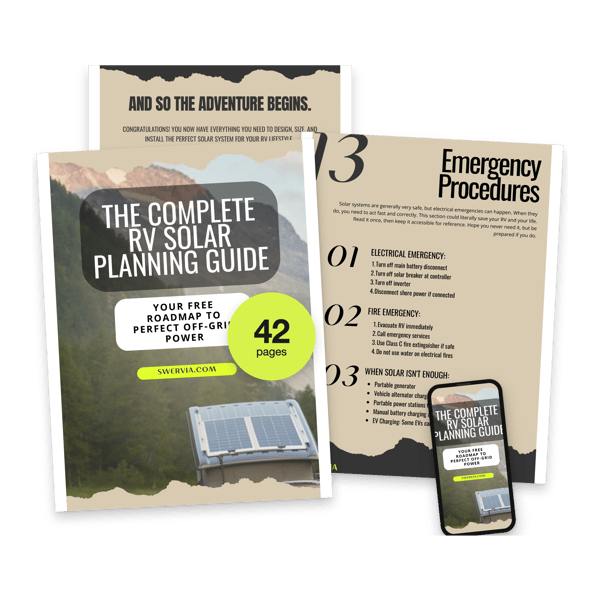
THE COMPLETE RV SOLAR PLANNING GUIDE
Most solar advice is either "slap some panels on the roof" or an engineering manual you need a physics degree to read. This 42-page guide sits in the middle: the exact power draw of every appliance in your RV, the formulas that turn that into panel, battery, and inverter sizes, and five complete systems with real pricing.
FREE · STRAIGHT TO YOUR INBOX
GET THE GUIDE BEFORE YOU BUY A SINGLE PANEL

✔️ THE POWER DRAW OF EVERY APPLIANCE IN YOUR RV, INCLUDING STARTUP SURGE
✔️ FIVE REAL CAMPING LIFESTYLES WITH THE DAILY MATH ALREADY DONE
✔️ THE FIVE SIZING FORMULAS, IN ORDER, WITH WORKED EXAMPLES
✔️ FIVE COMPLETE SYSTEM BUILDS FROM $2,200 TO $15,000
✔️ 42 PAGES ACROSS 13 SECTIONS, INSTALL TO TROUBLESHOOTING TO PAYBACK
✔️ OFFLINE-READY PDF THAT WORKS WITHOUT A CELL SIGNAL

Undersize it and you're running the generator by 9 p.m. anyway. Oversize it and you've spent thousands on panels that never fill a battery bank you didn't need. Both mistakes get made for the same reason: nobody starts with the actual number.
So the guide starts there. Every appliance, with its running watts, its startup surge, and what it costs you over a day. A residential fridge is 3,600Wh. A 12V compressor fridge doing the same job is 800Wh. A roof AC is 12,000Wh and a mini-split is 6,400Wh. Those four numbers alone decide most of the system.
Then it does the math with you. Five formulas, in order, for the battery bank, the solar array, the inverter, and the charge controller, each worked through with a real scenario. Digital nomads at 4,000Wh a day in 5 peak sun hours need a 1,173W array. That's the whole calculation, shown.
And it prices the answer. Five complete builds, from a $2,200 minimalist van setup to a $13,000 to $15,000 full-timer system with generator backup, with the panel, battery, inverter, and controller specs for each. Plus what a shop can't tell you: full-timers usually break even in 18 to 24 months.
GET THE GUIDE NOW, STRAIGHT TO YOUR INBOX.
START WITH THE NUMBER THAT MATTERS
Every major appliance, with running watts, startup surge, and estimated daily consumption. Know what your RV actually uses before you spend a dollar on solar.
SIZE THE SYSTEM WITH CONFIDENCE
Five formulas, in order, for the battery bank, solar array, inverter, and charge controller. Each one worked through with a real scenario, so you can run the numbers for your own RV.
SEE WHAT THE WHOLE SYSTEM COSTS
Five complete builds with components designed to work together, from a $2,200–$2,600 minimalist van setup to a $13,000–$15,000 full-timer system with generator backup.
KNOW WHAT TO FIX FIRST
System won't charge. Inverter shuts off under load. Batteries won't hold. Follow the diagnostic steps in order, and know when temperature can keep lithium batteries from charging.

Weekend warriors: 1,695Wh. Van minimalists: 1,260Wh. Digital nomads: about 4,000Wh. Boondockers: 7,590Wh. Full-timers: up to 20,270Wh. Find the setup closest to yours, then start with the numbers.

Appliance database, sizing formulas, complete system builds, RV-specific installation, troubleshooting, advanced configurations, seasonal performance, cost analysis, checklists, and emergency fixes.
Van, truck camper, travel trailer, fifth wheel, Class A, or Class C. See how much roof space you have, where the batteries go, which components make sense, and where each type of rig presents its own challenges.

WE DID THE RESEARCH SO YOU DON'T HAVE TO.
▷ KNOW YOUR REAL DAILY POWER NEEDS
▷ SIZE EVERY COMPONENT WITH THE RIGHT FORMULA
▷ BUY COMPONENTS THAT ACTUALLY WORK TOGETHER
▷ PLAN THE SYSTEM AROUND YOUR RV
▷ KNOW WHAT IT WILL COST BEFORE YOU BUY
We're Swervia, and we build guides for RVers who'd rather know the numbers than find out at 9 p.m. with a dead battery bank. We dug through appliance specs, system formulas, installer quotes, complete builds, and real-world power needs to figure out what actually matters when you're sizing solar for an RV. That research is the guide. It's free, it works without a cell signal, and it's yours in about a minute.
SKIP THE GENERATOR.